

Home
Class 12
PHYSICS
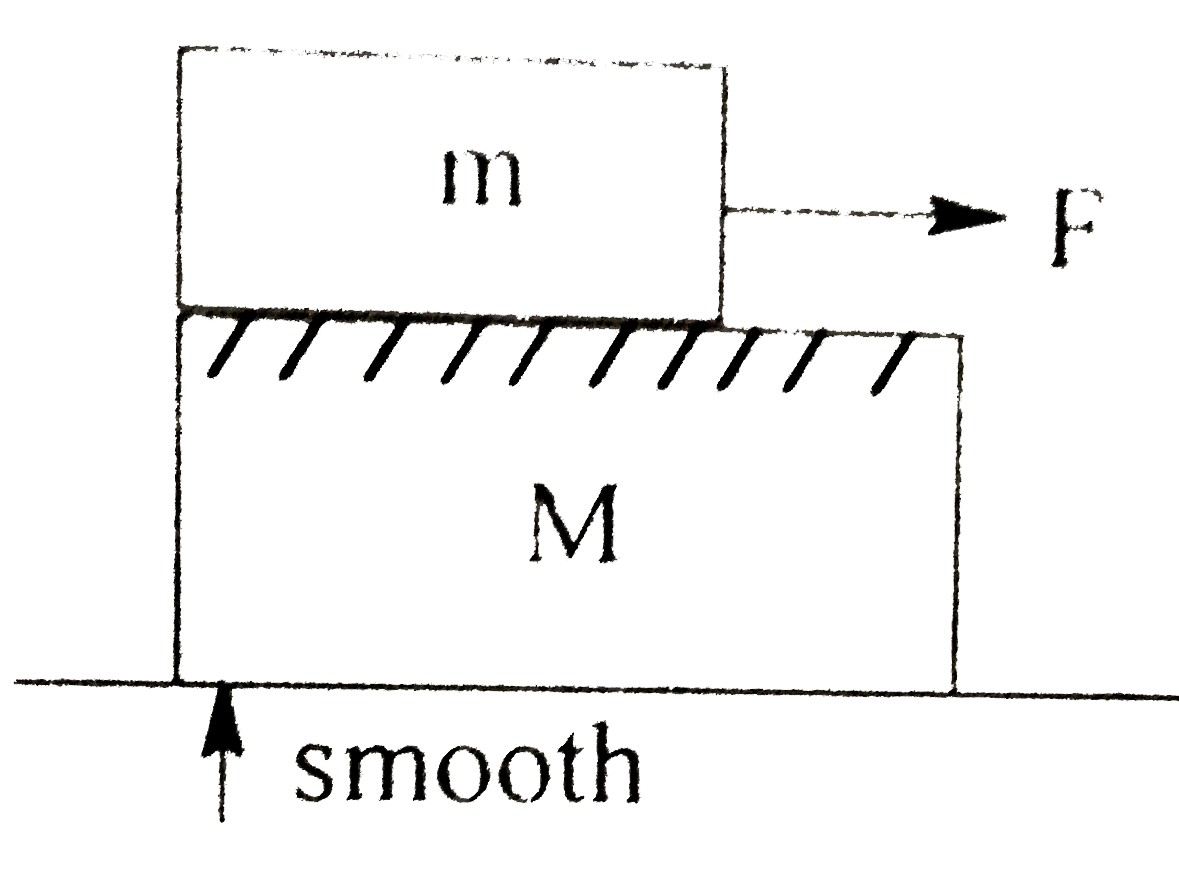
A plank having mass M is placed on smoot...


A plank having mass M is placed on smooth horizontal surface. Block of mass m is placed on it coefficient of friction between block and plank is `mu_(0)+kx`, where k is constant and x is relative displacement between block and plank. A force F is applied on block where `F=at`, where a=10 t is in second. find `t_(0)` when relative motion will occur between block and plank.

Promotional Banner

Similar Questions

Explore conceptually related problems

A block of mass m is kept on an another block of mass M. The coefficient of friction between the blocks varies as mu=(mu_(0)+kx) while friction between lower block and ground is zero. A time varying force F = 10t is applied horizontally on the upper block. Find time t_(0) when relative motion will start between the blocks. (x is relative displacement between the blocks.)

A block of mass m is kept on an another block of mass M. The coefficient of friction between the blocks varies as mu=(mu_(0)+kx) while friction between lower block and ground is zero. A time varying force F = 10t is applied horizontally on the upper block. Find time t_(0) when relative motion will start between the blocks. (x is relative displacement between the blocks.)

A block of mass m is pushed with a velocity v_(0) along the surface of a trolley car of mass M . If the horizontal ground is smooth and the coefficient of kinetic friction between the block of plank is mu . Find the minimum distance of relative sliding between the block and plank.

A block of mass m is pushed with a velocity v_(0) along the surface of a trolley car of mass M . If the horizontal ground is smooth and the coefficient of kinetic friction between the block of plank is mu . Find the minimum distance of relative sliding between the block and plank.

A block of mass m is gently placed over a massive plank moving horizontal over a smooth surface with velocity 10 ms^(-1) . The coefficient of friction between the block and the plank is 0.2. The distance travelled by the block till it slides on the plank is [g = 10 ms^(-2)]

A block of mass m is gently placed over a massive plank moving horizontal over a smooth surface with velocity 10 ms^(-1) . The coefficient of friction between the block and the plank is 0.2. The distance travelled by the block till it slides on the plank is [g = 10 ms^(-2)]

A plank of mass M and length L is placed at rest on a smooth horizontal surface A small block of mass m is projected wii:h a velocity v_(0) as shown in the Fig. 3.31 (a), The coefficient of friction between the block and the plank is mu , plank is very long so that block eventually comes to rest on it. (i) Find the work done by the ftjctioh force on the block during the period it slides on the plank. Is the Work positive or negative ?' (ii) Calculate the work done on the plank during the same period. Is the work positive or negative? (iii) Also, determine the net work done by friction. Is it positive or negative ?

A plank of mass 10 kg and a block of mass 2 kg are placed on a horizontal plane as shown in the figure. There is no friction between plane and plank. The coefficient of friction between block and plank is 0.5 .A force of 60 N is applied on plank horizontally. In first 2 s the work done by friction on the block is

A plank of mass 10 kg and a block of mass 2 kg are placed on a horizontal plane as shown in the figure. There is no friction between plane and plank. The coefficient of friction between block and plank is 0.5 .A force of 60 N is applied on plank horizontally. In first 2 s the work done by friction on the block is

A plank of mass 2 kg and length 1 m is placed on horizontal floor.A small block of mass 1 kg is placed on top of the plank , at its right extreme end .The coefficient of friction between plank and floor is 0.5 and that between plank and block is 0.2 . If a horizontal force = 30 N starts acting on the plank to the right ,the time after which the block will fall off the plank is (g = 10 ms^(-2))