

Home
Class 11
CHEMISTRY
The following data are obtained when din...

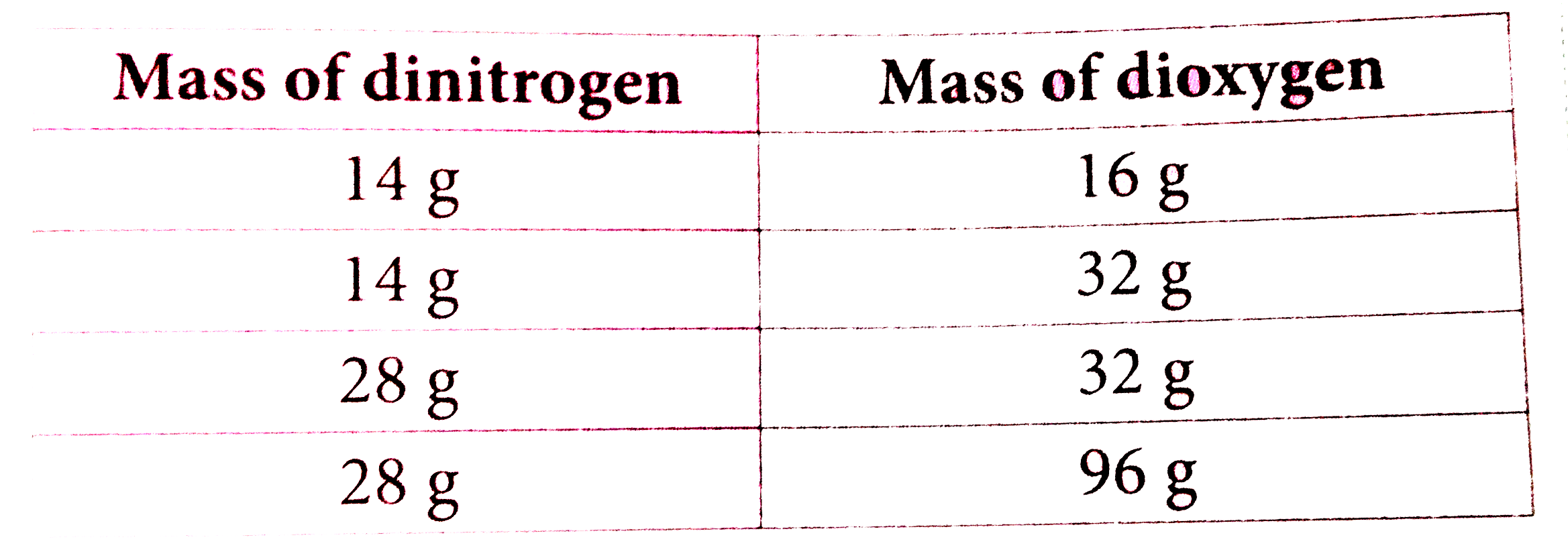
The following data are obtained when dinitrogen and dioxygen react together to form different compounds:

Which law of chemical combination is obeyed by the above experimental data ?

Promotional Banner

Similar Questions

Explore conceptually related problems

The following data were obtained when dinitrogen (N_2) and dioxygen (O_2) react together to form different compounds. Name the law of chemical combination obeyed by the given experimental data.

The following data are obtained when dinitrogen and dioxygen react to gether to form different compounds: {:(,,"Mass of dinitrogen",,"Mass of dioxygen"),(i.,,14 g,,16 g),(ii.,,14 g,,32 g),(iii.,,28 g,,32 g),(iv.,,28 g,,80 g):} a. Which law of chemical combination is obeyed by the above experimental data? Give its statement. d. Fill in the blanks in the following conversions: I. 1 km = ....... mm= ......pm II. 1 mg= ........ kg= ......... ng III. 1 mL = ........ L= ......... dm^(3)

The following data are obtained when dinitrogen and dioxygen react to gether to form different compounds: {:(,,"Mass of dinitrogen",,"Mass of dioxygen"),(i.,,14 g,,16 g),(ii.,,14 g,,32 g),(iii.,,28 g,,32 g),(iv.,,28 g,,80 g):} a. Which law of chemical combination is obeyed by the above experimental data? Give its statement. b. Fill in the blanks in the following conversions: I. 1 km= ....... mm= ......pm II. 1 mg= ........ kg= ......... ng III. 1 mL= ........ L= ......... dm^(3)

The following data are obtained when dinitrogen and dioxygen react together to form different compounds : {:(,"(i)","(ii)","(iii)","(iv)"),("Mass of dinitrogen ",14,14,28,28),("Mass of dioxygen ",16,32,32,80):} Which law of chemical combination is obeyed by the above experimental data ? Give its statement.

Which law of Chemical Combination does not obey Dalton's atomic theory?

Hydrogen and oxygen combines to form H_2O_2 . Which law of chemical combination is illustrated here?

Which of the following law of chemical combination is satisfied by the figure?

Which of the following law of chemical combination is satisfied by the figure?