A
B
C
D
Text Solution
Verified by Experts
The correct Answer is:



Topper's Solved these Questions
Similar Questions
Explore conceptually related problems
KCET PREVIOUS YEAR PAPERS-KARNATAKA CET 2015-MATHEMATICS
- If alpha and beta are the roots of x^(2)-ax+b^(2)=0 , then alpha^(2...
Text Solution
|
- If the 2^(nd) and 5^(th) terms of a G.P are 24 and 3 respectively , th...
Text Solution
|
- The middle term of expansion (10/x+x/10)^(10) is
Text Solution
|
- If |(2a,x(1),y(1)),(2b,x(2),y(2)),(2c,x(3),y(3))| = (abc)/2 != 0 , th...
Text Solution
|
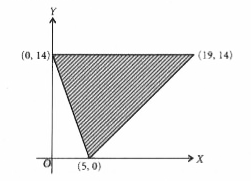
- The shaded region shown in fig . Is given by the in equation
Text Solution
|
- ~ [(~p) ^^q] is logically equivalent to
Text Solution
|
- The value sin^(-1) ((2sqrt(2))/3) +sin^(-1)(1/3) is equal to
Text Solution
|
- If the ecentricity of the hyperbola (x^(2))/(a^(2)) -(y^(2))/(b^(2))=...
Text Solution
|
- If vec(a) = hat(i) + 2hat(j) +2hat(k) , |vec(b)| = 5 and the angle ...
Text Solution
|
- Let vec(a) = hat(i) - 2hat(j) +3hat(k) . If vec(b) is a vector such ...
Text Solution
|
- If direction cosines of a vector of magnitude 3 are 2/3 , - 9/3 , 2/3...
Text Solution
|
- Equation of line passing through the point (2,3,1) and parallel to...
Text Solution
|
- Foot of perpendicular drawn from the origin to the plane 2x-3y +4z = ...
Text Solution
|
- If two dice are thrown simultaneously , then the probability that the ...
Text Solution
|
- If y = f(x^(2)) and f'(3) = 5 then (dy)/(dx) at x = 1 is
Text Solution
|
- If x = a cos^(3) theta , y = a sin^(3) theta , then 1+((dy)/(dx))^(2)...
Text Solution
|
- Slope of normal to the curve y = x^(2) - 1/(x^(2)) at (-1,0) is
Text Solution
|
- int 1/(x^(2)(x^(4)+1)^(3//4)) dx is equal to .
Text Solution
|
- If f : R to R is defined by f(x) = x/(x^(2)+1) find f(f(2)) .
Text Solution
|
- Evaluate |(cos 15^(@),sin15^(@)),(sin75^(@),cos75^(@))|
Text Solution
|