

Home
Class 12
CHEMISTRY
Carbon can reduce ferric oxide to iron a...

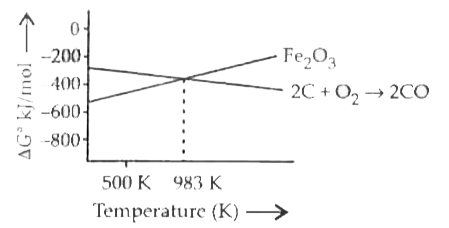
Carbon can reduce ferric oxide to iron at a temperature above 983 K because

A

Free energy change for the formation of CO is more negative than that of `Fe_(2)O_(3)`

B

CO is thermodynamically more stable than `Fe_(2)O_(3)`

C

Carbon has higher affinity towards oxygen than iron

D

iron has higher affinity towards oxygen than carbon

Text Solution

Verified by Experts

The correct Answer is:
D


Below 983 K, conversion of iron to ferric oxide is more favourable .i.e., iron has higher affinity towards oxygen than carbon.
Promotional Banner

Topper's Solved these Questions

  • SOLVED PAPER 04

    KCET PREVIOUS YEAR PAPERS|Exercise CHEMISTRY|60 Videos

Similar Questions

Explore conceptually related problems

Henry's law constant for oxygen and nitrogen dissolved in water at 298 K are 2.0 xx 10^(9) Pa and 5.0 xx 10^(9) Pa , respectively . A sample of water at a temperature just above 273 K was equilibrated with air (20% oxygen and 80% nitrogen ) at 1 atm. The dissolved gas was separated from a sample of this water and the dried. Determine the composition of this gas.

Draw Ellingham diagram [DeltaG^(@)VsT] for the oxidation of carbon monoxide and for the formation of Fe_(2)O_(3) and CO. Suggest suitable reducing agents for the reduction of Fe_(2)O_(3) at a temperature below 983 K (710^(@)C) and at a temperature above 983 K.

The sprinkling of water reduces slightly the temperature of a closed room because

Answer the following questions based on the P-T phase diagram of carbon dioxide: At what temperature and pressure can the solid, liquid and vapour phases of CO_(2) co-exist in equilibrum ?

Carbon cannot be used to reduce the oxide of sodium, magnetsium, calcium, etc.to their respective metals. State the method used for obtaining these metals from their salts. For obtaining sodium from its compound. a. Name the salt used, gas produced, and the electrode at which the metal deposits. b. Show the chemical reaction taking place during the process. c. Name any two other metals which can be obtained from its compounds by the above method.

Two metal rods made up of iron (K_1=79Wm^(-1)K^(-1)) and brass (K_2=109Wm^(-1)K^(-1)) are of identical shape and size. These are fused at the junction. If the temperature at the free end of iron is at a steam point and brass at ice point then calculate the temperature at the junction, when the steady state is attained.

KCET PREVIOUS YEAR PAPERS-SOLVED PAPER 2011-CHEMISTRY
  1. Ethyl benzene can not be prepared by :

    Text Solution

    |

  2. 1.2g of an organic compound on Kjeldahlization liberates ammonia which...

    Text Solution

    |

  3. Carbon can reduce ferric oxide to iron at a temperature above 983 K be...

    Text Solution

    |

  4. The yellow precipitate formed during the chromyl chloride test in chem...

    Text Solution

    |

  5. One gram of silver gets distributed between "10 cm"^(3) of molten zinc...

    Text Solution

    |

  6. Which one of the following is true?

    Text Solution

    |

  7. In Ramsay and Rayleigh's isolation of noble gases from air,the nitroge...

    Text Solution

    |

  8. The expected spin magnetic moment of Fe^(3+) is :

    Text Solution

    |

  9. Write the IUPAC name of the complex [Cr(NH3)4 Cl2] Cl.

    Text Solution

    |

  10. Excess of silver nitrate solution is added to 100 ml of 0.01 M penta a...

    Text Solution

    |

  11. The following data were obtained during the first order decomposition ...

    Text Solution

    |

  12. The time required for 100% completion of a zero order reaction is

    Text Solution

    |

  13. The activation energy for a reaction at the temperature T K was found...

    Text Solution

    |

  14. pH value of which one of the following is NOT equal to one ?

    Text Solution

    |

  15. A buffer solution contains 0.1 mole of sodium acetate dissolved in 100...

    Text Solution

    |

  16. H(2)S is passed into one dm^(3) of a solution containing 0.1 mole of Z...

    Text Solution

    |

  17. E(1),E(2) and E(3) are the emfs of the following three galvanic cells...

    Text Solution

    |

  18. 0.023g of sodium metal is reacted with 100 cm^(3) of water. The pH of ...

    Text Solution

    |

  19. The standard emf of a galvanic cell involving 2 moles of electrons in ...

    Text Solution

    |

  20. 9.65C of electric current is passed through fused anhydrous magnesium ...

    Text Solution

    |