

Home
Class 12
PHYSICS
A particle moves along a straight line p...

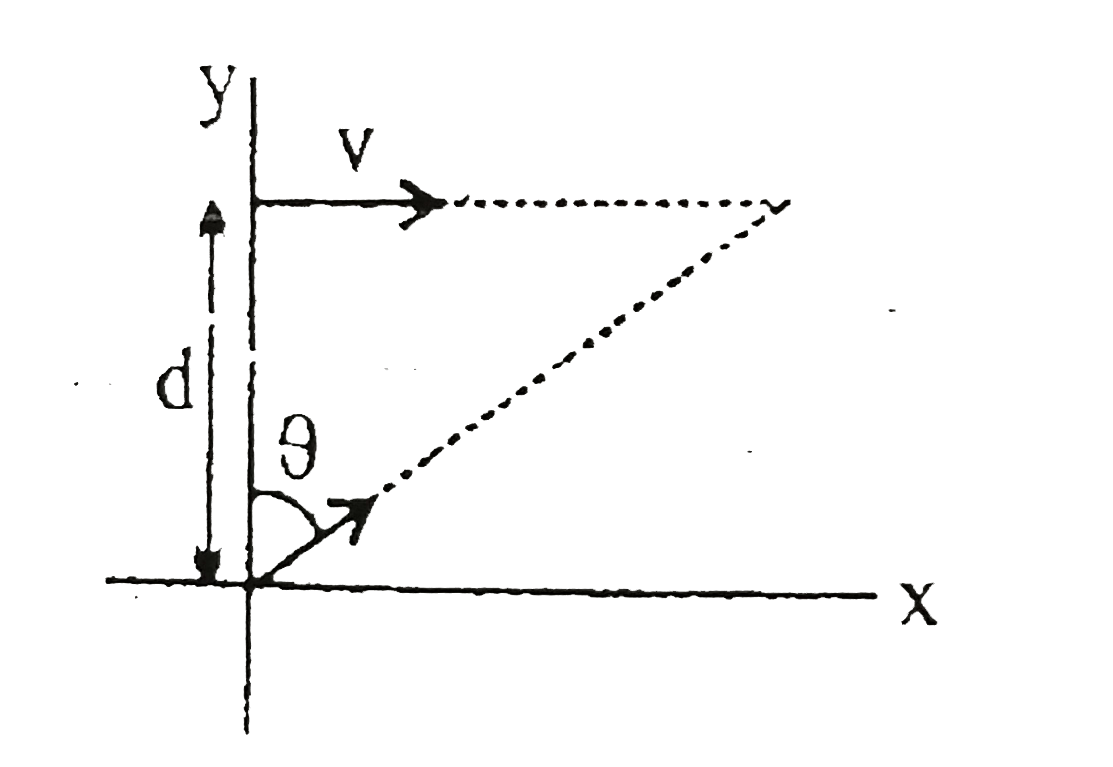
A particle moves along a straight line parallel to x-axis at a distancce `d = 3`m from it, with constant speed of `v = 3 m//s`. Another particle stats from the origin with constant acceleration `a = 4 m//s^(2)` at an angle `theta` with y-axis along a straight line at the instant the first particle crosses y-axis. Find 'theta' such that the two particle collide.

Promotional Banner

Similar Questions

Explore conceptually related problems

A particle is moving along a straight line parallel to x-axis with constant velocity. Find angular momentum about the origin in vector form :

A particle is moving along a straight line parallel to x-axis with constant velocity. Find angular momentum about the origin in vector form :

A body starts from rest from the origin with an acceleration of 3 m//s(2) along the x-axis and 4 m//s^(2) along the y-axis. Its distance from the origin after 2 s will be

A particle is given velocity 3 m//s along the positive x-axis subjected to constant accelaration 4 m//s^(2) along the positive y-axis. Find the distaplacement of the particle in 2 s and trajectory followed by the particle.

A particle A moves along the line, y=30 m with a constant velocity, v parallel to x-axis. At the moment particle A passes the y-axis, a particle B starts from the origin with zero initial speed and a constant acceleration, a=0.40m//sec^(2) . The angle between a and y-axis is 60^(@) . If the particles A and B collide after sometimes, then the value of |v| will be

A particle is moving along a straight line.The initial velocity is 10m/s and it is , moving with constant retardation of 2m/s^(2) .. The distance travelled by the particle until it comes to rest is

A particle moves in a straight line with constant speed of 4 m//s for 2 s, then with 6 m//s for 3 s. Find the average speed of the particle in the given time interval.

A particle moves in a straight line with constant speed of 4 m//s for 2 s, then with 6 m//s for 3 s. Find the average speed of the particle in the given time interval.