

Home
Class 11
PHYSICS
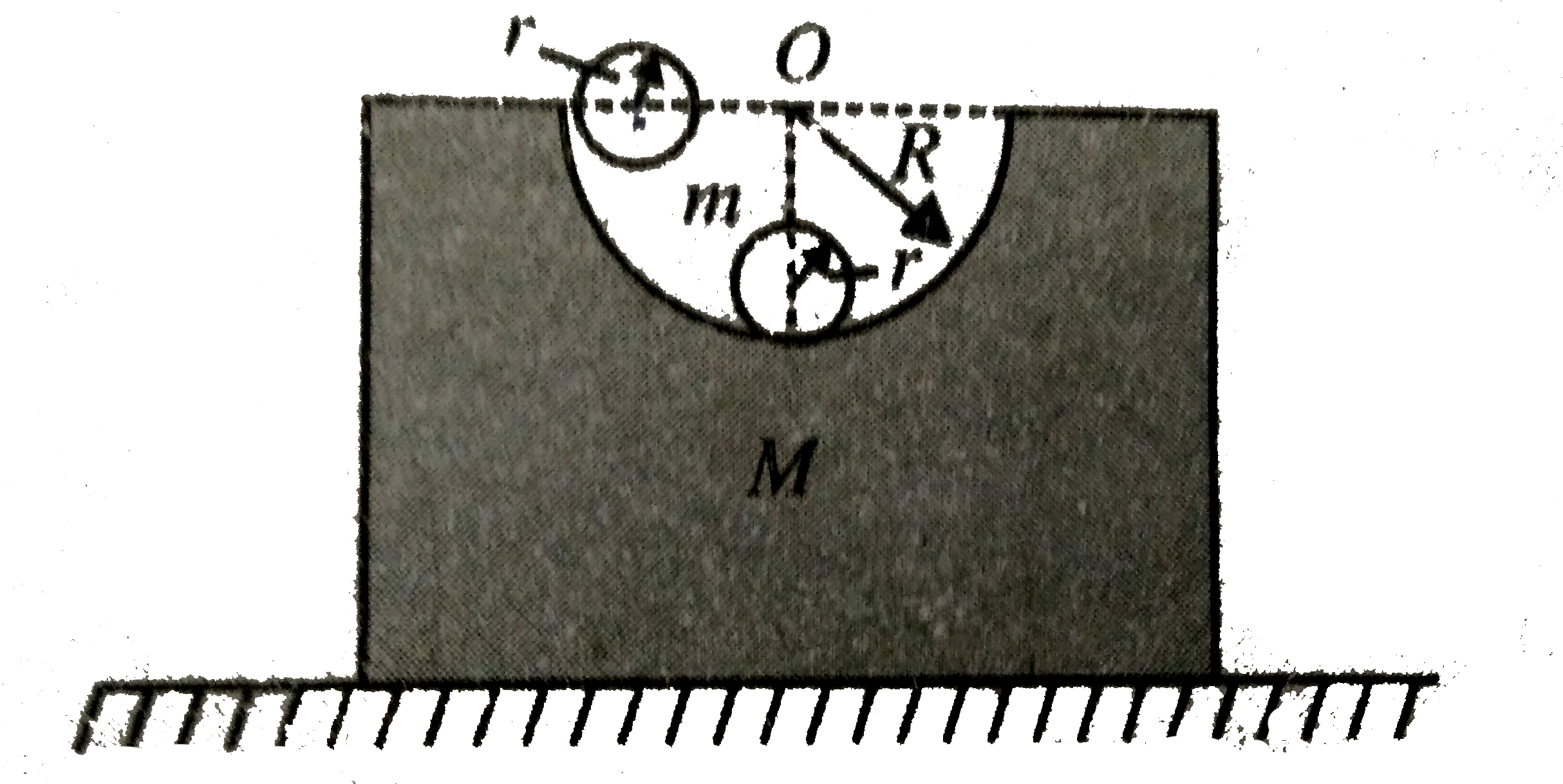
Calculate the displacement of the wedge ...

Calculate the displacement of the wedge when the hall reaches at the bottom of the groove,

Promotional Banner

Similar Questions

Explore conceptually related problems

A wooden wedge of mass 10 m has a smooth groove on its inclined surface. The groove is in shape of quarter of a circle of radius R = 0.55 m . The inclined face makes an angle theta =cos^(-1)((sqrt(11))/(5)) with the horizontal A block 'A' of mass m is palced at the top of the groove and given a gentle push so as to slide along the groove. There is no friction between the wedge and the horizontal ground on which it has been placed. Neglect width of the groove. (a) Find the magnitude of displacement of the wedge by the instant the block A reaches the bottom of the groove (b) Find the velocity of a wedge at the instant the block A reaches the bottom of the groove.

A block of mass m is initially lying on a wedge of mass M with an angle of inclination theta as shown in figure. Calculate the displacement of the wedge when the block is released and reaches to the bottom of the wedge.

A block is released on the convex surface of a hemispherical wedge as shown in Fig. Determine the displacement of the wedge when the block reaches the angular position theta

A block is released on the convex surface of a hemispherical wedge as shown in Fig. Determine the displacement of the wedge when the block reaches the angular position theta

A block of mass m is released from the top of a wedge of mass M as shown in figure. Find the displacement of wedges on the horizontal ground when the block reaches the bottom of the wedges. Neglect friction everywhere.

A block of mass m is released from the top of a wedge of mass M as shown in figure. Find the displacement of wedges on the horizontal ground when the block reaches the bottom of the wedges. Neglect friction everywhere.

A particle of mass m is placed at rest on the top of a smooth wedge of mass M, which in turn is placed at rest on a smooth horizontal surface as shown in figure. Then the distance moved by the wedge as the particle reaches the foot of the wedge is :

A particle of mass m is placed at rest on the top of a smooth wedge of mass M, which in turn is placed at rest on a smooth horizontal surface as shown in figure. Then the distance moved by the wedge as the particle reaches the foot of the wedge is :

A small block of mass m is placed at rest on the top of a smooth wedge of mass M, which in turn is placed at rest on a smooth horizontal surface as shown in figure. If h be the height of wedge and theta is the inclination, then the distance moved by the wedge as the block reaches the foot of the wedge is

A small block of mass m is placed at rest on the top of a smooth wedge of mass M, which in turn is placed at rest on a smooth horizontal surface as shown in figure. It h be the height of wedge and theta is the inclination, then the distacne moved by the wedge as the block reaches the foot of the wedge is