

Home
Class 11
PHYSICS
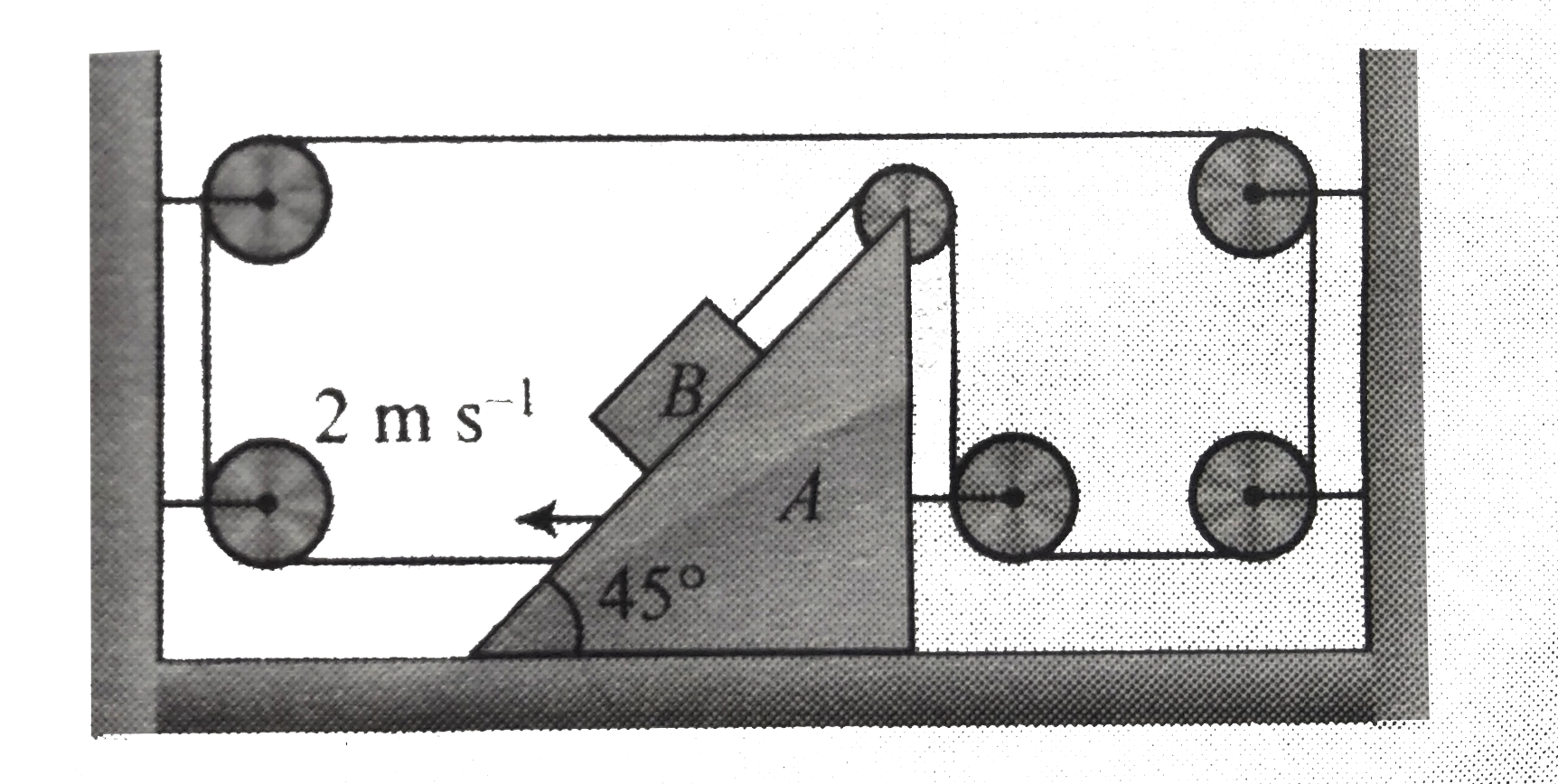
System is shown in fig. and wedge is mov...

System is shown in fig. and wedge is moving toward left with speed `2ms^(-1)`. Find the velocity of the block B.

Promotional Banner

Similar Questions

Explore conceptually related problems

If the wedge A shown in figure-1.93, is moving toward left with acceleration 3 m/s^(2) , find the net acceleration of block B which is constrainedtoslide along the wedge surface. (theta=30^(@))

A sphere of redius R is ibn contact with a wedge. The point of contact is ( R)/(5) from the ground as shown in figure.Wedge is moving with velocity 20 m s^(-1) towards left then the velocity of the sphere at this instant will be

A sphere of radius R is in contact with a wedge. The point of contact is ( R)/(5) from the ground as shown in figure.Wedge is moving with velocity 20 m s^(-1) towards left then the velocity of the sphere at this instant will be

A sphere of redius R is ibn contact with a wedge. The point of contact is ( R)/(5) from the ground as shown in figure.Wedge is moving with velocity 20 m s^(-1) towards left then the velocity of the sphere at this instant will be

5 A sphere of radius R is in contact with a R wedge. The point of contact is from the ground as shown in the figure. Wedge is moving with velocity 20ms-1 towards left then the velocity of the sphere at this instant will be 20m/s R15

For the pulley system shown in fig. each of the cables at A and B is given a velocity of 2ms^(-1) in the direction of the arrow. Determine the upward velocity v of the load m.

For the pulley system shown in fig. each of the cables at A and B is given a velocity of 2ms^(-1) in the direction of the arrow. Determine the upward velocity v of the load m.

In the arrangement shown in the fig. the block of mass m lies on the wedge. Wedge is moving with acceleration a = 5 m/sec . Find the wedge acceleration of the block with respect to wedge.

In the system shown, the block A is moving down eith velocity v_(1) and C is moving up with velocity v_(3) . Express velocity of the block B in terms of velocities of the blocks a and C.