

Home
Class 11
PHYSICS
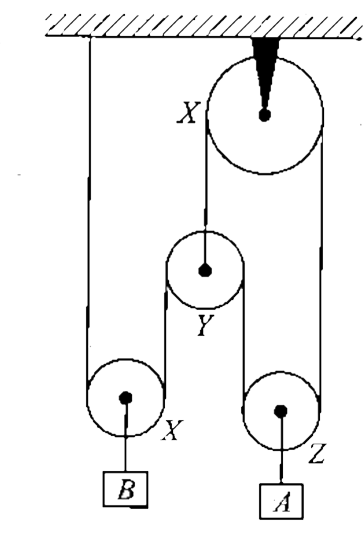
Figure-1.65 shows a system of four pulle...

Figure-1.65 shows a system of four pulleys with two masses A and B. Find, at an instant:

Promotional Banner

Similar Questions

Explore conceptually related problems

Figure shows, a system of four pulley with two masses A and B. Find at an instant. (a) Speed of block A when block B is going up at 1ms^(-1) and pulley Y is going up at 2 ms^(-1) . (b) Acceleration of block A if block B is going up 3 ms^(-2) and pulley Y is going down at 1 ms^(-2) .

Figure shows a system of four pulleys with two masses m_(A) =3kg and m_(B)=4 kg . At an instant force acting on block A if block B is going up at an acceleration of 3 m//s^(2) and pulley Q is going down at an acceleration of 1 m//s^(2) is .

Figure shows a system of four pulleys with two masses m_(A) =3kg and m_(B)=4 kg . At an instant force acting on block A if block B is going up at an acceleration of 3 m//s^(2) and pulley Q is going down at an acceleration of 1 m//s^(2) is .

Figure shows a system of four pulleys. The upper two pulleys are fixed and the lower two are movable. (a) Draw a string around the pulleys. Also show the point of application and direction in which the effort E is applied. (b) What is the velocity ratio of the system ? (c) How are load and effort of the pulley system related ? (d) What assumption do you make in arriving at your answer in part (c) ?

Figure (a) and (b) shows a system of two masses A and B a motor M. find the relation in velocities of mass A and B, if the motor winding speed is v.

Figure shows a system consisting of pulley having radius R, a spring of force constant k and a block of mass m. Find the period of its vertical oscillation.

Figure shows wavefront P Passing through two systems A and B, and emerging as Q and then as R. Then systems A and B could, respectively, be

Figure shows wavefront P Passing through two systems A and B, and emerging as Q and then as R. Then systems A and B could, respectively, be

Figure shows a pulley over which is string passes and connected to two masses A and B. Pulley moves up with a velocity V_(P) and mass B is also going up at a velocity V_(B) . Find the velocity of mass A if (a) V_(P)=5ms^(-1) and V_(B)=10ms^(-1) (b) V_(P)=5ms^(-1) and V_(B)=-20 ms_(-1) .

Figure shows a pulley over which is string passes and connected to two masses A and B. Pulley moves up with a velocity V_(P) and mass B is also going up at a velocity V_(B) . Find the velocity of mass A if (a) V_(P)=5ms^(-1) and V_(B)=10ms^(-1) (b) V_(P)=5ms^(-1) and V_(B)=-20 ms_(-1) .