

Home
Class 12
PHYSICS
A disc having radius r = 2 m is placed o...

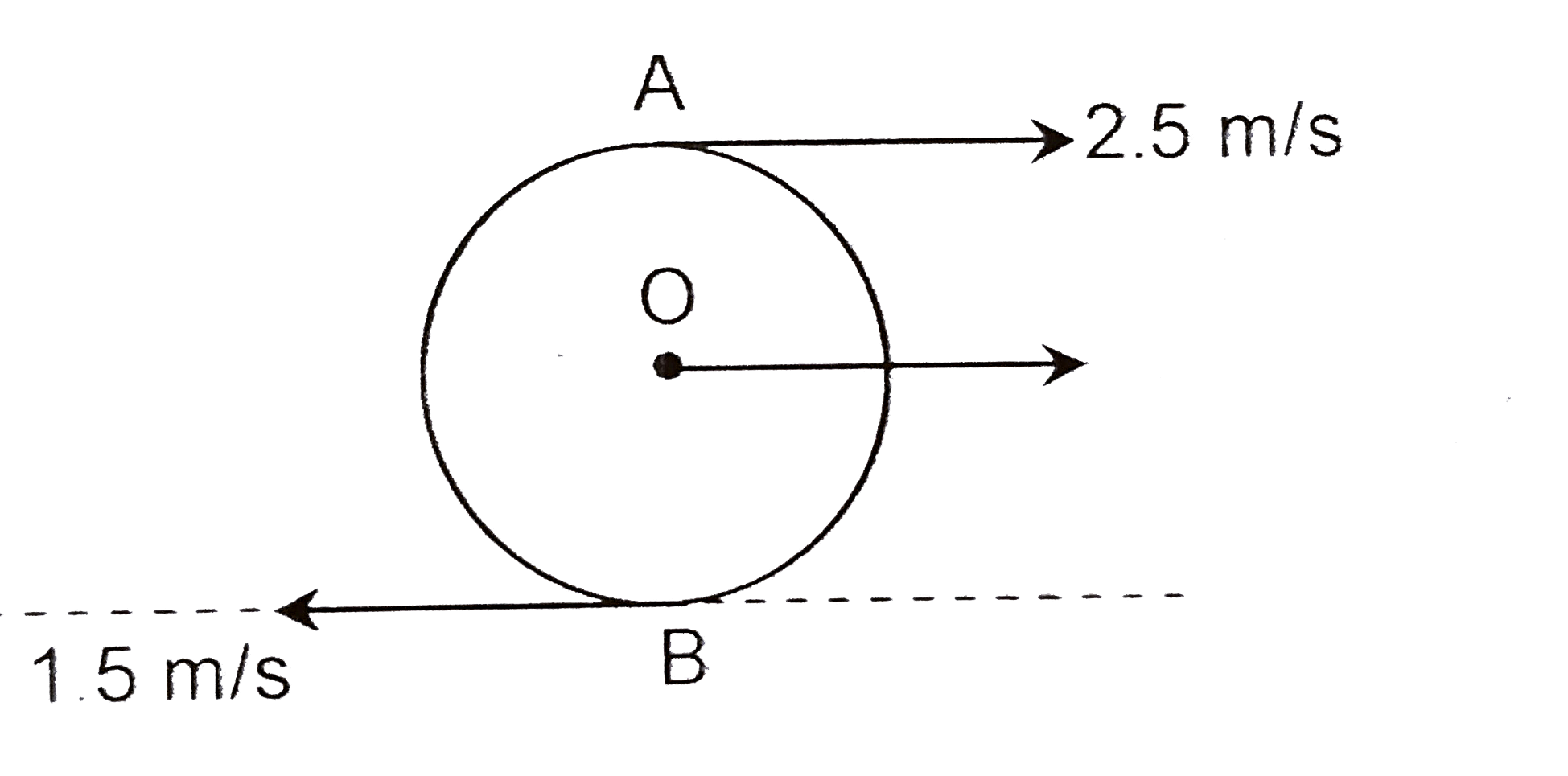
A disc having radius `r = 2 m` is placed on smooth horizontal surface. Velocity of point A and B is given as shown in fig. Distance between point O and axis of rotation at the particular instant is

Promotional Banner

Similar Questions

Explore conceptually related problems

A uniform circular disc of radius R is placed on a smooth horizontal surface with its plane horizontal and hinged at circumference through point O as shown . An impulse P is applied at a perpendicular distance h from its centre C. The value of h so that the impulse due to hinge is zero, is

A uniform circular disc of radius R is placed on a smooth horizontal surface with its plane horizontal and hinged at circumference through point O as shown . An impulse P is applied at a perpendicular distance h from its centre C. The value of h so that the impulse due to hinge is zero, is

A disc of radius R rolls without slipping at speed v along positive x -axis. Velocity of point P at the instant shown in Fig. is

A disc of radius R rolls without slipping at speed v along positive x -axis. Velocity of point P at the instant shown in Fig. is

A disc of radius R is moving on a rough horizontal surface with velocity v and angular speed omega at an instant as shown in figure. Choose the correct statement.

A disc of radius R is moving on a rough horizontal surface with velocity v and angular speed omega at an instant as shown in figure. Choose the correct statement.

The velocity of point A on the rod is 2ms^(-1) (leftwards) at the instant shown in fig. The velocity of the point B on the rod at this instant is

The velocity of point A on the rod is 2ms^(-1) (leftwards) at the instant shown in fig. The velocity of the point B on the rod at this instant is

A uniform disc of mass m , radius R is placed on a smooth horizontal surface. If we apply a horizontal force F at P as shown in the figure. If F = 4 N, m= .1 kg, R = 1 m and r = 1/2 m then, find the: angular acceleration of the disc. (rads^(-1))