

Home
Class 11
PHYSICS
In the photoelectric experiment, if we u...

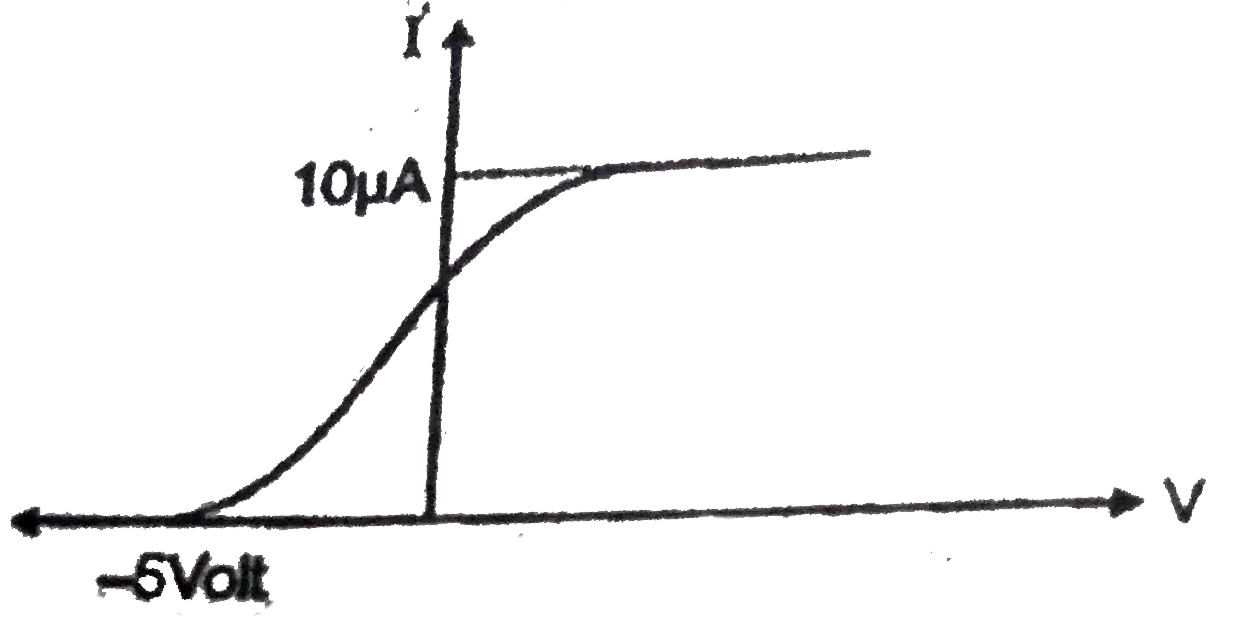
In the photoelectric experiment, if we use a monochromatic light, the I-V curve is as shown. If work function of the metal is 2eV, estimate the power of light used. (Assume efficiency of photo emission `=10^(-3)%`, i.e. number of photoelectrones emitted are `10^(-3)%` of number of photons incident on metal.)

Promotional Banner

Similar Questions

Explore conceptually related problems

In the photoelectric experiment, if we use a monochromatic light, the I – V curve is as shown. If work function of the metal is 2 eV, estimate the power of light used. (Assume efficiency of photo emission =10^(-3) , i.e. number of photoelectrons emitted are 10^(-3) times of number of photons incident on metal).

In the photoelectric experiment, if we use a monochromatic light, the I – V curve is as shown. If work function of the metal is 2 eV, estimate the power of light used. (Assume efficiency of photo emission =10^(-3) , i.e. number of photoelectrons emitted are 10^(-3) times of number of photons incident on metal).

In the photoelectric experiment, if we use a monochromatic light, the I – V curve is as shown. If work function of the metal is 2 eV, estimate the power of light used. (Assume efficiency of photo emission =10^(-3) , i.e. number of photoelectrons emitted are 10^(-3) times of number of photons incident on metal).

The work function of a metal is 1.5 eV, light of wavelength 6600 overset@A is made incident on it. The maximum k.e. of emitted photo - electron is:

The work function of a metal is 2.5 eV. Light of wavelength 3600 Å is incident on this metal surface. The velocity of emitted photoelectrons will be

The work function of a metal is 2.5 eV. Light of wavelength 3600 Å is incident on this metal surface. The velocity of emitted photoelectrons will be

In a photoelectric experiment a parallel beam of monochromatic light with power of 200 is incident on a perfectly absorbing cathode of work function 6.25. The frequency of light is just above the threshold frequency so that the photoelectrons are emitted with negligible kinetic energy. Assume that the photoelectron emission efficiency is 100%. A potential difference of 500 is applied between the cathode and the anode. All the emitted electrons are incident normally on the anode and are absorbed. The anode experiences a force 10 due to the impact of the electrons. The value of is __________. Mass of the electron 910 and 1.01.610.

In a photoelectric experiment a parallel beam of monochromatic light with power of 200W is incident on a perfectly absorbing cathode of work function 6.25. The frequency of light is just above the threshold frequency so that the photoelectrons are emitted with negligible kinetic energy. Assume that the photoelectron emission efficiency is 100%. A potential difference of 500V is applied between the cathode and the anode. All the emitted electrons are incident normally on the anode and are absorbed. The anode experiences a force n xx 10^(-4) N due to the impact of the electrons. The value of n is __________. Mass of the electron 9.1 xx 10^(-31) Kg and charge is 1.6 xx 10^(-19) C