

Home
Class 12
PHYSICS
Three blocks of masses m(1)=4kg, m(2)=2k...

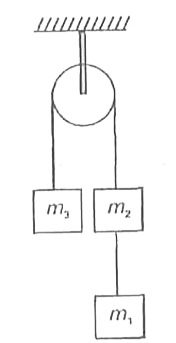
Three blocks of masses `m_(1)=4kg, m_(2)=2kg, m_(3)=4kg` are connected with ideal strings passing over a smooth, massless pulley as shown in figure. The acceleration of blocks will be `(g=10m//s^(2))`

Promotional Banner

Similar Questions

Explore conceptually related problems

A block of mass m_1 = 4kg lying on a plane inclined at an angle of 30^(@) , is connected to another freely suspended block of mass m_2 = 6kg with the help of a string passing over a smooth pulley as shown in the figure. The acceleration of each block is (g = 10 m/ s^2 )

Two blocks of masses m_(1) and m_(2)(m_(1) gt m_(2)) connected by a massless string passing over a frictionless pulley Magnitude of acceleration of blocks would be

Two blocks of masses m_(1) and m_(2)(m_(1) gt m_(2)) connected by a massless string passing over a frictionless pulley Magnitude of acceleration of blocks would be

Two masses M_(1)=5kg,M_(2)=10 kg are connected at the ends of an inextensible string passing over a frictionless pulley as shown. When masses are released, then acceleration of masses will be

Two blocks of masses 10 kg and 9 kg are connected with light string which is passing over an ideal pulley as shown in figure. If system is released from rest then the acceleration of 9 kg block at the given instant is about (Assume all the surfaces are smooth and g = 10 m/s^2 )

Two blocks of masses M_(1)=4 kg and M_(2)=6kg are connected by a string of negligible mass passing over a frictionless pulley as shown in the figure below. The coefficient of friction between the block M_(1) and the horizontal surface is 0.4. when the system is released, the masses M_(1) and M_(2) start accelrating. What additional mass m should be placed over M_(1) so that the masses (M_(1)+m) slide with a uniform speed?

Two blocks of masses M_(1)=4 kg and M_(2)=6kg are connected by a string of negligible mass passing over a frictionless pulley as shown in the figure below. The coefficient of friction between the block M_(1) and the horizontal surface is 0.4. when the system is released, the masses M_(1) and M_(2) start accelrating. What additional mass m should be placed over M_(1) so that the masses (M_(1)+m) slide with a uniform speed?

Three blocks A,B and C of mass 10 kg each are hanging on a string passing over a fixed frictionless pulley as shown in figure. The tension in the string connecting blocks B and C is (g=10m//s^(2))