

Home
Class 11
PHYSICS
Rate of heat flow through two conducting...

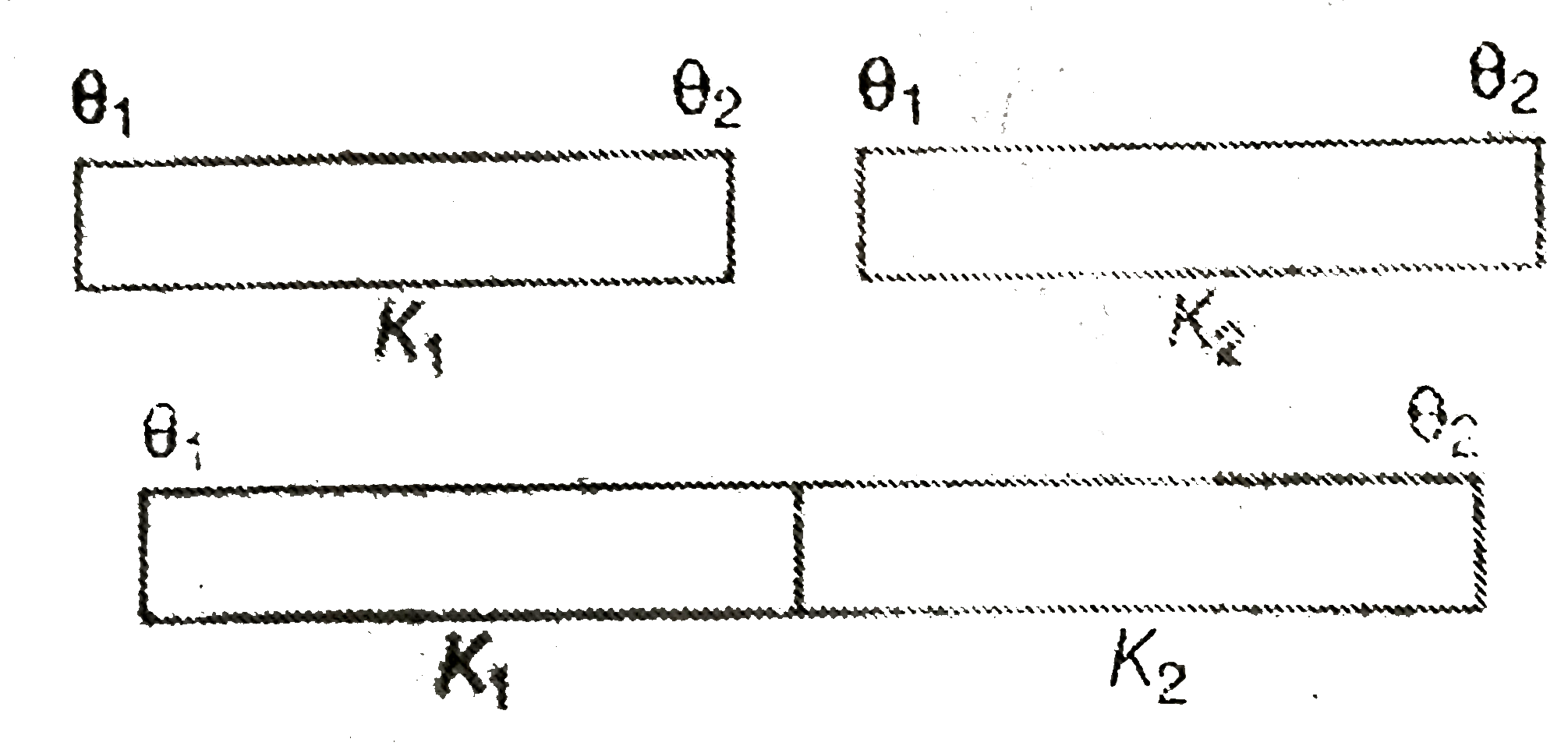
Rate of heat flow through two conducting rods of identiclal dimensions having thermal conductivities `K_(1)` and `K_(2)` and `Q_(1)` and `Q_(2)` when their ends are maintained at the same difference of temperature individually. When the two rods are joined in series with their ends maintained at the same temperature difference (as shown in the figure), the rate of heat flow will be

Promotional Banner

Similar Questions

Explore conceptually related problems

Which of the following rods made of same material will conduct more heat in given time when their ends are maintained at the same temperature difference .

Which of the following cylindrical rods will conduct most heat, when their ends are maintained at the same steady temperature

Which of the following cylindrical rods will conduct most heat, when their ends are maintained at the same steady temperature

Two identical rods of same metal are first waleded in series and then in parallel are maintained at same temperature difference then the ratio of heats conducted in same time is .

Three rods of same dimensions are arranged as shown in the figure. They have thermal conductivities K_(1) , K_(2) and K_(3) . The points A and B are maintained at different temperatures. For the heat to flow at the same rate along ACB and AB,

which of the following cylindrical rods will conduct most heat,when their ends are maintained at the same steady temperature?

Five rods of same dimensions are arranged as shown in the figure. They have thermal conductivities k_(1),k_(2),k_(3),k_(4) and k_(5) when points A and B are maintained at different temperatures. No heat flows through the central rod if

Five rods of same dimensions are arranged as shown in the figure. They have thermal conductivities k_(1),k_(2),k_(3) and k_(5) . When points A and C are maintained at different temperature, no heat flows through the central rod if

Five rods of same dimensions are arranged as shown in the figure. They have thermal conductivities K _(1) , K_(2) , K _(3) , K_( 4) and K_( 5) . When points A and B are maintained at different temperatures, no heat flows through the central rod if

Five rods of same dimensions are arranged as shown in the figure. They have thermal conductivities K _(1) , K_(2) , K _(3) , K_( 4) and K_( 5) . When points A and B are maintained at different temperatures, no heat flows through the central rod if