

Home
Class 12
CHEMISTRY
Use of dilution formula (M(1)V(1) = M(2)...

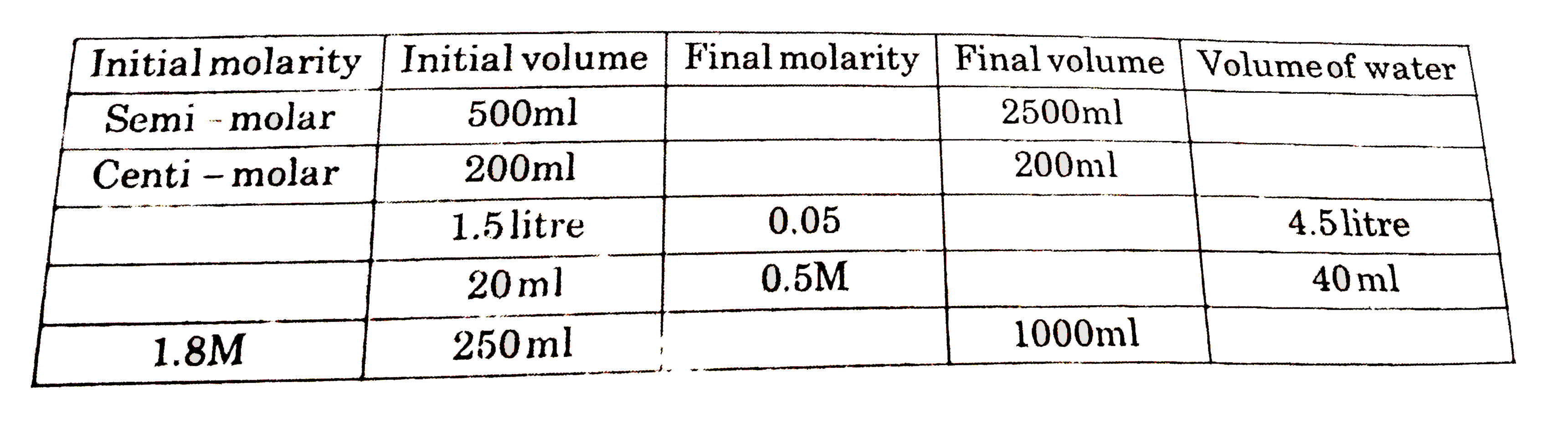
Use of dilution formula `(M_(1)V_(1) = M_(2) V_(2))`

Promotional Banner

Similar Questions

Explore conceptually related problems

Calculate the molarity of each of the following solution : (a) 30g of CO(NH_(3))_(2).6H_(2)O in 4.3 L of solution. (b) 30 mL of 0.5" MH"_(2)"SO"_(4) diluted to 500 mL. (a) Molarity =("moles of solute")/("Volume of solution litre") and moles of solute =("mass of solute")/("molar solution of solute") So, first find molar mass by adding atomic masses of different elements, then find moles of solute and then molarity. (b) Use molarity equation for dilution. M_(1)V_(1)=M_(2)V_(2) (Before dilution) (After dilution)

V_(1)mL of CH_(3)COONa solution (of molarity M_(1) ) and V_(2)mL of a HCl solution (of Molarity M_(2) ) are available ,Can the two be mixed to obtain a buffer solution? If Yes, what should be the mathematical condition relating M_(1),M_(2),V_(1)& V_(2) for this?

Two particles of masses m_(1) and m_(2) in projectile motion have velocities vec(v)_(1) and vec(v)_(2) , respectively , at time t = 0 . They collide at time t_(0) . Their velocities become vec(v')_(1) and vec(v')_(2) at time 2 t_(0) while still moving in air. The value of |(m_(1) vec(v')_(1) + m_(2) vec(v')_(2)) - (m_(1) vec(v)_(1) + m_(2) vec(v)_(2))|

Two particles of masses m_(1) and m_(2) in projectile motion have velocities vec(v)_(1) and vec(v)_(2) , respectively , at time t = 0 . They collide at time t_(0) . Their velocities become vec(v')_(1) and vec(v')_(2) at time 2 t_(0) while still moving in air. The value of |(m_(1) vec(v')_(1) + m_(2) vec(v')_(2)) - (m_(1) vec(v)_(1) + m_(2) vec(v)_(2))|

Two particles of masses m_(1) and m_(2) in projectile motion have velocities vec(v)_(1) and vec(v)_(2) , respectively , at time t = 0 . They collide at time t_(0) . Their velocities become vec(v')_(1) and vec(v')_(2) at time 2 t_(0) while still moving in air. The value of |(m_(1) vec(v')_(1) + m_(2) vec(v')_(2)) - (m_(1) vec(v)_(1) + m_(2) vec(v)_(2))|

Two solution of H_(2)SO_(4) of molarities x and y are mixed in the ratio of V_(1) mL : V_(2) mL to form a solution of molarity M_(1) . If they are mixed in the ratio of V_(2) mL : V_(1) mL , they form a solution of molarity M_(2) . Given V_(1)//V_(2) = (x)/(y) gt 1 and (M_(1))/(M_(2)) = (5)/(4) , then x : y is

Two solution of H_(2)SO_(4) of molarities x and y are mixed in the ratio of V_(1) mL : V_(2) mL to form a solution of molarity M_(1) . If they are mixed in the ratio of V_(2) mL : V_(1) mL , they form a solution of molarity M_(2) . Given V_(1)//V_(2) = (x)/(y) gt 1 and (M_(1))/(M_(2)) = (5)/(4) , then x : y is

The Graham's law states that ''at constant pressure and temperature the rate of diffusion or effusion of a gas is inversely proportional to the squar root of its density Rate of diffusion prop (1)/(sqrt(d)) If r_(1) and r_(2) represent the rates of diffusion of two gases and d_(1) and d_(2) are their respective densities, then r_(1)/(r_(2))=sqrt((d_(2))/(d_(1))) r_(1)/(r_(2)) =sqrt((M_(2))/(M_(1))) xx P_(1)/(P_(2)) (V_(1)xxt_(2))/(V_(2)xxt_(1)) = sqrt((d_(2))/(d_(1))) = sqrt((M_(2))/(M_(1))) V prop n (where n is no of moles) V_(1) prop n_(1) and V_(2) prop n_(2) If some moles of O_(2) diffuse in 18 sec and same moles of other gas diffuse in 45sec then what is the molecular weight of the unknown gas ? .

The Graham's law states that ''at constant pressure and temperature the rate of diffusion or effusion of a gas is inversely proportional to the squar root of its density Rate of diffusion prop (1)/(sqrt(d)) If r_(1) and r_(2) represent the rates of diffusion of two gases and d_(1) and d_(2) are their respective densities, then r_(1)/(r_(2))=sqrt((d_(2))/(d_(1))) r_(1)/(r_(2)) =sqrt((M_(2))/(M_(1))) xx P_(1)/(P_(2)) (V_(1)xxt_(2))/(V_(2)xxt_(1)) = sqrt((d_(2))/(d_(1))) = sqrt((M_(2))/(M_(1))) V prop n (where n is no of moles) V_(1) prop n_(1) and V_(2) prop n_(2) Helium and argon monoatomic gases and their atomic weights are 4 and 40 respectively Under identical conditions helium will diffuse through a semipermeable membrane .