

Home
Class 11
PHYSICS
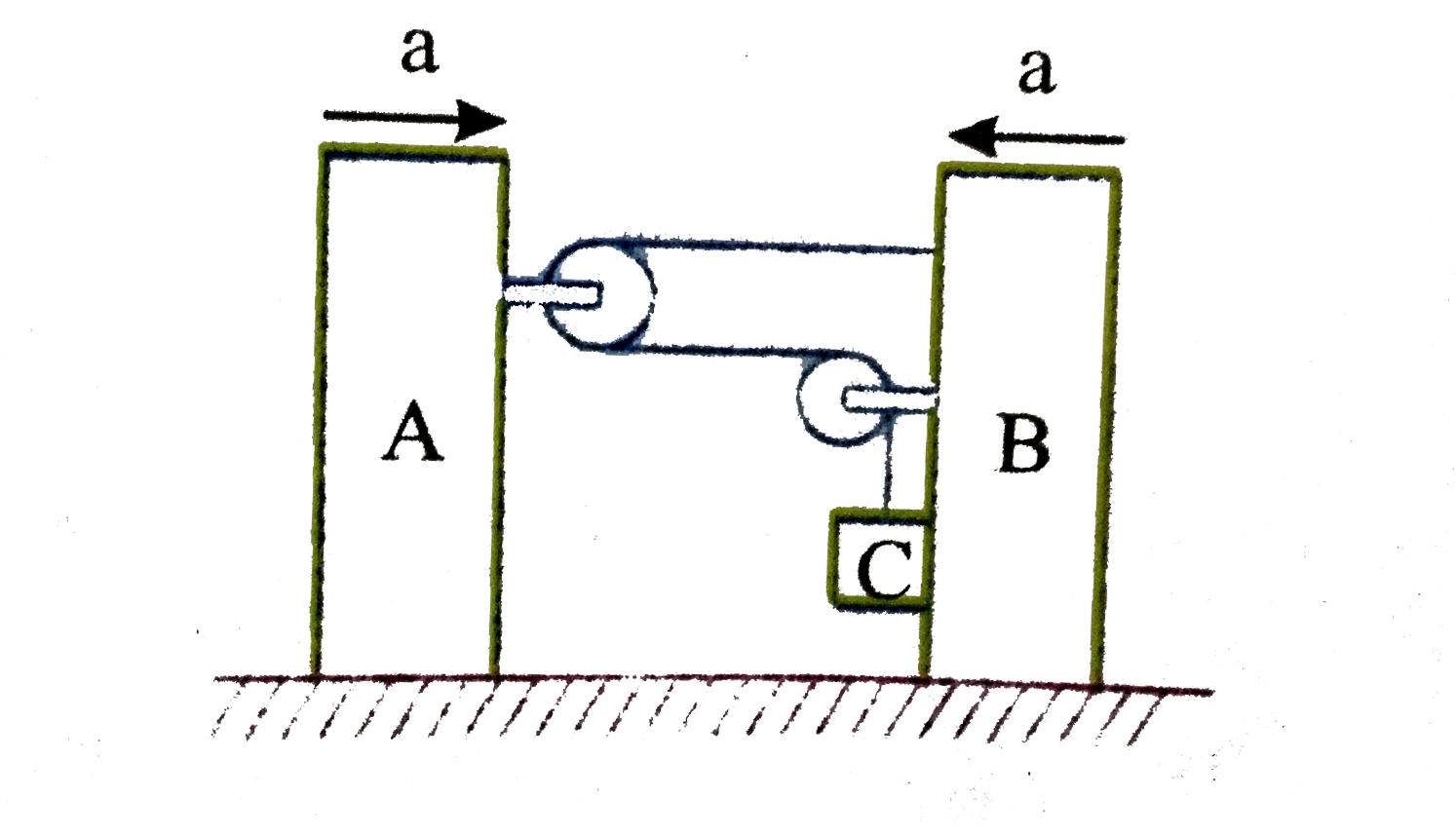
If A and B moves with acceleration a as ...

If `A` and `B` moves with acceleration a as shown in diagram calculate accelration of `C` with respect to `B`
.

Promotional Banner

Similar Questions

Explore conceptually related problems

If A and B moves with acceleration a block c moves up with acceleration b calculate acceleration of D with respective A . .

The system shown in figure starts from rest, and each block moves with a constant acceleration. If the relative acceleration of block C with respect to block B is 6m//s^(2) upward and the relative acceleration of block D with respect to block C after 3s from starts.

Two particles are moving in different circles in same plane with different angular velocities as shown in figure. At t = 0, initial positions of particles A and B are shown by dots on the respective circles. Initial distance between particles is 1m. Particle A move anticlockwise in the first circle whereas B moves clockwise in the second circle. Angle described (rotated) by A and B in time 't' are theta_(A)=((pi)/2t) and theta_(B)=(pit) respectively. here theta is in radian and t is in second. Radius of each circle is shown in diagram. At time t=1 sec. the magnitude of acceleration of A with respect to B is

If the blocks A and B are moving towards each other with accelerations a and b shown in fig. find the net acceleration of block C.

If the blocks A and B are moving towards each other with accelerations a and b shown in fig. find the net acceleration of block C.

Two metal plates A and B are connected to cell of emf 2V is shown in the figure Calculate acceleration of an electron moving from B to A

For the system as shown in fig. find the acceleration of C. the accelerations of A and B with respect to ground are marked.

For the system as shown in fig. find the acceleration of C. the accelerations of A and B with respect to ground are marked.

Four particles A, B, C and D are moving with constant speed v each at the instant shown relative velocity of A with respect to B, C and D are in directions

Four particles A, B, C and D are moving with constant speed v each at the instant shown relative velocity of A with respect to B, C and D are in directions