

Home
Class 12
PHYSICS
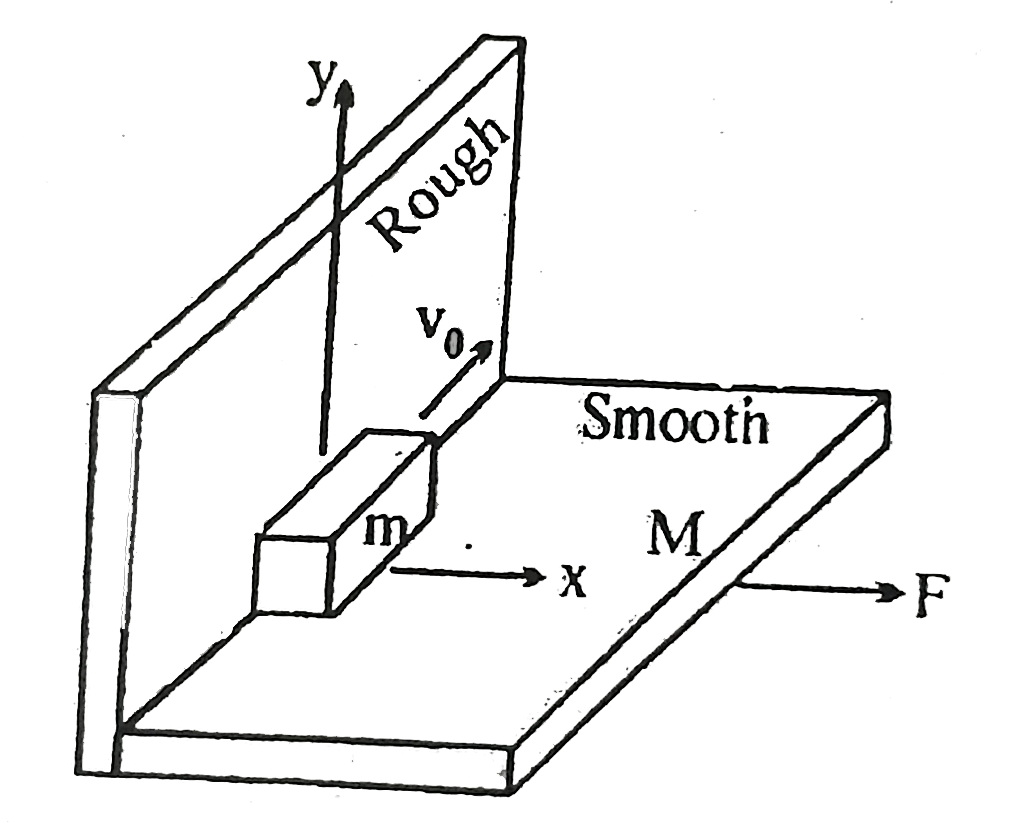
Figure shows a block placed on a bracket...

Figure shows a block placed on a bracket. Bracket is placed on a smooth floor, it is pulled by a force F=6N horizontally Block is projected with velocity v_(0) relative to bracket as shown in figure. Find time in second after which it stops relative to bracket. Horizontal surface of bracket is smooth while vertical surface is rough (Given `m=1 kg M=5 kg v_(0)=5 m //s mu =0.5)` (Round off nearest integer)

Promotional Banner

Similar Questions

Explore conceptually related problems

Four blocks each of mass M connected by a massless strings are pulled by a force F on a smooth horizontal surface, as shown in figure.

A force of 50N acts in the direction as shown in figure. The block of mass 5kg, resting on a smooth horizontal surface. Find out the acceleration of the block.

A force of 50N acts in the direction as shown in figure. The block of mass 5kg, resting on a smooth horizontal surface. Find out the acceleration of the block.

A force of 50N acts in the direction as shown in figure. The block of mass 5kg, resting on a smooth horizontal surface. Find out the acceleration of the block.

A force of 50N acts in the direction as shown in figure. The block of mass 5kg, resting on a smooth horizontal surface. Find out the acceleration of the block.

A block of mass m is placed on a smooth block of mass M = m with the help of a spring as shown in the figure. A velocity v_(0) is given to upper block when spring is in natural length. Find maximum compression in the spring.

A block A of mass m is placed over a plank B of mass 2m plank B is placed over a smooth horizontal surface .The coefficient of friction between A and B is 0.4 Block A is given a velocity v_(0) toward right Find acceleration (in ms^(-2) of B relative to A

A block A of mass m is placed over a plank B of mass 2m plank B is placed over a smooth horizontal surface .The coefficient of friction between A and B is 0.4 Block A is given a velocity v_(0) toward right Find acceleration (in ms^(-2) of B relative to A

A body of mass M with a small block m placed on it rests on a smooth horizontal surface. The block is set in motion in the horizontal direction with a velocity v . To what height relative to the initial level will the block rise after breaking off from the body M . Friction can be assumed to be absent.

Two blocks of masses of 0.2 kg and 0.5 kg which are placed 22m apart on a horizontal surface (mu = 0.5) are acted uponby two forces of magnitude 3 N each as shown in figure in time t = 0 Then the time t at which they collide with each other is