Home
Class 14
REASONING
One or two statements are given followed...

One or two statements are given followed by two Conclusions/assumptions, I and II. You have to consider the statement to be true, even if it seems to be at variance from commonly known facts. You are to decide which of the given Conclusions/assumptions can definitely be drawn from the given statement. Indicate your answer.
Statements:
1. All mangoes are golden in colour.
2. No golden coloured things are cheap.
Conclusions :
I. All mangoes are cheap.
II. Golden-coloured mangoes are not cheap.

A

Only ConclusionI follows

B

No golden coloured things are cheap.

C

Either Conclusion I or Conclusion II follows

D

Both Conclusions I and II follow

Text Solution

Verified by Experts

The correct Answer is:
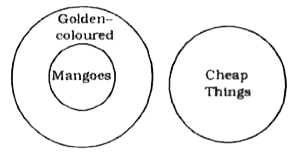
B

First Premise is Universal Negative (E-type).
All magoes are golden in colour.Itimplies that all mangoes without an exception are golden in colour.
No golden coloured things are cheap.

Thus , conclusion II follows.
Promotional Banner

Similar Questions

Explore conceptually related problems

One or two statements are given followed by two Conclusions/Assumptions, I and II. You have to consider the statement to be true, even if it seems to be at variance from commonly known facts. You are to decide which of the given conclusions/assumptions can definitely be drawn from the given statement. Indicate your answer. Statements : No man is a donkey. Rahul is a man. Conclusions : I. Rahul is not a donkey. II. All men are not Rahul

Two statements are given followed by two conclusions/assumptions, I and II. You have to consider the statement to be true, even if it seems to be at variance from commonly known facts. You are to decide which of the given conclusions/assumptions can definitely be drawn from the given statement. Indicate your answer. Statements : All Hindus are God fearing. No Japanese is a Hindu. Conclusions : I. The Japanese are not God fearing. II. All God fearing are Hindus.

In the following questions, two statements are given followed by two conclusions/assumptions, I and II. You have to consider the statement to be true, even if t seems to be at variance from commonly known facts. You are to decide which of the given conclusions/assumption can definitely be drawn from the given statements. Indicate your answer. Statements : I. All poets are day dreamers. II. All painters are day dreamers. Conclusions : I. All painters are poets. II. Some day dreamers are not painters.

Two statements are given followed by two Conclusions/Assumption, I and II. You have to consider the statements to be true, even if it seems to be at variance from commonly known facts. You are to decide which of the given conclusions/assumptions can definitely be drawn from the given statement. Indicate your answer. Statements a. All children are students. b. All students are players. Conclusions I. All cricketers are students. II. All children are players.

One or two statements are given followed by two conclusions, I and Il. You have to consider the statement to be true, even if it seems to be at variance from commonly known facts. You are to decide which of the given conclusions/assumptions can definitely be drawn from the given statement. Indicate your answer. Statements : All boys are tall. Rajiv is a boy. Conclusions : I. Rajiv is tall. II. Rajiv is not tall.

In the following question, one or two statement(s) is/are given followed by two Conclusions/assumptions, I and II. You have to consider the statement to be true, even if it seems to be at variance from commonly known facts. You are to decide which of the given conclusions/assumptions can definitely be drawn from the given statement. Indicate your answer. Statements : Some kings are queens. All queens are beautiful. Conclusions : I. All kings are beautiful. II. All queens are kings.

In the following questions, two statements are given followed by two conclusions/assumptions, I and II. You have to consider the statement to be true, even if t seems to be at variance from commonly known facts. You are to decide which of the given conclusions/assumption can definitely be drawn from the given statements. Indicate your answer. Statements : I. Some men are good. II. Some men are wise. Conclusions : I. Some wise men are good. II. Some good men are wise.

In each of the following questions, one/two statements are given followed by two conclusions/assumption, I and II. You have to consider the statements to be true, even if they seem to be at variance from commonly known facts. You are to decide which of the given conclusions/assumptions can definitely be drawn from the given statements. Indicate your answer. Statements : All cows are animals. All deers are cows. Consluions I. All eers are animals. II. All animals are cows.

Two statements are given followed by two Conclusions I and II. You have to be consider the statements to be true, even if it seems to be at variance from commonly known facts, You are to decide which of the given conclusion can definitely be drawn from the given statement. Indicate your answer. Statements : All pens are pencils. No pencil is an eraser. Conclusions : I. No eraser is a pen. II. No pen is an eraser.

In each of the following questions, one or two statements are given followed by two conslusions/assumption, I and II. You have to consider the statement(s) to be true, even if they seem to be at variance from commonly known facts. You have to decide which of the given conclusions/assumption can definitely be drawn from the given statement(s). Indicate your answer. Statements : All women are cats. All cats are rats. Conclusions : I. All women are rats. II. All rats are women.

Recommended Questions
  1. One or two statements are given followed by two Conclusions/assumption...

    Text Solution

    |

  2. क्लोरोफॉर्म को प्रकाश एवं वायु के प्रभाव से बचाने के लिए क्या सावधानि...

    Text Solution

    |

  3. एक रेखिक समीकरण दी गई है । दो चरो में एक ऐसी और रेखिक समीकरण लिख...

    Text Solution

    |

  4. समस्याओ में रेखिक समीकरणों के युग्म बनाइए और उनके हल (यदि उनका ...

    Text Solution

    |

  5. एक मित्र दूसरे से कहता है कि 'यदि मुझे एक सौ दे दो, तो मैं आपसे दो गुन...

    Text Solution

    |

  6. ठोस पदार्थो में दोष (defects in solids) से संबंधित कौन-सा (से) वक्तव्...

    Text Solution

    |

  7. क्या मानक अवस्थाओं में Fe^(3+),Br^(-) में Br(2) ऑक्सीकृत कर सकता है ? ...

    Text Solution

    |

  8. नीचे कुछ अभिक्रियाएँ दी गयी है- (a) ACl(2)+BtoBCl(2)+A (b) B+DCl t...

    Text Solution

    |

  9. दो सेलो के मानक विधुत वाहक बल नीचे दिए गये है । 2Ag+Pt^(2+)to2Ag^(+)...

    Text Solution

    |

