

Home
Class 11
PHYSICS
Binary stars of comparable masses rotate...

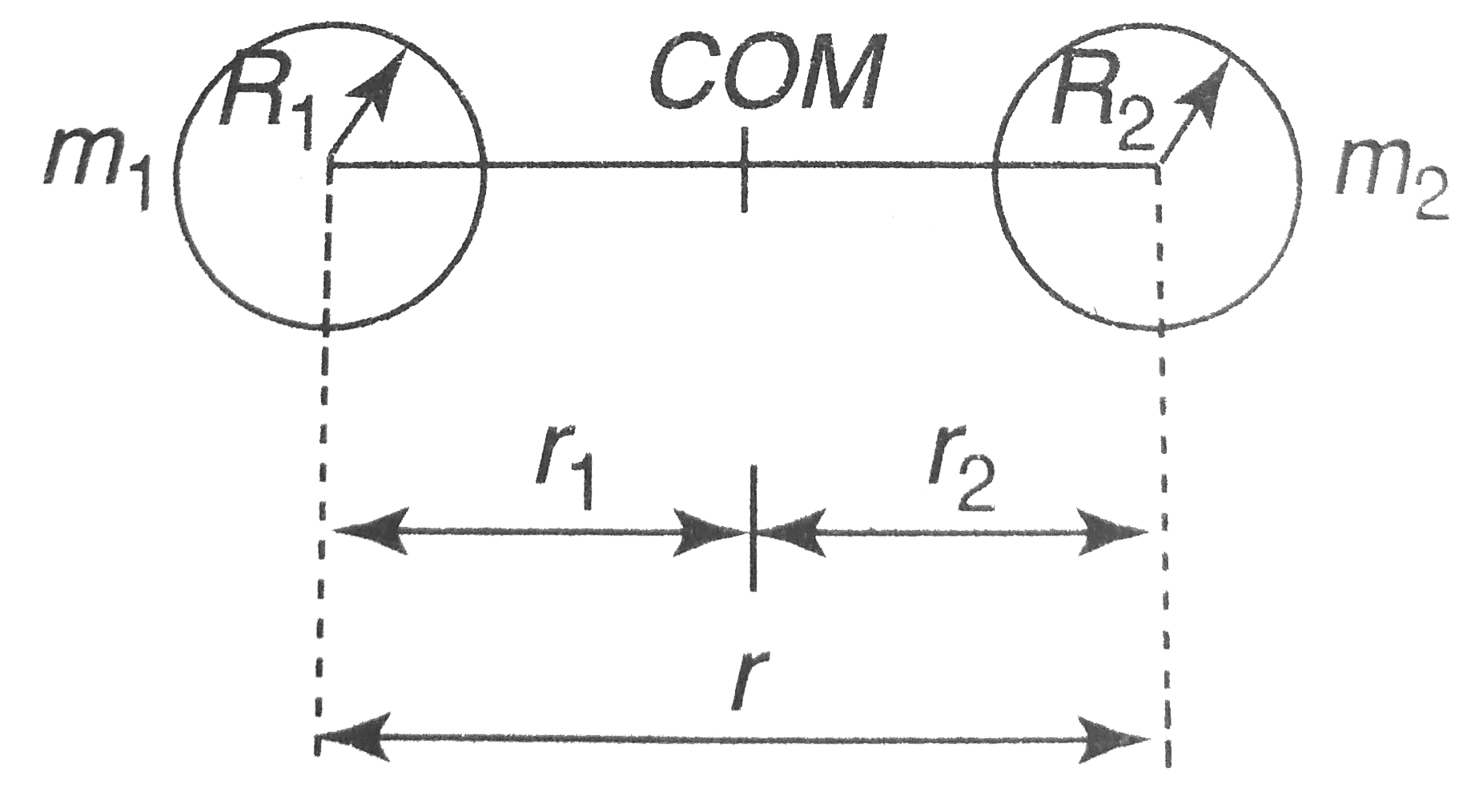
Binary stars of comparable masses rotates under the influence of each other's gravity at a distance `[(2G)/(omega^(2))]^(1//3)` where `omega` is the angular velocity of each of the system. If difference between the masses of two stars is `6` units. Find the ratio of the masses of smaller to bigger star.

Promotional Banner

Similar Questions

Explore conceptually related problems

Binary stars rotate under mutual gravitational force at separation 2(G/(omega^(2)))^(1/3) , where omega is the angular velocity of each of the star about centre of mass of the system. If difference between the mass of stars is 6 units. Find the ratio of mass of bigger star to smaller star.

Binary stars rotate under mutual gravitational force at separation 2(G/(omega^(2)))^(1/3) , where omega is the angular velocity of each of the star about centre of mass of the system. If difference between the mass of stars is 6 units. Find the ratio of mass of bigger star to smaller star.

Binary stars of comparable masses m_(1) and m_(2) rotate under the influence of each other's gravity with a time period T . If they are stopped suddenly in their motions, find their relative velocity when they collide with each constant of gravitation.

Binary stars of comparable masses m_(1) and m_(2) rotate under the influence of each other's gravity with a time period T . If they are stopped suddenly in their motions, find their relative velocity when they collide with each constant of gravitation.

The two components of Procyon have a separation of 4.55'' and period o 40.6 uears. If the distance of the binary is 11.3 light years, calculate the sum of the masses of the two stars in solar units. If the ratio of their masses is 3:1 , find the mass of each star.

Angular velocity of a ring is omega . If we put two masses each of mass m at the diametrically opposite points then the resultant angular velocity (m=mass of ring)

Angular velocity of a ring is omega . If we put two masses each of mass m at the diametrically opposite points then the resultant angular velocity (m=mass of ring)

In a binary star system one star has thrice the mass of other. The stars rotate about their common centre of mass then :

A pair of stars rotates about their centre of mass One of the stars has a mass M and the other has mass m such that M =2m The distance between the centres of the stars is d (d being large compared to the size of either star) . The ratio of kinetic energies of the two stars (K_(m) //K_(M)) is .