Home
Class 12
CHEMISTRY
At 298 K the standard free energy of for...

At 298 K the standard free energy of formation of `H_(2)O(l)` is `-237.20 kJ/"mole"` while that of its ionisation into `H^(+)` ions and hydroxyl ions is `80kJ/"mole"`, then the emf of the following cell at 298 K will be :
[Take 1F = 96500 C]
`H_(2)O(g, 1 bar)|H^(+)(1M)||OH^(-)(1M) |O_2)(g, 1bar)`

A

`0.40` V

B

`0.81` V

C

`1.23 V `

D

`0.40` V

Text Solution

Verified by Experts

The correct Answer is:
A

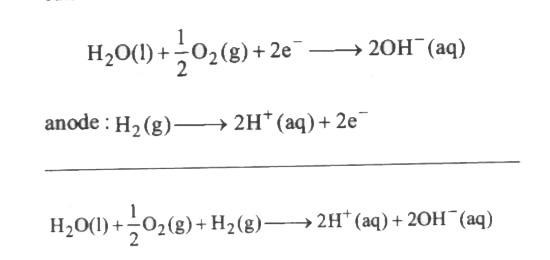
Cell reaction
cathode :

Also we have
`H_(2) (g) + (1)/(2) O_(2) (g) to H_(2) O (l),`
`Delta G_(f)^(@) = -237.2 kJ`/mole
`H_(2)O (l) to H^(+) (aq) + OH^(-) (aq)`
`Delta G^(@) = 80` kJ/mol
Hence for cell reaction
`Delta G^(@) = -237.2 + (2 xx 80) = -77.20` kJ/mol
`therefore E^(@) = - (DeltaG^(@))/(nF) = (77200)/(2 xx 96500) xx 0.40` V
Promotional Banner

Topper's Solved these Questions

  • COORDINATION COMPOUNDS

    DISHA PUBLICATION|Exercise Exercise|122 Videos
  • ENVIRONMENTAL CHEMISTRY

    DISHA PUBLICATION|Exercise Exercise -2 : Concept Applicator|15 Videos

Similar Questions

Explore conceptually related problems

At 298 K the standard free energy of formation of H_(2)O (l) is -237.20 kJ/"mole" while DeltaG^(@) of its ionisation into H^(+) ion and hydroxyl ionosis 80kJ//"mole" , then the emf of the following cell at 298 K will be: H-92)(g,1bar)| H^(+)(1 M) || OH^(-)(1M) | O_(2)(g,1bar)

At 298K the standard free energy of formation of H_(2)O(l) is -256.5 kJ..mol , while that of its ionisation to H^(+) & OH^(-) is 80 kJ//mol . What will be emf at 298 K of the cell. H_(2)(g,1 bar) |H^(+)(1M) || O_(2)(g,1bar) Fill your answer by multiplying it with 10.

The standard reduction potential of the reaction H_(2)O+e^(-) rarr 1/2 H_(2) +OH , at 298 K, is

At 25^(@)C the heat of formation of H_(2)O_((l)) is -285.9" kJ mole"^(-1) and that for H_(2)O_((g)) is -242.8" kJ mole"^(-1) . The heat of vaporization of water at the same temperature is

The enthalpy of solution , sodium and sodium oxide in large volume of water , are -18KJ/mole and -238KJ/mol, respectively . If the enthalpy of formation of water is -286 KJ/mol, then what is the enthalpy of formation of sodium oxide ? All the enthalpies are at 298K and 1 bar pressure. [Given : reaction involved are 2Na(s)+2H_(2)O(l)to 2NaOH(aq)+H_(2)(g) Na_(2)O(s)+H_(2)O(l)to2NaOH(aq)

Standard free energies of formation (I kJ // mol ) at 298 K are -237 .2 , - 394 .4 and - 8.2 for H_2 O(1), CO_2 (g) and pentange (g) , respectively . The value of E_(cell)^@ for the pentane-oxygen fuel cell is .

DISHA PUBLICATION-ELECTROCHEMISTRY -Exercise
  1. Which one is not called a anode reaction from the following?

    Text Solution

    |

  2. Which of the following statements is true for an electrochemical cell ...

    Text Solution

    |

  3. At 298 K the standard free energy of formation of H(2)O(l) is -237.20 ...

    Text Solution

    |

  4. If the following half cells have E^(@) values as A^(3+) + e^(-) to A...

    Text Solution

    |

  5. In a galvanic cell

    Text Solution

    |

  6. Based on the cell notation for a spontaneous reaction, at the anode: ...

    Text Solution

    |

  7. Zn can displace :-

    Text Solution

    |

  8. The oxidation potential of a hydrogen electrode at pH = 10 and P(H(2))...

    Text Solution

    |

  9. The E^(@) at 25^(@)C for the following reaction is 0.22 V. Calculate t...

    Text Solution

    |

  10. A galvanic cell is composed of two hydrogen electrods, one of which i...

    Text Solution

    |

  11. The solution of CuSO(4) in which copper rod is immersed is diluted to ...

    Text Solution

    |

  12. For a given reaction :M^((x+n))+n e^(-)rarr M^(c+),E^(c-).(red) is kn...

    Text Solution

    |

  13. In the electrochemical reaction, 2Fe^(3+)+Zn rarr Zn^(2+) + 2Fe^(2+)...

    Text Solution

    |

  14. What is the standard reducing potential (E^(@)) for Fe^(3+)to Fe? (Gi...

    Text Solution

    |

  15. What will be the emf for the given cell ? Pt|H(2)(g,P(1))|H^(+)(aq)|...

    Text Solution

    |

  16. Ni|Ni^(2+)(1.0M)||Au^(3+)(1.0M)| Au (where E^(@) for Ni^(2+)//Niis -0...

    Text Solution

    |

  17. For a cell reaction involvinig a two electron change, the standard emf...

    Text Solution

    |

  18. Following cell has EMF 0.7995 V . Pt| H(2) (1) atm) |HNO(3) (1M)|| A...

    Text Solution

    |

  19. An electrochemical cell is shown below Pt, H(2)(1 "atm")|HCl(0.1 M)|C...

    Text Solution

    |

  20. The emf of the cell Cr(s) abs(Cr^(3+)(1.0M))abs(Co^(2+)(1.0M))Co(s) [E...

    Text Solution

    |

