Home
Class 12
CHEMISTRY
Out of (i) XeO(3)(ii) XeOF(4) and (iii) ...

Out of (i) `XeO_(3)(ii) XeOF_(4) and (iii) XeF_(6)` the molecules having same number of lone pairs on `Xe` are

A

(i) and (ii) only

B

(i)and (iii) only

C

(ii) and (iii) only

D

(i),(ii) and (iii)

Text Solution

Verified by Experts

The correct Answer is:
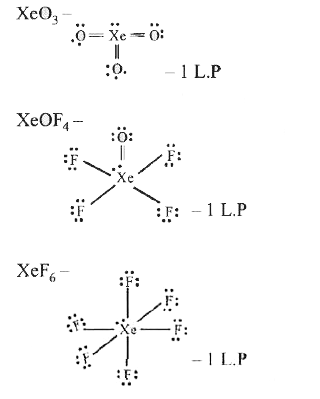
D

Promotional Banner

Topper's Solved these Questions

  • The p-Block Elements (Group 13 and Group 14)

    DISHA PUBLICATION|Exercise Exercise-2: Concept Applicator|30 Videos
  • THE s-BLOCK ELEMENTS

    DISHA PUBLICATION|Exercise Exercise - 2 : Concept Applicator|30 Videos

Similar Questions

Explore conceptually related problems

Out of (i)XeO_(3)(ii)XeO_(2)F_(2) and (iii)XeO_(4) , the molecules having same number of lone pairs are

Among the following molecules (i) XeO_(3) (ii) XeOF_(4) (iii) XeF_(6) those having same number of lone pairs on Xe are

Among the following molecules, (i)XeO_(3)(ii)XeOF_(4)(iii)XeF_(6) those having same number of lone pairs on Xe are:

Among the following molecule (i)XeO_(3)(ii)XeOF_(4)(iii)XeF_(6) Those having same number of lone pairs on Xe are

The approximate shape of a molecule can often be predicted by using what is called the valence-shell electron-pair repulsion (VSEPR) model. Electrons in bonds and in lone pairs can be thought of a ''charge cloud'' that repel one another nad stay as far apart as possible, thus causing molecules to assume specific shapes. The repulsive interactions of electron pairs decrease in the order: Lone pair - Lone pair gt Lone pair - Bond pair gt Bond pair - Bond pair These repulsive effects result in deviations from idealised shapes and alteration in bond angles in molecules. Among the following molecules. (P) XeO_(3)" (Q)"XeOF_(4) (R) XeO_(2)F_(2)" (S)"XeF_(5) Those having different molecular geometry but same number of lone pairs on Xe are :

In XeF_(2),XeF_(4) and XeF_(6)(g) the number of lone pairs on Xe respectively are :

The ratio of total number of lone pairs in XeF_2 and XeF_4 are:

DISHA PUBLICATION-THE P-BLOCK ELEMENTS (GROUP 15, 16, 17 & 18)-Exercise
  1. [X] +H(2)SO(4) to [Y] colourless with irritating smell. [Y] +K(2)Cr(2...

    Text Solution

    |

  2. The correct order of O - O bond length in O(2)H(2)O(2) and O(3) is

    Text Solution

    |

  3. Identify the correct sequence of increasing number of pi-bonds in the ...

    Text Solution

    |

  4. The correct order of S-S bod length is following oxyanions is : (i) ...

    Text Solution

    |

  5. Which of the following statements is false?

    Text Solution

    |

  6. Oxygen and sulphur both are the members of the same group in periodic ...

    Text Solution

    |

  7. A greenish yellow gas reacts with an alkali metal hydroxide to form a ...

    Text Solution

    |

  8. Which one of the following pairs of reactantas does not form oxygen wh...

    Text Solution

    |

  9. Which of the following is correct statement?

    Text Solution

    |

  10. Only iodine forms hepta-fluroide IF(7), but chlorine and bromine give ...

    Text Solution

    |

  11. The incorrect order is

    Text Solution

    |

  12. Which of the following oxyacids of chlorine is formed on shaking chlor...

    Text Solution

    |

  13. The correct statement(s) regarding, (i) HClO, (ii) HClO(2), (iii) HC...

    Text Solution

    |

  14. The formation of O(2)^(+)[PtF(6)]^(-) is the basis for the formation o...

    Text Solution

    |

  15. Inert gases such as heliume behave like ideal gases over a wide rang...

    Text Solution

    |

  16. Out of (i) XeO(3)(ii) XeOF(4) and (iii) XeF(6) the molecules having sa...

    Text Solution

    |

  17. Noble gases can be separated by:

    Text Solution

    |

  18. XeF(2) and XeF(6) are separately hydrolysed then:

    Text Solution

    |

  19. SbF5 react with XeF4 to form an adduct. The shapes of cation and anion...

    Text Solution

    |

  20. Which one of the following statements regarding helium is incorrect?

    Text Solution

    |

