Home
Class 12
PHYSICS
A truck increases its speed at constant ...

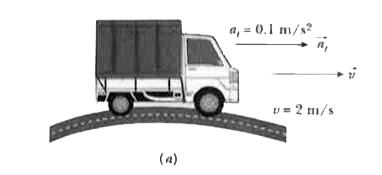
A truck increases its speed at constant rate of `0.1m//s^(2)` and it passes over a semicircular bridge of radius 40 m. At the time car reaches the top of the bridge, its speed is 2m/s. What are the magnitude and direction of the to total acceleration vector at this moment?

Text Solution

Verified by Experts
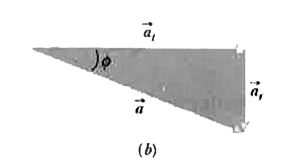
The truck moves long a curved path with variable speed. Thus, the truck has both tangential and radial acceleration. The radial acceleration is given by `a_(r)=v^(2)//R`, with `v=2m//s` and R=40m. The radial acceleration vector is directed straight downward, and the tangential acceleration vector has magnitude `0.1m//s^(2)` and its is horizontal.
Calculation: Let us calculate the radial acceleration:
`a_(r)=(v^(2))/R=((2m//s)^(2))/(40m)=0.1m//s`
Now
`|bara|=sqrt(a_(r)^(2)+a_(4)^(2))=sqrt(2)(0.1)m//s^(2)`
Which is the magnitude of `veca`. Now, the angle `phi` between `veca` and the horizontal is given by
`phi=tan^(-1)((a_(r))/(a_(t)))=45^(@)`
Promotional Banner

Topper's Solved these Questions

  • CIRCULAR MOTION

    RESNICK AND HALLIDAY|Exercise PROBLEMS|56 Videos
  • CIRCULAR MOTION

    RESNICK AND HALLIDAY|Exercise PRACTICE QUESTIONS(SINGLE CORRECT CHOICE TYPE)|40 Videos
  • CIRCUITS

    RESNICK AND HALLIDAY|Exercise Practice Questions (Integer Type)|3 Videos
  • CURRENT AND RESISTANCE

    RESNICK AND HALLIDAY|Exercise Practice Questions (Integer Type)|3 Videos

Similar Questions

Explore conceptually related problems

In the overhead view of Fig. 4-40, Jeeps P and B race along straight lines, across flat terrain, and past stationary border guard A. Relative to the guard, B travels at a constant speed of 25.0 m/s, at the angle theta_(2)=30.0^(@) . Relative to the guard, P has accelerated from rest at a constant rate of 0.400m//s^(2) at the angle theta_(1)=60.0^(@) . At a certain time during the acceleration, P has a speed of 40.0 m/s. At that time, what are the (a) magnitude and (b) direction of the velocity of P relative to B and the ( c) magnitude and (d) direction of the acceleration of P relative to B?

A particle is performing circular motion of radius 1 m. Its speed is v=(2t^(2)) m//s . What will be magnitude of its acceleration at t=1s .

A car is moving on a circular road of radius 100m . At some instant its speed is 20m//s and is increasing at the rate of 3m//s^(2) . The magnitude of its acceleration is

A car is moving with speed 20 ms ^(-1) on a circular path of radius 100 m. Its speed is increasing at a rate of 3 ms^(-2) . The magnitude of the acceleration of the car at that moment is

A car is moving with speed 30m//sec on a circular path of radius 500 m . Its speed is increasing at the rate of , 2m//sec^(2) , What is the acceleration of the car

A roller coaster car has mass of 1300 kg when fully loaded with passengers. As the car passes over the top of a circular hil of radius 20m, its speed is not changing. At the top of the hill, what are the (a) magnitude F_(N) and (b) direction (up or down) of the normal force on the car from the track if the car's speed is v=11m/s? What are (C) F_(N) and (d) the direction if v=14m/s?

A car is moving with speed of 2ms^(-1) on a circular path of radius 1 m and its speed is increasing at the rate of 3ms(-1) The net acceleration of the car at this moment in m//s^2 is

A motor car is travelling 20m/s on a circular road of radius 400 m. If it increases its speed at the rate of 1 m//s^(2) , then its acceleration will be

A motor car is travelling at 60m//s on a circular road of radius 1200m. It is increasing its speed at the rate of 4m//s^(2) . The acceleration of the car is:

