Home
Class 12
PHYSICS
In the given table Column I shows the di...

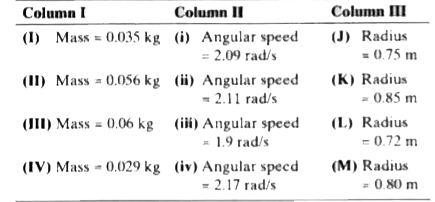
In the given table Column I shows the different values of masses of the body. Column II shows the different values of angular speed of the body and Column III shows the radius of circle in which the body moves.

Which combination has 0.13N as the centrepetal force?

A

(i) (iii) (L)

B

(IV)(i)(M)

C

(II)(iv)(K)

D

(I)(i)(K)

Text Solution

Verified by Experts

The correct Answer is:

D
Promotional Banner

Topper's Solved these Questions

  • CIRCULAR MOTION

    RESNICK AND HALLIDAY|Exercise PRACTICE QUESTIONS(INTEGER TYPE)|2 Videos
  • CIRCULAR MOTION

    RESNICK AND HALLIDAY|Exercise CHECK POINTS|6 Videos
  • CIRCULAR MOTION

    RESNICK AND HALLIDAY|Exercise PRACTICE QUESTIONS(LINKED COMPREHENSION)|2 Videos
  • CIRCUITS

    RESNICK AND HALLIDAY|Exercise Practice Questions (Integer Type)|3 Videos
  • CURRENT AND RESISTANCE

    RESNICK AND HALLIDAY|Exercise Practice Questions (Integer Type)|3 Videos

Similar Questions

Explore conceptually related problems

In the given table Column I shows the different values of masses of the body. Column II shows the different values of angular speed of the body and Column III shows the radius of circle in which the body moves. Which combination has 0.199N as the centrepetal force?

In the given table column I shows the values of linear velocity. Column II shows the values of linear velocity, Column II shows the values of angular velocity and Column III shows the radius of the circle in which circular (angular) motion takes place. Which combination describes the conditions when body is displaced by 28 m in 4s and accelerates with 2m/s?

In the given table column I shows the values of linear velocity. Column II shows the values of linear velocity, Column II shows the values of angular velocity and Column III shows the radius of the circle in which circular (angular) motion takes place. Which combination describes the conditions when body starts with zero initial linear velocty and accelerates with 2"rad"//s^(2) for 3s?

In the given table column I shows the values of linear velocity. Column II shows the values of linear velocity, Column II shows the values of angular velocity and Column III shows the radius of the circle in which circular (angular) motion takes place. Which combination describes the conditions when body starts with zero initial linear velocty and accelerates with 2m//s^(2) for 3s?

In each equation, there is a table having 3 columns and 4 rows. Based on the table, there are 3 questions. Each question has 4 options (a), (b), (c ) and (d), ONLY ONE of these four options is correct. Four quantum numbers shows the electronic configuration of the element. In the given table, Column I shows the different values of principal quantum number, Column II shows the different values of angular momentum quantum number and Column III shows the energy levels for different orbitals. What are the characteristics of 2p orbital?

In each equation, there is a table having 3 columns and 4 rows. Based on the table, there are 3 questions. Each question has 4 options (a), (b), (c ) and (d), ONLY ONE of these four options is correct. Four quantum numbers shows the electronic configuration of the element. In the given table, Column I shows the different values of principal quantum number, Column II shows the different values of angular momentum quantum number and Column III shows the energy levels for different orbitals. What are the characteristics of 2s orbital?

In each equation, there is a table having 3 columns and 4 rows. Based on the table, there are 3 questions. Each question has 4 options (a), (b), (c ) and (d), ONLY ONE of these four options is correct. Four quantum numbers shows the electronic configuration of the element. In the given table, Column I shows the different values of principal quantum number, Column II shows the different values of angular momentum quantum number and Column III shows the energy levels for different orbitals. What are the characteristics of 1s orbital?

In each equation, there is a table having 3 columns and 4 rows. Based on the table, there are 3 questions. Each question has 4 options (a), (b), (c ) and (d), ONLY ONE of these four options is correct. There are different types of lasers. In the given table, Colums I shows the properties of different lasers or material used in lasers, Column II shows the different names of the lasers and Column III shows the uses of different type of lasers. What are the characteristics of solid-state laser?

In each equation, there is a table having 3 columns and 4 rows. Based on the table, there are 3 questions. Each question has 4 options (a), (b), (c ) and (d), ONLY ONE of these four options is correct. There are different types of lasers. In the given table, Colums I shows the properties of different lasers or material used in lasers, Column II shows the different names of the lasers and Column III shows the uses of different type of lasers. What are the characteristics of semiconductor laser?

In each equation, there is a table having 3 columns and 4 rows. Based on the table, there are 3 questions. Each question has 4 options (a), (b), (c ) and (d), ONLY ONE of these four options is correct. There are different types of lasers. In the given table, Colums I shows the properties of different lasers or material used in lasers, Column II shows the different names of the lasers and Column III shows the uses of different type of lasers. What are the characteristics of liquid state laser?
