Home
Class 12
PHYSICS
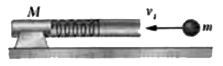
In Fig. , a ball of mass m = 60 g is sho...

In Fig. , a ball of mass m = 60 g is shot with speed `v_i` = 22 m/s into the barrel of a spring gun of mass M= 240 g initially at rest on a frictionless surface. The ball sticks in the barrel at the point of maximum compression of the spring. Assume that the increase in thermal energy due to friction between the ball and the barrel is negligible. (a) What is the speed of the spring gun after the ball stops in the barrel? (6) What fraction of the initial kinetic energy of the ball is stored in the spring?

Text Solution

Verified by Experts

The correct Answer is:

(a)4.4 m/s ; (b) 0.80
Promotional Banner

Topper's Solved these Questions

  • CENTER OF MASS

    RESNICK AND HALLIDAY|Exercise Practice Questions (Single Correct Choice )|47 Videos
  • CENTER OF MASS

    RESNICK AND HALLIDAY|Exercise Practice Questions (More than One Correct Choice)|5 Videos
  • CENTER OF MASS

    RESNICK AND HALLIDAY|Exercise Practice Questions (Integer )|4 Videos
  • CAPACITANCE

    RESNICK AND HALLIDAY|Exercise PRACTICE QUESTION (INTEGER TYPE)|3 Videos
  • CIRCUITS

    RESNICK AND HALLIDAY|Exercise Practice Questions (Integer Type)|3 Videos

Similar Questions

Explore conceptually related problems

A ball of mass m is projected with a speed v into the barrel of a spring gun of mass M initially at rest lying on a frictionless surface. The mass sticks in the barrel at the point of maximum compression in the spring. The fraction of kinetic energy of the ball stored in the spring is

A ball of mass m=6kg is shot with speed v=20m//s into a barrel of spring gun of mass M=24kg initially at rest. All surfaces are smooth & spring is massless. Sped of gun after ball stops relative to gun is

A ball of mass m is projected horizontally with velocity v into the barrel of a spring gun of mass M initially at rest on a frictionless table. The mass m sticks in the barrel at the point of maximum compression of the spring. What fraction of the initial energy of the ball is stored in the spring ? [Hint : Apply energy conservation principal to the system to obtain the maximum work done on the spring which is stored as potential energy of the spring. The spring will be progressively compressed till the two acquire a common velocity]

The ball strikes the block and sticks to it. Find the maximum compression of spring. ( L : natural length of spring)

A loaded spring gun, initially at rest on a horizontal frictionless surface fires a marble of mass m at an angle of elecation theta , then velocity of the gun just after the firing is :

A block of mass 200 g is given velocity 2(m)//(s) on a horizontal surface as shown in the figure. Find the maximum compression of spring of spring constant k=100(N)//(m)

A ball of mass 'm' moving with speed 'u' undergoes a head-on elastic collision with a ball of mass 'nm' initially at rest. Find the fraction of the incident energy transferred to the second ball.

Two blocks of mass 2kg and 5kg are given speed as shown in the figure. System is lying on a frictionless surface and the blocks are connected by a massless spring if spring constant 35 N/m . Find the maximum compression in the spring.

A spring, placed horizontally on a rough surface is compressed by a block of mass m, placed on the same surface so as to store maximum energy in the spring. If the coefficient of friction between the block and the surface is mu , the potential energy stored in the spring is

A block of mass 180 g is placed on a spring (spring constant k = 120 N//m ) fixed from below. A ball of mass 20 g is dropped from height 20 m and the collision is completely inelastic. Find the maximum compression of the spring. Neglect the initial compression of the spring due to the block.

RESNICK AND HALLIDAY-CENTER OF MASS -Problems
  1. A 5.20 g bullet moving at 700 m/s strikes a 700 g wooden block at rest...

    Text Solution

    |

  2. A completely inelastic collision occurs between two balls of wet putty...

    Text Solution

    |

  3. Block A has a mass 3kg and is sliding on a rough horizontal surface wi...

    Text Solution

    |

  4. In the "before" part of Fig., car A (mass 1100 kg) is stopped at a tra...

    Text Solution

    |

  5. In Fig. , a ball of mass m = 60 g is shot with speed vi = 22 m/s into ...

    Text Solution

    |

  6. Two titanium spheres approach each other head-on with the same speed a...

    Text Solution

    |

  7. Block 1 of mass m1 slides along a frictionless floor and into a one-di...

    Text Solution

    |

  8. Particle 1 with mass m and velocity v and particle 2 with mass 2m and ...

    Text Solution

    |

  9. Block 1, with mass m1 and speed 3.0 m/s, slides along an x axis on a f...

    Text Solution

    |

  10. In Fig., particle 1 of mass m1 = 0.30 kg slides rightward along an x a...

    Text Solution

    |

  11. In Fig. , block 1 of mass m1 slides from rest along a frictionless ram...

    Text Solution

    |

  12. A small ball of mass m is aligned above a larger ball of mass M = 0.63...

    Text Solution

    |

  13. In Fig. puck 1 of mass m1 = 0.25 kg is sent sliding across a frictionl...

    Text Solution

    |

  14. In the two-dimensional collision in Fig., the projectile particle has ...

    Text Solution

    |

  15. After a completely inelastic collision two objects of the same mass an...

    Text Solution

    |

  16. A force vecF acts on two particles of masses m and 4.0m moving at the ...

    Text Solution

    |

  17. A bob of mass 10m is suspended through an inextensible string of lengt...

    Text Solution

    |

  18. A 6090 kg space probe moving nose-first toward Jupiter at 120 m/s rela...

    Text Solution

    |

  19. Consider a rocket that is in deep space and at rest relative to an ine...

    Text Solution

    |

  20. (a) A rocket set for vertical firing weighs 50kg and contains 450kg of...

    Text Solution

    |
