Home
Class 12
PHYSICS
A uniform bar with mass m lies symmetric...


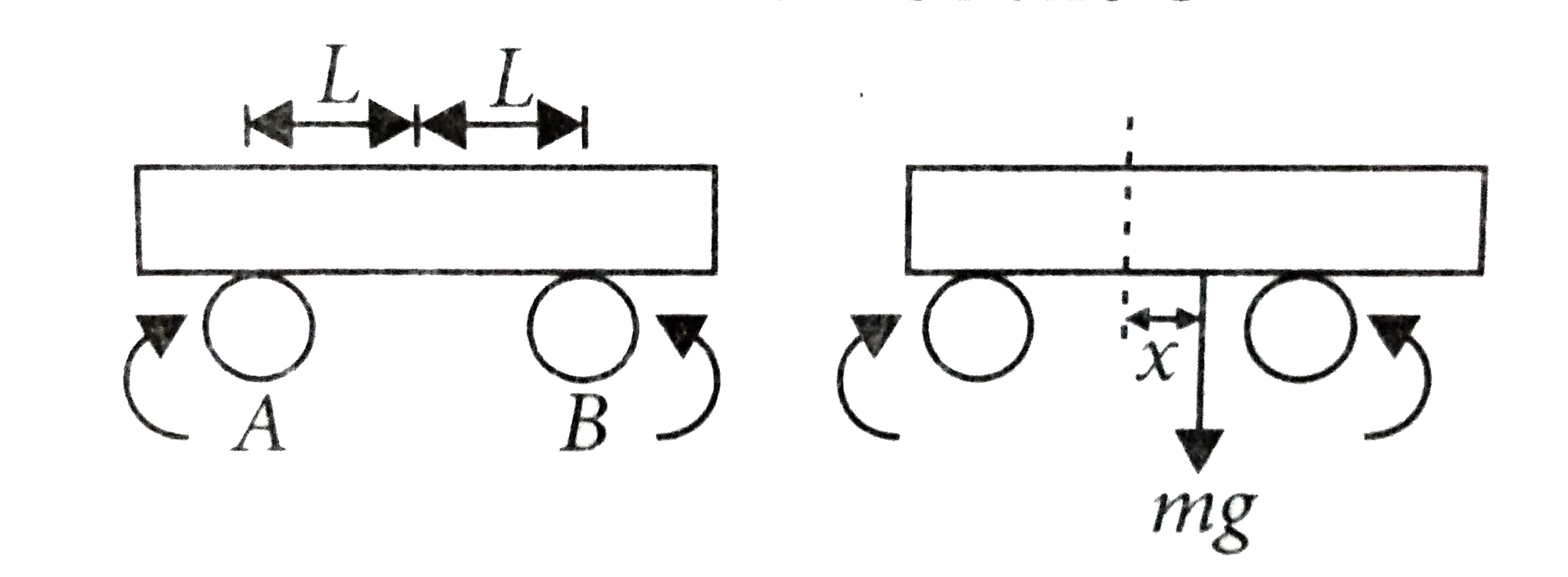
A uniform bar with mass m lies symmetrically across two rapidly rotating fixed rollers, A and B with distance L=2.0 cm between the bar's centre of mass and each roller. The rollers, whose directions of rotation are shown in figures slip against the bar with coefficient of kinetic friction `mu_(k)=0.40`. suppose the bar is displaced horizontally by the distance x as shown in figure and then released. the angular frequency `omega` of the resulting horizontal simple harmonic motion of the bar is (in `rad" "s^(-1)`)

Text Solution

Verified by Experts
(1) This situation seems very different from other SHM situations we have analyzed. However, the key idea here is that we can find `omega` if we find an expression for the horizontal acceleration a of the bar as a function of x and then compare it with `a= - omega^(2)x`.
(2) Since vertical forces (as shown in Fig.15.14b), horizontal frictional forces, and torques all act on the bar, we shall apply Newton.s second law both vertically and horizontally, and then in angular form about one of the contact points between bar and roller.
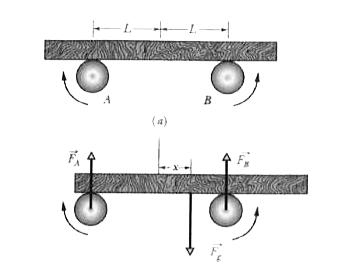
Calculations: The vertical force acting on the bar are the gravitational force `vec(F)_(g)` (with magnitude mg) and supporting forces `vec(F)_(A)` due to roller A and `vec(F)_(B)` due to roller B. Since there is no vertical acceleration of the bar. Newton.s second law for components along a vertical y axis `(F_("net, y") = ma_(y))` gives us
`F_(A) + F_(B) - mg= 0`
The horizontal forces acing on the bar are the kinetic frictional forces `F_(kA) = mu_(k) F_(A)` (toward the right) due to roller A and `f_(kB) = mu_(k) F_(B)` (toward the left) due to roller B. Thus,

Figure 15.14 (a) A bar is in equilibrium on two rotating rollers. A and B, that slip beneath it. (b) The bar is displaced from equilibrium by a distance x and then released.
Newton.s second law for components along a horizontal x axis `(F_("net.x") = ma_(x))` gives us
`mu_(k) F_(A) - mu_(k) F_(B) = ma`
`a= (mu_(k) F_(A) - mu_(k) F_(B))/(m)`
We now consider torques about an axis perpendicular to the plane of Fig. 15.14 and through the contact point between the bar and roller A. The bar experiences no angular acceleration about that axis, so Newton.s second law for torque about an axis `(tau_("net") = I_(a))` gives us
`F_(A) (0) + F_(B) 2L-mg (L+x) + f_(kA) (0) + f_(kB) (0) = 0`
where the forces `vec(F)_(A), vec(F)_(B), m vec(g), vec(f)_(kA), and vec(f)_(kB)` have moment arms about that axis of 0, 2L, L + x, 0 and 0, respectively. Solving Eq.15.36 for `F_(B)` and then solving Eq.15.34 for `F_(A)` we find
`F_(B) = (mg (L+x))/(2L) and F_(A) = (mg (L-x))/(2L)`
Substituting these results into Eq.15.35 yields.
`a= (mu_(k) g)/(L) x`
Thus `omega= sqrt((mu_(k)g)/(L)) = sqrt(((0.40)(9.8 m//s^(2)))/(0.020m))`
= 14 rad/s
Learn: Another important point is that the rollers will be experiencing kinetic friction which cal slow them dwon. There must be some external torque on the rollers to maintain the motion of the rollers.
Promotional Banner

Topper's Solved these Questions

  • OSCILLATIONS

    RESNICK AND HALLIDAY|Exercise Checkpoint|8 Videos
  • OSCILLATIONS

    RESNICK AND HALLIDAY|Exercise Problems|39 Videos
  • MOTION IN TWO AND THREE DIMENSIONS

    RESNICK AND HALLIDAY|Exercise PRACTICE QUESTIONS (MATRIX-MATCH)|10 Videos
  • PHOTONS AND MATTER WAVES

    RESNICK AND HALLIDAY|Exercise PRACTICE QUESTIONS(Integer Type)|4 Videos
RESNICK AND HALLIDAY-OSCILLATIONS-Practice Questions
  1. A uniform bar with mass m lies symmetrically across two rapidly rotati...

    Text Solution

    |

  2. Which one of the following statement is true concerning an object exec...

    Text Solution

    |

  3. Resonance occurs in harmonic motion when

    Text Solution

    |

  4. A simple pendulum has length L and period T. As it passes through its ...

    Text Solution

    |

  5. An object of mass m, oscillating on the end of a spring with spring co...

    Text Solution

    |

  6. The velocity of a certain simple harmonic oscillator is given by v= -(...

    Text Solution

    |

  7. A 0.20kg object mass attached to a spring whose spring constant is 500...

    Text Solution

    |

  8. A ball hung from a vertical spring oscillates in simple harmonic motio...

    Text Solution

    |

  9. A 1.2kg mass is oscillating without friction on a spring whose spring ...

    Text Solution

    |

  10. The displacement of an object oscillating on a spring is given by x(t)...

    Text Solution

    |

  11. The displacement of an object oscillating on a spring is given by x(t)...

    Text Solution

    |

  12. A 0.25kg block oscillates on the end of the spring with a spring const...

    Text Solution

    |

  13. The amplitude of oscillation of a simple pendulum is increased from 1^...

    Text Solution

    |

  14. A particle undergoes damped harmonic motion. The spring constant is 10...

    Text Solution

    |

  15. Five particles undergo damped harmonic motion. Value for the spring co...

    Text Solution

    |

  16. A particle is osicllating according to the equation X= 7 cos (0.5 pi t...

    Text Solution

    |

  17. An archer pulls the bowstring back for a distance of 0.470m befor rele...

    Text Solution

    |

  18. A simple pendulum is made from a 0.65m long string and a small ball at...

    Text Solution

    |

  19. The length of a simple pendulum is 0.79m and the mass of the particle ...

    Text Solution

    |

  20. A block is attached to a horizontal spring and oscillates back and for...

    Text Solution

    |

  21. A copper rod (length =2.0m, radius =3.0 xx 10^(-3)m) hangs down from t...

    Text Solution

    |

