Home
Class 12
PHYSICS
In Fig. 15.33, a stick of length L= 1.65...

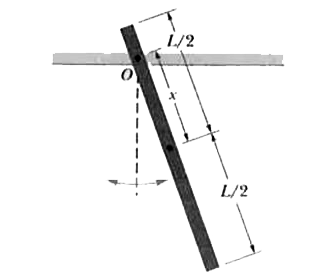
In Fig. 15.33, a stick of length L= 1.65 m oscillates as a physical pendulum. (a) What value of distance x between the stick's center of mass and its pivot point O gives the least period? (b) What is that least period?

Text Solution

Verified by Experts

x= 0.48m, (b) T= 2.0s
Promotional Banner

Topper's Solved these Questions

  • OSCILLATIONS

    RESNICK AND HALLIDAY|Exercise Practice Questions|57 Videos
  • OSCILLATIONS

    RESNICK AND HALLIDAY|Exercise Checkpoint|8 Videos
  • MOTION IN TWO AND THREE DIMENSIONS

    RESNICK AND HALLIDAY|Exercise PRACTICE QUESTIONS (MATRIX-MATCH)|10 Videos
  • PHOTONS AND MATTER WAVES

    RESNICK AND HALLIDAY|Exercise PRACTICE QUESTIONS(Integer Type)|4 Videos

Similar Questions

Explore conceptually related problems

In physical pendulum, the time period for small oscillation is given by T=2pisqrt((I)/(Mgd)) where I is the moment of inertial of the body about an axis passing through a pivoted point O and perpendicular to the plane of oscillation and d is the separation point between centre of gravity and the pivoted point. In the physical pendulum a speacial point exists where if we concentrate the entire mass of body, the resulting simple pendulum (w.r.t. pivot point O) will have the same time period as that of physical pendulum This point is termed centre of oscillation. T=2pisqrt((I)/(Mgd))=2pisqrt((L)/(g)) Moreover, this point possesses two other important remarkable properties: Property I: Time period of physical pendulum about the centre of oscillation (if it would be pivoted) is same as in the original case. Property II: If an impulse is applied at the centre of oscillatioin in the plane of oscillation, the effect of this impulse at pivoted point is zero. Because of this property, this point is also known as the centre of percussion. From the given information answer the following question: Q. A uniform rod of mass M and length L is pivoted about point O as shown in Figgt It is slightly rotated from its mean position so that it performs angular simple harmonic motion. For this physical pendulum, determine the time period oscillation.

A uniform stick of length l is hinged so as to rotated about a harmonic axis perpendicular to the stick, at a distance from the center . Find the value of x, for which the time period is minimum.

In physical pendulum, the time period for small oscillation is given by T=2pisqrt((I)/(Mgd)) where I is the moment of inertial of the body about an axis passing through a pivoted point O and perpendicular to the plane of oscillation and d is the separation point between centre of gravity and the pivoted point. In the physical pendulum a speacial point exists where if we concentrate the entire mass of body, the resulting simple pendulum (w.r.t. pivot point O) will have the same time period as that of physical pendulum This point is termed centre of oscillation. T=2pisqrt((I)/(Mgd))=2pisqrt((L)/(g)) Moreover, this point possesses two other important remarkable properties: Property I: Time period of physical pendulum about the centre of oscillation (if it would be pivoted) is same as in the original case. Property II: If an impulse is applied at the centre of oscillatioin in the plane of oscillation, the effect of this impulse at pivoted point is zero. Because of this property, this point is also known as the centre of percussion. From the given information answer the following question: Q. If an impulse J is applied at the centre of oscillation in the plane of oscillation, then angular velocity of the rod will be .

In physical pendulum, the time period for small oscillation is given by T=2pisqrt((I)/(Mgd)) where I is the moment of inertial of the body about an axis passing through a pivoted point O and perpendicular to the plane of oscillation and d is the separation point between centre of gravity and the pivoted point. In the physical pendulum a speacial point exists where if we concentrate the entire mass of body, the resulting simple pendulum (w.r.t. pivot point O) will have the same time period as that of physical pendulum This point is termed centre of oscillation. T=2pisqrt((I)/(Mgd))=2pisqrt((L)/(g)) Moreover, this point possesses two other important remarkable properties: Property I: Time period of physical pendulum about the centre of oscillation (if it would be pivoted) is same as in the original case. Property II: If an impulse is applied at the centre of oscillatioin in the plane of oscillation, the effect of this impulse at pivoted point is zero. Because of this property, this point is also known as the centre of percussion. From the given information answer the following question: Q. For the above question, locate the centre of oscillation.

A uniform stick of length l is mounted so as to rotate about a horizontal axis perpendicular to the stick and at a distance d from the centre of mass. The time period of small oscillation has a minimum value when d//l is

The time period of a physical pendulum about some pivot point is T. When we take another pivot point, opposite of the first one such that the centre of mass of the physical pendulum lies on the line joining these two pivot points, we obtain the same time period. If the two points are separated by a distance L, then the time period T is

A meter stick of negligible mass can rotate about a vertical axis through a point at distant x from the point marked "0". A small block of mass 0.100 kg is glued at the mark of "0" and a small block of mass 0.500 kg is glued at the opposite end, at the mark of "1." The stick and blocks are to rotate with an angular speed of 5.00 rad/min. (a) For what choice of x is the associated rotational kinetic energy least and (b) what is that least erergy?

RESNICK AND HALLIDAY-OSCILLATIONS-Problems
  1. A 10g particle undergoes SHM with an amplitude of 2.0mm, a maximum acc...

    Text Solution

    |

  2. Figure 15.32a is a partial graph of the position function x(t) for a s...

    Text Solution

    |

  3. In Fig. 15.33, a stick of length L= 1.65 m oscillates as a physical pe...

    Text Solution

    |

  4. What is the phase constant for the harmonic oscillator with the veloci...

    Text Solution

    |

  5. What is the oscillation amplitude of a 4.00kg box oscillating on a spr...

    Text Solution

    |

  6. A 5.00kg object on a horizontal frictionless surface is attached to a ...

    Text Solution

    |

  7. What is the maximum acceleration of a platform that oscillates at ampl...

    Text Solution

    |

  8. What is the phase constant for the harmonic oscillator with the positi...

    Text Solution

    |

  9. A body undergoes simple harmonic motion of amplitude 4.25cm and period...

    Text Solution

    |

  10. A thin uniform rod (mass= 0.90kg) swings about an axis that passes thr...

    Text Solution

    |

  11. A pendulum is formed by pivoting a long thin rod about a point on the ...

    Text Solution

    |

  12. The 0.800kg cube in Fig. 15.38 has edge lengths d= 6.00cm and is mount...

    Text Solution

    |

  13. Figure 15.39 shows the kinetic energy K of a simple harmonic oscillato...

    Text Solution

    |

  14. An object undergoing simple harmonic motion takes 0.25g to travel from...

    Text Solution

    |

  15. If the phase angle for a block -spring system in SHM is pi//8 rad and ...

    Text Solution

    |

  16. An oscillator consists of a block attached to a spring (k= 425N/m). At...

    Text Solution

    |

  17. An oscillating block-spring system takes 0.25s to begin repeating its ...

    Text Solution

    |

  18. A particle with a mass of 3.00 xx 10^(-20)kg is oscillating with simpl...

    Text Solution

    |

  19. When the displacement in SHM is 0.40 times the amplitude x(m), what fr...

    Text Solution

    |

  20. A block rides on a piston (a squatcylindrical piece) that is moving ve...

    Text Solution

    |
