Home
Class 12
PHYSICS
An aluminium cube of side 20cm floats in...

An aluminium cube of side `20cm` floats in mercury. How much farther will the block sink when tempereture rises from `27^(@)C` to `77^(@)C` ? Density of aluminium and mercury at `27^(@)C` are `2.7` and `13.6g//cc` while the coeficient of volume expansion of mercury and linear expansion of aluminium are `1.8xx10^(-4)//^(@)C` and `23xx10^(-6)//^(@)C` respectively.

Text Solution

Verified by Experts
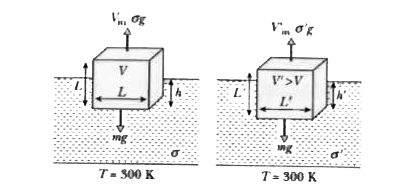
KEY IDEA
As the temperature rises, the block expands and the density of the liquid decreases, so it like we are putting a bigger block of same weight in a lighter liquid . So , to apply the same buoyant force , a larger fraction of the volume should sink into the liquid .

Calculations : If side of cube, density of liquid (mercury) and length of the floating cube inside the liquid are L.
`sigma , h`, and L., `sigma. , h. ` at 300 K and 350 K , respectively , then by principle of floatation
`m =V_("in") sigma =V_("in")^(.) sigma^(.) ` (with `m = V_(rho) = rhoL^3`)
This is , as `V_("in") = hA = hL ^(2)`,
`h L^2sigma = h^(.) (L.) sigma^(.)`
or `[(h.)/h]=[L/L^(.)]^2xx[sigma/sigma^(.)]`
Now as L. `= L (1+ alpha_2DeltaT) and sigma^(.) = sigma (1+ gamma_L DeltaT)` , therefore ,
`[(h.)/h]=((1+gamma_LDeltaT))/((1+alpha_sDeltaT))=((1+gammaDeltaT))/((1+2alpha_sDeltaT))=1+(gamma_L-2alpha_s)DeltaT`
So, `Deltah, =(h.-h)=h(gamma_L-2alpha_s)xxDeltaT`
Also, from the equation `m=V_("in")sigma , ` we have
`rhoL^(3) = hL^(2) sigma `
That is , `h=[rho/sigma]L=[(2.7)/(13.6)]xx20=3.970cm`
So, `Deltah = 3.970 (1.8xx10^(-4)-2xx23xx10^(-6))(350-300)`
`= 2.66 xx10^(-2)cm`
As expected the block sinks deeper.
Promotional Banner

Topper's Solved these Questions

  • TEMPERATURE, ZEROTH LAW OF THERMODYNAMICS AND THERMAL EXPANSION

    RESNICK AND HALLIDAY|Exercise CHECKPOINT|8 Videos
  • TEMPERATURE, ZEROTH LAW OF THERMODYNAMICS AND THERMAL EXPANSION

    RESNICK AND HALLIDAY|Exercise PROBLEMS|24 Videos
  • RIGID BODY DYNAMICS-II

    RESNICK AND HALLIDAY|Exercise PRACTICE QUESTIONS (Integer Type)|2 Videos
  • THE FIRST LAW OF THERMODYNAMICS

    RESNICK AND HALLIDAY|Exercise PRACTICE QUESTIONS ( INTEGER TYPE )|3 Videos

Similar Questions

Explore conceptually related problems

An iron rod of length 50cm is joined at an end to an aluminium rod of length 100cm . All measurements refer to 20^(@)C . Find the length of the composite system at 100^(@)C and its average coefficient of linear expansion. The coefficient of linear expansion of iron and aluminium are 12xx10^(-6)//^(@)C and 24xx10^(-6)//^(@)C respectively.

Find the ratio of the lengths of an iron rod and an aluminium rod for which the difference in the lengths in independent of temperature. Coefficients of linear expansion of iron and aluminium are 12 xx10^(-6) 0^C^(-1) and 23 xx 10^(-6) 0^C(-1) respectively.

What should be the sum of lengths of an aluminium and steel rod at 0^(@)C is, so that all the temperature their difference in length is 0.25m . (Take coefficient of linear expansion for aluminium and steel at 0^(@)C as 22 xx 10^(-6)//.^(@)C and 11 xx 10^(-5)//.^(@)C respectively.)

A glass flask of volume one litre at 0^(@)C is filled level full of mercury at this temperature. The flask and mercury are now heating to 100^(@)C . How much mercury will spill out if coefficient of volume expansion of mercury is 1.2xx10^(-4)//^(@)C and linear expansion of glass is 1.0xx10^(-4)//^(@)C respectively ?

A glass flask of volume one litre at 0^(@)C is filled, level full of mercury at this temperature. The flask and mercury are now heated to 100^(@)C . How much mercury will spill out if coefficient of volume expansion of mercury is 1.82 xx 10^(-4)//^(@)C and linear expansion of glass is 0.1 xx 10^(-4)//^(@)C respectively?

An iron rod of length 50 cm is joined at an end to an aluminum rod of length 100 cm. All measurements refer to 20^(@)C . The coefficients of linear expansion of iron and aluminum are 12xx10^(-6)//^(@)C and 24xx10^(-6)//^(@)C , respectively. The average coefficient of expansion of composite system is :

A glass vessel of volume 100 cm^(3) is filled with mercury and is heated from 25^(@)C to 75^(@)C . What volume of mercury will overflow? Coefficient of linear expansion of glass = 1.8 xx 10^(-6)//'^(@)C and coefficeient of volume expansion of mercury is 1.8 xx 10^(-4)//'^(@)C .

A barometer having a brass scale reads 77.24 cm at a temperature of 20^(@)C . The scale is graduated to be accurate at 0^(@)C . What would be the readint at 0^(@)C ? Coefficient of cubical expansion of mercury =18xx10^(-5).^(@)C^(-1) and linear expansion of brass -19xx10^(-6).^(@)C^(-1)

Coefficient of volume expansion of mercury is 0.18xx10^(-3)//.^(@)C . If the density of mercury at 0^(@)C is 13.6g/cc, then its density at 200^(@)C is

