Home
Class 12
PHYSICS
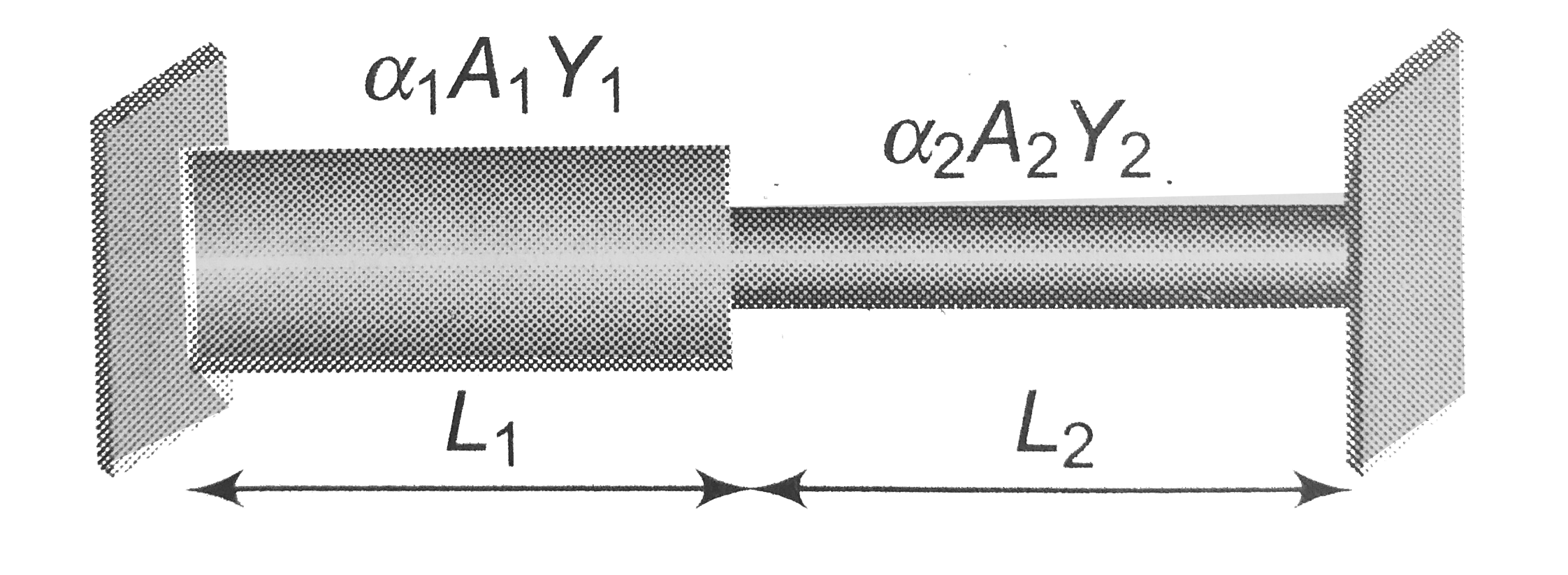
Two rods are joined between fixed suppor...

Two rods are joined between fixed supports as shown in the figure. Condition for no change in the length of individual rods with the increase of temperature will be
`"(" alpha_(1), alpha_(2)=` linear expansion coefficient
`A_(1), A_(2)=` Area of rods
`Y_(1), Y_(2)=` Young modulus `")"`

A

`A_1 /A_2 = (alpha_1y_1)/(alpha_2y_2)`

B

`A_1 /A_2 = (L_1alpha_1y_1)/(L_2alpha_2y_2)`

C

`A_1 /A_2 = (L_2alpha_1y_1)/(L_1alpha_2y_2)`

D

`A_1 /A_2 = (alpha_2y_2)/(alpha_1y_1)`

Text Solution

Verified by Experts

The correct Answer is:

D
Promotional Banner

Topper's Solved these Questions

  • TEMPERATURE, ZEROTH LAW OF THERMODYNAMICS AND THERMAL EXPANSION

    RESNICK AND HALLIDAY|Exercise PRACTICE QUETIONS (More than One Correct Choice Type )|7 Videos
  • TEMPERATURE, ZEROTH LAW OF THERMODYNAMICS AND THERMAL EXPANSION

    RESNICK AND HALLIDAY|Exercise PRACTICE QUETIONS (Matrix- Match )|3 Videos
  • TEMPERATURE, ZEROTH LAW OF THERMODYNAMICS AND THERMAL EXPANSION

    RESNICK AND HALLIDAY|Exercise PROBLEMS|24 Videos
  • RIGID BODY DYNAMICS-II

    RESNICK AND HALLIDAY|Exercise PRACTICE QUESTIONS (Integer Type)|2 Videos
  • THE FIRST LAW OF THERMODYNAMICS

    RESNICK AND HALLIDAY|Exercise PRACTICE QUESTIONS ( INTEGER TYPE )|3 Videos

Similar Questions

Explore conceptually related problems

The variation of lengths of two moles rods A and B with change in temperature is shown in figure . The ratio of (alpha_(a))/(alpha_(B)) is :-

Two rods AB and BC of equal cross-sectional area are joined together and clamped between two fixed supports as shown in the figure. For the rod AB and road BC lengths are l_(1) and l_(2) coefficient of linear expansion are alpha_(1) and alpha_(2) , young's modulus are Y_(1) and Y_(2) , densities are rho_(1) and rho_(2) respectively. Now the temperature of the compound rod is increased by theta . Assume of that there is no significant change in the lengths of rod due to heating. then the time taken by transverse wave pulse to travel from end A to other end C of the compound rod is directly proportional to

Two metal rods are fixed end to end between two rigid supports as shown in figure. Each rod is of length l and area of cross-section is A . When the systeam is heated up,datermine the condition when the juncation between rods does not shift ? ( Y_(1) and Y_(2) are Young's modulus of materials of rods, alpha_(1) and alpha_(2) are coefficients of linear expansion)

Two metal rods are fixed end to end between two rigid supports, as shown in figure. Each rod is of length 'l' and area of cross-section is A. When the system is heated up, determine the conditioin whenthe juction between rods does not shift. [Given, Y_(1) and Y_(2) are Young's modulus of materials of the rods, alpha_(1) and alpha_(2) are coefficient at linear expansion.

Two rods of different materials having coefficient of thermal expansion alpha_(1), alpha_(2) and young's modulii Y_(1) ,Y_(2) respectively are fixed between two rigid massive walls. The rods are heated such that they undergo the same increase in temperature. There is no bending of rods. If alpha_(1) :alpha_(2)=2 : 3 , the thermal stresses developed in the two rods are equal provided Y_(1) : Y_(2) is equal to

Two rods of equal cross sections, one of copper and the other of steel, are joined to form a composite rod of length 2.0 m at 20^@C , the length of the copper rod is 0.5 m. When the temperature is raised to 120^@C , the length of composite rod increases to 2.002m. If the composite rod is fixed between two rigid walls and thus not allowed to expand, it is found that the lengths of the component rods also do not change with increase in temperature. Calculate Young's moulus of steel. (The coefficient of linear expansion of copper, alpha_c=1.6xx10^(-5@)C and Young's modulus of copper is 1.3xx10^(13)N//m^(2) ).

The coefficient of linear expansion of a rod is alpha and its length is L. The increase in temperature required to increase its legnth by 1% is

RESNICK AND HALLIDAY-TEMPERATURE, ZEROTH LAW OF THERMODYNAMICS AND THERMAL EXPANSION -PRACTICE QUESTIONS (Single Correct Choice Type)
  1. A copper plate has a length of 0.1 m and a width of 0.12 m at 25^@C . ...

    Text Solution

    |

  2. It is more difficult to measure the coefficient of volume expansion o...

    Text Solution

    |

  3. A steel string guitar is strung so that there is negligible tension in...

    Text Solution

    |

  4. The strips of iron and zinc are riveted together to from a bimetallic...

    Text Solution

    |

  5. The coefficient of linear expansion of a certain of a certain solid is...

    Text Solution

    |

  6. The given figure shows a brass disk tightly filled into a steel tube. ...

    Text Solution

    |

  7. A tanker ship is filled with 2.25 xx10^(5) m^3 of gasoline at a refin...

    Text Solution

    |

  8. The figure shows a rectangular brass plate at 0^@C . in which there i...

    Text Solution

    |

  9. The coefficient of volume expansion for gold is 4.20xx10^(-5)//""^@C ....

    Text Solution

    |

  10. Dermatologists often remove small precancerous skin lesions by freezin...

    Text Solution

    |

  11. An aluminium baseball bat has a length of 0.86 m at a temperature of 1...

    Text Solution

    |

  12. When the temperature of a coin is raised by 75^@C , the coin's diamete...

    Text Solution

    |

  13. The given figure shows that,two thin strips of metal are bolted togeth...

    Text Solution

    |

  14. At a temperature of 0^@C , the mass and volume of a fluid are 825 kg a...

    Text Solution

    |

  15. A steel rod of length L0 . has a cross sectional area A. The force re...

    Text Solution

    |

  16. A piece of metal floats on mercury. The coefficients of volume expansi...

    Text Solution

    |

  17. Three rods of equal of length are joined to from an equilateral triang...

    Text Solution

    |

  18. An iron rod of length 50 cm is joined at an end to an aluminum rod of ...

    Text Solution

    |

  19. Two rods are joined between fixed supports as shown in the figure. Con...

    Text Solution

    |

  20. An iron ball (coefficient of linear expansion=1.2xx(10^(-5)//^(@)C) ha...

    Text Solution

    |
