

Home
Class 12
PHYSICS
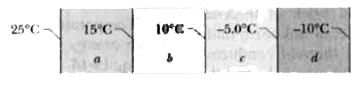
The figure shows the face and interface ...

The figure shows the face and interface temperatures of a composite slab consisting of four materials, of identical thickness, through which the heat transfer is steady. Rank the materials according to their thermal conductivities, greatest first.

Promotional Banner

Topper's Solved these Questions

  • HEAT-MEASUREMENT AND TRANSFER

    RESNICK AND HALLIDAY|Exercise PROBLEMS|35 Videos
  • HEAT-MEASUREMENT AND TRANSFER

    RESNICK AND HALLIDAY|Exercise PRACTICE QUESTIONS|60 Videos
  • HEAT-MEASUREMENT AND TRANSFER

    RESNICK AND HALLIDAY|Exercise CHECKPOINT 1|1 Videos
  • GRAVITATION

    RESNICK AND HALLIDAY|Exercise PRACTICE QUESTIONS (INTEGER TYPE)|4 Videos
  • HYDROGEN ATOM

    RESNICK AND HALLIDAY|Exercise PRACTICE QUESTIONS(Integer Type)|6 Videos

Similar Questions

Explore conceptually related problems

The figure shows the face and interface temperature of a composite slab containing of four layers of two materials having identical thickness. Under steady state condition, find the value of temperature theta .

The figure shows the face and interface temperature of a composite slab containing of four layers of three materials having indentical thickness. Under steady state condition, find the value of temperture theta .

The diagram shows four slabs of different materials with equal thickness, placed side by side. Heat flows from left to right and the steady-state temperatures of the interfaces are given. Rank the materials according to their thermal conductivities, smallest to largest.

Consider a compound slab consisting of two different material having equal thickness and thermal conductivities K and 2K respectively. The equivalent thermal conductivity of the slab is

In the following figure gives the stopping voltage V versus the wavelength lambda of light for three different materials. Rank the materials according to their work function, greatest first.

Materials A, B and C are solids that are at their melting temperatures. Material A requires 200 J to melt 4 kg, material B requires 300 J to melt 5 kg, and material C requires 300 J to melt 6 kg. Rank the materials according to their heats of fusion, greatest first.

A slab consists of two layers of different materials of the same thickness and having thermal conductivities K_(1) and K_(2) . The equivalent thermal conductivity of the slab is

The figure shows a book-like object (one side is longer than the other) and four choices of rotation axes, all perpendicular to the face of the object. Rank the choices according to the rotational inertia of the object about the axis, greatest first.