Home
Class 12
PHYSICS
Two bars, A and B, each of length 2.0 m ...

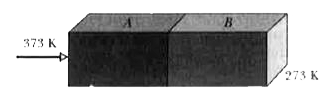
Two bars, A and B, each of length 2.0 m and cross-sectional area `10m^(2)`, are placed and to end as shown in the figure.
The thermal conductivities of the bars are `k_(A) = 339 (J //s. m.K)` and `k_(B) = 837 J//(s.m.K)`, respectively. The left end of bar A is maintained at 373 K while the right end of B is maintained at 273 K

Wha tis the temperature at the interface between A and B?

A

332K

B

302 K

C

323K

D

313K

Text Solution

Verified by Experts

The correct Answer is:

B
Promotional Banner

Topper's Solved these Questions

  • HEAT-MEASUREMENT AND TRANSFER

    RESNICK AND HALLIDAY|Exercise PRACTICE QUESTIONS( INTEGER TYPE)|5 Videos
  • HEAT-MEASUREMENT AND TRANSFER

    RESNICK AND HALLIDAY|Exercise PRACTICE QUESTIONS(MORE THAN ONE CORRECT CHOICE TYPE )|8 Videos
  • GRAVITATION

    RESNICK AND HALLIDAY|Exercise PRACTICE QUESTIONS (INTEGER TYPE)|4 Videos
  • HYDROGEN ATOM

    RESNICK AND HALLIDAY|Exercise PRACTICE QUESTIONS(Integer Type)|6 Videos

Similar Questions

Explore conceptually related problems

Two bars, A and B, each of length 2.0 m and cross-sectional area 10m^(2) , are placed and to end as shown in the figure. The thermal conductivities of the bars are k_(A) = 339 ( J //s. m.K) and k_(B) = 837 J//(s.m.K) , respectively. The left end of bar A is maintained at 373 K while the right end of B is maintained at 273 K Which one of the following statements is true concerning the above situation ?

Two bar of identical dimensions are kept as shown in figure. If K_1 and K_2 are their coefficients of thermal conductivities, then equivalent K

Two bars of thermal conductivities K and 3K and lengths 1 cm and 2 cm respectively have equal cross-sectional area, they are joined lengths wise as shown in the figure. If the temperature at the ends of this composite br is 0^(@)C and K^(2)//l respectively (see figure), then the temperature phi of the interface is

Two bars of equal length and the same cross-sectional area but of different thermal conductivities, k_(1) and k_(2) , are joined end to end as shown in figure-4.36. One end of the composite bar is maintained at temperature T_(h) whereas the opposite end is held at T_(c) . If there are no heat losses from the sides of the bars, the temperature T_(j) of the junction is given by :

Two rods of length l and 2l thermal conductivities 2K and K are connected end to end. If cross sectional areas of two rods are eual, then equivalent thermal conductivity of the system is .

A composite rod made of three rods of equal length and cross-section as shown in fig. The thermal conductivites of the materials of the rods are K//2 , 5K and K respectively. The end A and end B are at constant tempertures. All heat entering the face A goes out of the end B there being no loss of heat from the sides of the bar. The effective thermal conductivity of the bar is

Two bars of same length and same cross-sectional area but of different thermal conductivites K_(1) and K_(2) are joined end to end as shown in the figure. One end of the compound bar it is at temperature T_(1) and the opposite end at temperature T_(2) (where T_(1) gt T_(2) ). The temperature of the junction is

Three metal rod A, B and C of same length and cross-section are placed end to end and a temperature difference is maintained between the free ends of A and C. If the thermal conductivity of B(K_B) is twice that of C(K_C) and half that of A(K_A) , then the effective thermal conductivity of the system will be
