Home
Class 12
PHYSICS
The cycle of a petrol engine can be appr...

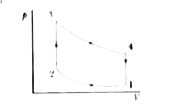
The cycle of a petrol engine can be approximated by an Otto cycle (Fig. 21-20a). 1`to` 2 and 3 `to ` 4 are adiabatic compression and expansion, respectively, 2 `to `3 and `4 to `1 are constant-volume processes. Treat the working medium as an ideal gas with constant `gamma =C_p //C_v `, Compute the efficiency of this cycle for g = 1.4 and compression ratio, `r=V_i //V_f =10`

Text Solution

Verified by Experts

We can see from the p-V graph (Fig. 21-20b) that it is a cyclic process as the working medium returns to its initial state. We can see from the p-V graph that in the process 3`to ` 4, the engine is doing positive work on the surroundings and in 1 `to ` 2, it is doing negative work as the gas is compressed. In other two processes, 2`to ` 3 and 4 `to ` 1, work done is zero, as `Delta `V =0.
The efficiency of a cyclic process is given by `epsi = W//Q_1`, where W is the work done by the cycle and `Q_1` is the amount of heat absorbed by the working medium in this case, gas). Because the working medium returns to its initial state `W =Q_1 -Q_2`, where` Q_2` is the amount of heat transferred from the gas. Therefore,
`epsi =(Q_1 -Q_2 )/(Q_1) =1 -(Q_2)/(Q_1)`
As the processes 1`to ` 2 and 3 `to `4 are adiabatic, heat transfer can take place only during the 2`to` 3 and 1 `to `4 stages.
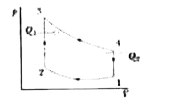
Calculations: Let us calculate `Q_1 ` and `Q_2` Since both processes are occurring at a constant volume (Fig. 21-20b), we may write
` Q_1 = int _(2)^3 dQ = C_v int _(2)^(3) dT =C_v (T_3 -T_2)`
` Q_2 = C_V int_(4)^(3) dT =- C_v (T_1 -T_4) =C_v (T_4 -T_1)`
and `(Q_2)/(Q_1) =(T_4-T_1 )/(T_3-T_2)`
We know that for an adiabatic process
` pV^( gamma)` = constant or `TV^(r-1)`= constant
So `_1 V_(i )^( gamma -1) =T_(2) V_(f)^(gamma -1)`
` T_3 V_f^(r-1)-T_4 V_(f)^( gamma -1)`
Dividing Eq. 21-49 by Eq. 21-48, we get
`(T_4 )/( T_1) =(T_3)/(T_2)`
Subtracting 1 from both sides and solving, gives
`(T_4-T_1)/(T_1) =(T_3 -T_2)/(T_2)`
Rearranging above relation and using Eq. 21-48 gives
` (T_3 -T_1 )/(T_3-T_2) =(T_1)/(T_2) =((V_f))/(V_(i ))^( gamma -1)`
and therefore, the efficiency is
` epsi =1-((1)/(r))^( gamma -1)`
For `gamma` = 1.4 and r= 10, the efficiency is
`epsi =1- ( 0.10 )^(0.4 ) = 0.6 = 60 % `
The maximum possible efficiency, if the cycle would have been Carnot cycle, would be,` 1 - T_2//T_4`, as `T_2` and `T_4` are the lowest and highest temperatures in the cycle. It can be seen that efficiency is less than the Carnot efficiency as the value of `T_1 //T_2`, would be more than `Т_2 //T_4 `
Promotional Banner

Topper's Solved these Questions

  • THE FIRST LAW OF THERMODYNAMICS

    RESNICK AND HALLIDAY|Exercise CHECK POINT|8 Videos
  • THE FIRST LAW OF THERMODYNAMICS

    RESNICK AND HALLIDAY|Exercise PROBLEMS|41 Videos
  • TEMPERATURE, ZEROTH LAW OF THERMODYNAMICS AND THERMAL EXPANSION

    RESNICK AND HALLIDAY|Exercise PRACTICE QUETIONS (Integer Type)|4 Videos
  • THE KINETIC THEORY OF GASES

    RESNICK AND HALLIDAY|Exercise PRACTICE QUESTIONS|72 Videos

Similar Questions

Explore conceptually related problems

If C_p and C_v are molar heats at constant pressure and constant volume respectively and R is gas constant for 1 mole, then the correct relation is

An engine operates by taking n moles of an ideal gas through the cycle ABCDA shown in figure. The thermal efficiency of the engine is -(Take C_(v) = 15.R, where R is gas constant)

A gas undergoes cyclic process 1-2-3-4-1 in which 1-2 and 3-4 are adiabatic process 2-3 and 4-1 are isobaric process. If (P_(2))/(P_(1))=k then what will be the efficiency of cycle in terms of k and gamma where gamma=C_(p)//C_(v) .

Initial pressure and volume of a gas are P and V respectively. First its volume is expanded to 4V by isothermal process and then again its volume makes to be V by adiabatic process then its final pressure is (gamma = 1.5) -

The efficiency of otto cycle for petrol engine is 50% and the adiabatic constant is 1.4. calculate the compression ratio.

How much heat energy is required to do 10 kWh of work by a petrol engine, whose adiabatic compression ratio is 10 ? Given gamma=1.4

The molar specific heat of an ideal gas at constant pressure and constant volume is C_(p) and C_(v) respectively. If R is the universal gas constant and the ratio of C_(p) to C_(v) is gamma , then C_(v) .

During an adiabatic process of an ideal gas, if P is proportional to (1)/(V^(1.5) , then the ratio of specific heat capacities at constant pressure to that at constant volume for the gas is

For a gas if gamma=1.4 , then atomically, C_p and C_v of the gas are respectively

