Home
Class 12
PHYSICS
shows, in cross section, a plastic, sphe...

shows, in cross section, a plastic, spherical shell with uniform charge `Q =-16e` and radius `R = 10cm.` A particle with charge `q = + 5e` is at the center. What is the electric field (magnitude and direction) at (a) point `P _(1)` at radial distance `r _(1) = 6.00cm` and (b) point `P _(2)` at radial distance `r _(2) =12.0cm` ?

Text Solution

Verified by Experts
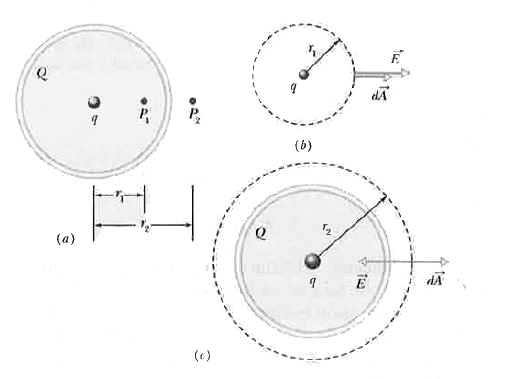
To find the field at point `P _(1),` we consturuct a Gaussian sphere with `P _(1)` on its surface and thus with a radius of `r _(1).` Because the charge enclosed by the Gaussian sphere is positive, the electric flux through the surface must be positive and thus outward. So, the electric field `vecE` pierces the surface outward and, because of the spherical symmetery, must be radially outward, as drawn in Theat figure does not include the plastic shell because the shell is not enclosed by the Gaussian sphere. Consider a patch element on the sphere at `P _(1).` Its area vector `dvecA` is radially outward (it must always be outward from a Gaussian surface). Thus the angle `theta` between

(a) A charged plastic spherical shell encloses a charged particle. (b) To find the electric field at `P _(1),` arrange for the point to be on a Gaussian aphere. The electric field pierces outward. The area vector for the patch element is out ward. (c ) `P _(2)` is on a Gaussian sphere, `vecE` is inward, and `dvecA` is still outward.
Know that the surface area of a sphere is `4pir ^(2).` Substituting these results, for Gauss. law gives us
`epsi _(0) E 4 pi r ^(2) = q _(enc).`
The only charge enclosed by the Gaussian surface through `P _(1)` is that of the particle. Solving for E and substituting `q _(enc) = 5e and r = r _(1) = 6.00 xx 10 ^(-2)m,` we find that the magnitude of the electric field at `P _(1)` is
`=E= (q _(cnc))/(4 pi epsi _(0) r ^(2))`
`= ( 5 (1. 60 xx 10 ^(-19)C))/( 4pi ( 8.85 xx 10 ^(-12) C ^(2) //N.m^(2))(0.00600m)^(2))`
`=2.00 xx 10 ^(-6) N//C.`
Promotional Banner

Topper's Solved these Questions

  • GAUSS' LAW

    RESNICK AND HALLIDAY|Exercise CHECKPOINT|7 Videos
  • GAUSS' LAW

    RESNICK AND HALLIDAY|Exercise PROBLEMS|42 Videos
  • FORCE AND MOTION-II

    RESNICK AND HALLIDAY|Exercise PRACTICE QUESTIONS (Integer Type)|1 Videos
  • GEOMETRICAL OPTICS : REFLECTION

    RESNICK AND HALLIDAY|Exercise PRACTICE QUESTIONS (Integer Type)|3 Videos

Similar Questions

Explore conceptually related problems

A spherical shell of radius R_(1) with uniform charge q is expanded to a radius R_(2) . Find the work performed by the electric forces in this process.

A conducting shell of radius R carries charge -Q . A point charge +Q is placed at the centre. The electric field E varies with distance r (from the centre of the shell) as

A spherical shell of radius R_(1) with a uniform charge q has a point charge q_0 at its center. Find the work performed by the electric forces during the shell expansion from radius R_(1) to radius R_(2) .

The electric field intensity at a point located at distance r(r lt R) from the center of a spherical conductor (radius R) charged Q will be-

A spherical shell of radius R has a charge +q units. The electric field due to the shell at a point

A point charge q is placed inside a conducting spherical shell of inner radius 2 R and outer radius 3 R at a distance of R from the center of the shell. Find the electric potential at the center of the shell.

A point charge q produces an electric field of magnitude 2.0 NC^(-1) at a point distant 50 cm from it. From the value of q.

A point charge q produces an electric field of magnitude 2NC^(-1) at a point distance 0.25 m from it. What is the value of charge ?

A thin spherical conducting shell of radius R has a charge q. Another charge Q is placed at the centre of the shell. The electrostatic potential at a point P a distance R/2 from the centre of the shell is

