Home
Class 12
PHYSICS
Figure shows a cross-section ofa spheric...

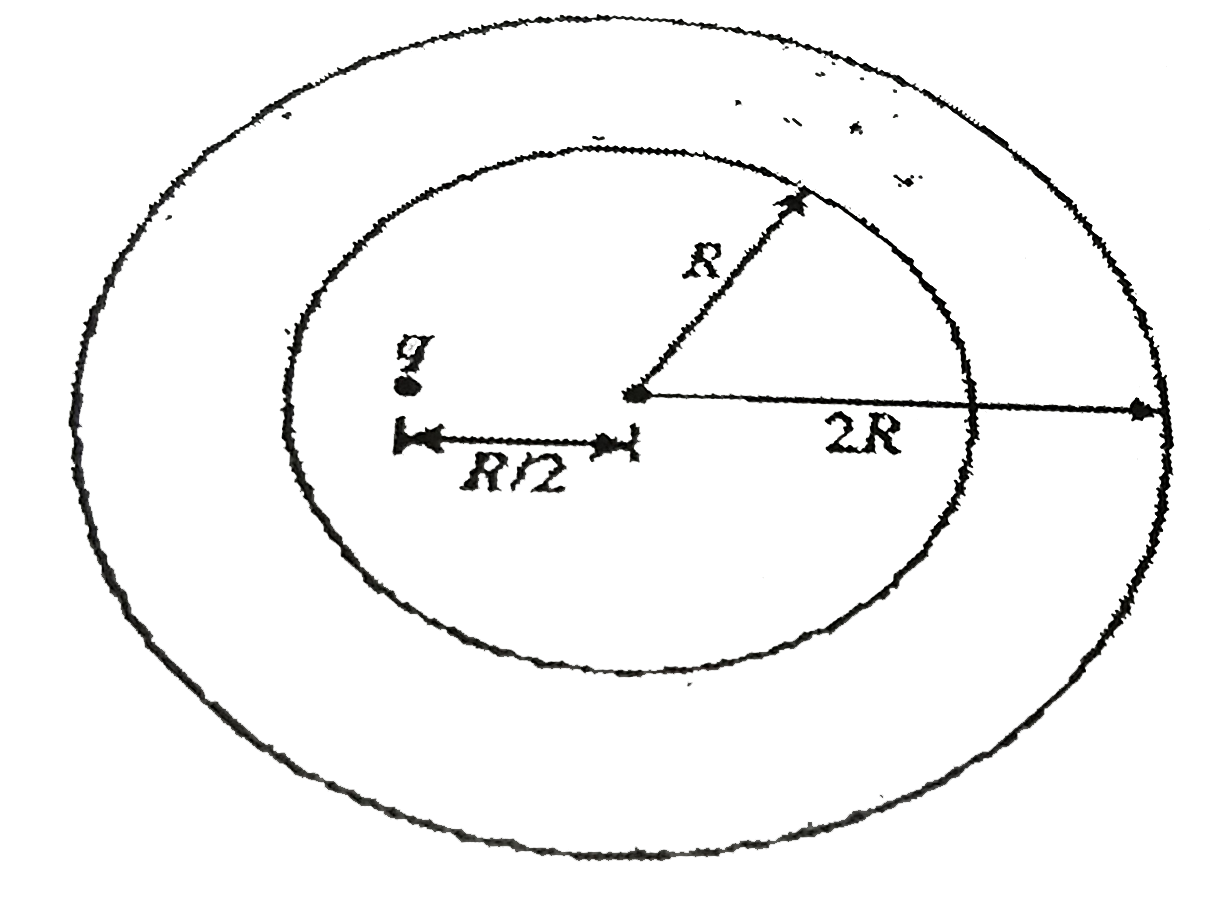
Figure shows a cross-section ofa spherical metal shell of inner radius R and out radius ZR. A point charge q is ·located at a distanceR/2 from the centre of the shell. If the shell is electrically neutral, then which of the following statements is/are correct :

Text Solution

Verified by Experts
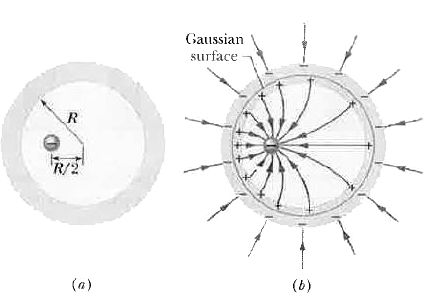
With a particle of charge `-5.0 muC` within the shell, a charge of `+5.0 muC` must lie on the inner wall of the shell in order that the net enclosed charge be zero.
If the particle were centered, this positive charge would be uniformly distributed along the inner wall. However, since the particle is off-center, the distribution of positive charge is skewed, as suggested by Fig. 23-25b, because the positive charge tends to collect on the section of the inner wall nearest the (negative) particle.
Because the shell is electrically neutral, its inner wall can have a charge of +`5.0 muC` only if electrons, with a total charge of `-5.0muC` uC, leave the inner wall and move to the outer wall. There they spread out uniformly, as is also suggested by Fig. 23-18b.
This distribution of negative charge is uniform because the shell is spherical and because the skewed distribution of positive charge on the inner wall cannot produce an electric field in the shell to affect the distribution of charge on the outer wall. Furthermore, these negative charges repel one another.

The field lines inside and outside the shell are shown approximately in Fig. 23-25b. All the field lines intersect the shell and the particle perpendicularly. Inside the shell the pattern of field lines is skewed because of the skew of the positive charge distribution. Outside the shell the pattern is the same as if the particle were centered and the shell were missing. In fact, this would be true no matter where inside the shell the particle happened to be located
Promotional Banner

Topper's Solved these Questions

  • GAUSS' LAW

    RESNICK AND HALLIDAY|Exercise CHECKPOINT|7 Videos
  • GAUSS' LAW

    RESNICK AND HALLIDAY|Exercise PROBLEMS|42 Videos
  • FORCE AND MOTION-II

    RESNICK AND HALLIDAY|Exercise PRACTICE QUESTIONS (Integer Type)|1 Videos
  • GEOMETRICAL OPTICS : REFLECTION

    RESNICK AND HALLIDAY|Exercise PRACTICE QUESTIONS (Integer Type)|3 Videos

Similar Questions

Explore conceptually related problems

Figure shows a point charge +Q, located at a distance R/2 from the centre of a spherical metal shell. Draw the electric field lines for the given system.

A point charge Q is placed inside a conducting spherical shell of inner radius 3R and outer radius 5R at a distance R from the centre of the shell. The electric potential at the centre of the shell will be

A point charge q is placed inside a conducting spherical shell of inner radius 2 R and outer radius 3 R at a distance of R from the center of the shell. Find the electric potential at the center of the shell.

A charge +q is placed somewhere inside the cavity of a thick conducting spherical shell of inner radius R_(1) and outer radius R_(2) . A charge – Q is placed at a distance r gt R_(2) from the centre of the shell. Then the electric field in the hollow cavity-

A point charge q is placed inside a conducting spherical shell of inner radius 2R and outer radius 3R at a distance of R fro the centre of the shell. The electric potential at the centre of shell will (potential at infinity is zero).

Consider an initially neutral hollow conducting spherical shell with inner radius r and outer radius 2r. A point charge +Q is now placed inside the shell at a distance r/2 from the centre. The shell is then grounded by connecting the outer surface to the earth. P is an external point at a distance 2r from the point charge +Q on the line passing through the centre and the point charge +Q as shown in the figure. The magnitude of the force on a test charge +q placed at P will be

A point charge +q is placed at the centre of a conducting spherical shell of inner radius a and outer radius b. Find the charge appearing on the inner and outer surface of the shell.

A metallic spherical shell has an inner radius R_(1) and outer radius R_(2) . A charge is placed at the centre of the spherical cavity. The surface charge density on the inner surface is

A conducting spherical shell having inner radius a and outer radius b carries a net charge Q. If a point charge q is placed at the centre of this shell, then the surface charge density on the outer surface of the shell is given as:
