1. We work through the system sheet by sheet, Crom the first one encountered by the light to the last one.
2. .Tu find the intensity transmitted by any sheet, we apply either the one-half rule or the cosine-squared rule, depending, on whether the light reaching the sheet is unpolarized or already polarized.
3. The light thaL is tTansmitted by a polarizing sheet is always polarized parallel to the polariring direction of the sheet.
First sheet: The original light wave is represented in Fig. 32-lSb, using, the head-on,double-arrow representation of Fig. 32-10 b. Because the light is initially unpolarized, the intensity `I_(1)` of the light tnmsmitted by the first sheet is given by the one-half rule (Eq. 32-31):
`I_(1) =(1)/(2) I_(0)`
Because the polarizing direction of the first sheet is parallel to the y axis, the polarization of the light transmitted by it is also, as shown in the head-on view of Fig. 32-15c. Second sheet: Because the light r eaching the second sheet is polarized, the intensity `I_(2)` of the light transmitted by that sheet is given by the cosine-squared rule (Eq. 32-33). The angle `theta` in the rule is the angle between the polarization direction of the entering Light (parallel to the y axis) and the polarizing direction of the second sheet `(60^(@)` counterclockwise Crom the y axis), and so `theta` is `60^(@)` . (The larger angle between the two dfrections, namely `120^(@)` , can also be used.) We have
`I_(2) =I_(1) cos^(2) 60^(@)` .
The polarization of this transmitted light is parallel to the polarizing di reclion of the sheet transmitting it-that is `60^(@)` counterclockwise from they axis, as shown in the head-on view of Fig. 32-15 d.
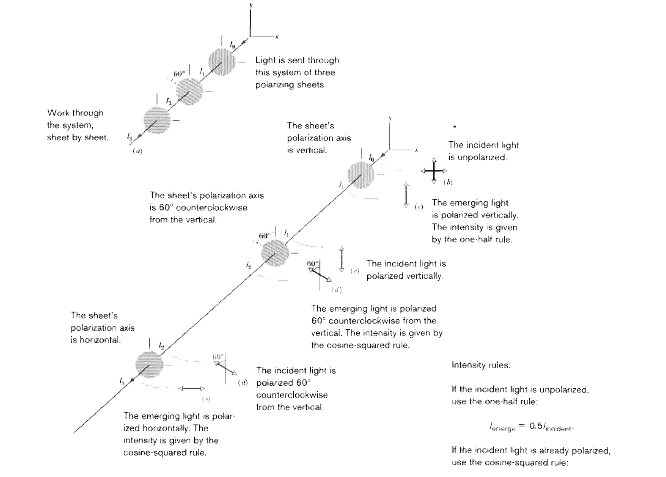
Figure (a) Initially unpolarized light or intensity `I_(0)` is sent into a system of three polarizing sheets. The intensities `I_(1) , I_(2)`and `I_(3)` of the light transmitted by tbe sheets are labeled. Shown also are the polarizations, from bead-on views, of (b) the initial light and the light lransmicted by (c) the first sheet, (d) the second sheet, and (e) the third sheet.
Third sheet: Because the Hght reaching the third sheet is polarized, the intensity `I_(3)` of the light transmitted by that sheet is given by the cosine-squared rule. The angle `theta` is now the angle between the polarization direction of the entering light (Fig. 32-15 d) and the polarizing direction of the third sheet (parallel to the x axis), and so `theta = 30°` . Thus
`I_(3) =I_(2) cos^(2) 30^(@)` .
This final transmitted light is polarized parallel to the x axis (Fig. 32-15e). We find its intensity by substituting first for `I_(2)` and then for `I_(1)` in the equation above:
`I_(3) =I_(2) cos^(2) 30^(@) = (I_(1) cos^(2) 60^(@)) cos^(2) 30^(@)`
`=((1)/(2)I_(0)) cos^(2) 60^(@) 30^(@) =0.094I_(0)` .
Thus `(I_(3))/(I_(0)) =0.094` . ( Answer )
That is to say, 9.4% of the initial intensity emerges from the three-sheet system. (If we now remove the second sheet, what fraction of the initial intensity emerges from the system?)


