

Home
Class 11
PHYSICS
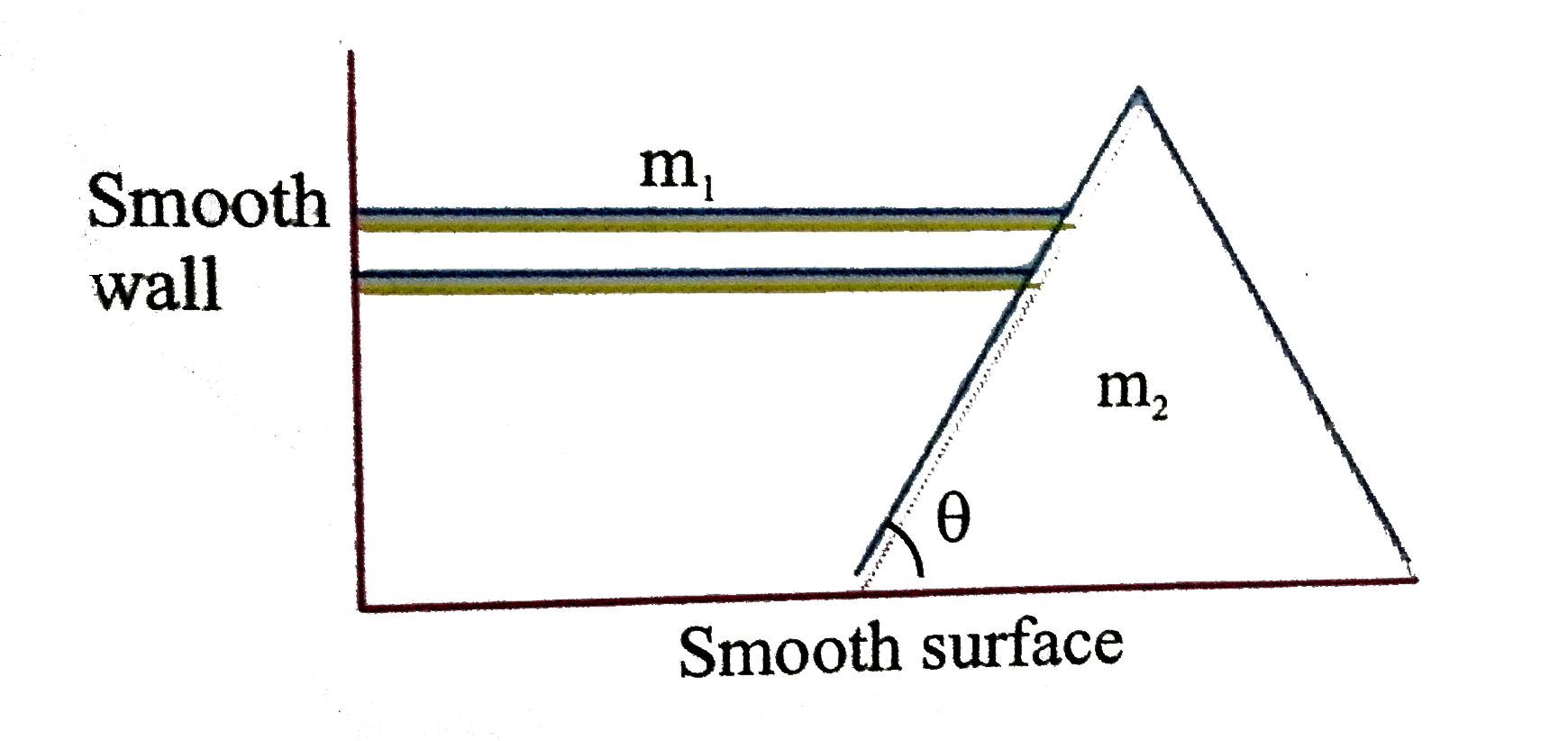
A horizontal bar of mass m(1) Prism of m...

A horizontal bar of mass `m_(1)` Prism of mass `m_(2)` can move as shown. There is no friction at any contact point. During the motion the length of the rod is always horizontal Now, magnitude valuse of
.

Promotional Banner

Similar Questions

Explore conceptually related problems

A man pushes a cylinder of mass m_1 with the help of a plank of mass m_2 as shown in figure. There in no slipping at any contact. The horizontal component of the force applied by the man is F. (a) the acceleration fo the plank and the center of mass of the cylinder, and (b) the magnitudes and direction of frictional force at contact points.

A man pushes a cylinder of mass m_1 with the help of a plank of mass m_2 as shown in figure. There in no slipping at any contact. The horizontal component of the force applied by the man is F. (a) the acceleration fo the plank and the center of mass of the cylinder, and (b) the magnitudes and direction of frictional force at contact points.

A horizontal force F acts on a wedge of mass m_1 as shown. A block of mass is placed on the front wall of my. Assuming all contact surfaces to be smooth and m_2 moves on a smooth horizontal surface.

A cube of mass m is placed on top of a wedge of mass 2m, as shown in figure. There is no friction between the cube and the wedge. The minimum co - efficient of friction between the wedge and the horizontal surface, so that the wedge does not move is

A cube of mass m is placed on top of a wedge of mass 2m, as shown in figure. There is no friction between the cube and the wedge. The minimum co - efficient of friction between the wedge and the horizontal surface, so that the wedge does not move is

The coefficient of friction between block A of mass m_(1)=5kg and block B of mass m_(2)=10 kg is mu_(2)=0.5 . There is no friction froce between block B and fixed horizontal surface. A force of 300N acts on block B in horizontal direction and a horizontal force of magnitude F acts on block A as shown , both towards right. Initially there is no relative motion between the blocks. The minimum value of F such that relative motion starts between A and B is :

The coefficient of friction between block A of mass m_(1)=5kg and block B of mass m_(2)=10 kg is mu_(2)=0.5 . There is no friction froce between block B and fixed horizontal surface. A force of 300N acts on block B in horizontal direction and a horizontal force of magnitude F acts on block A as shown , both towards right. Initially there is no relative motion between the blocks. The minimum value of F such that relative motion starts between A and B is :

A heavy mass m slides down a triangular prism of mass M . The prism lies on a horizontal surface and can move along it without friction . What will be the direction of motion of m if the inclination of the hypotenuse of the prism is alpha with the horizontal ?