

Home
Class 11
PHYSICS
A shell of mass m is moving horizontally...

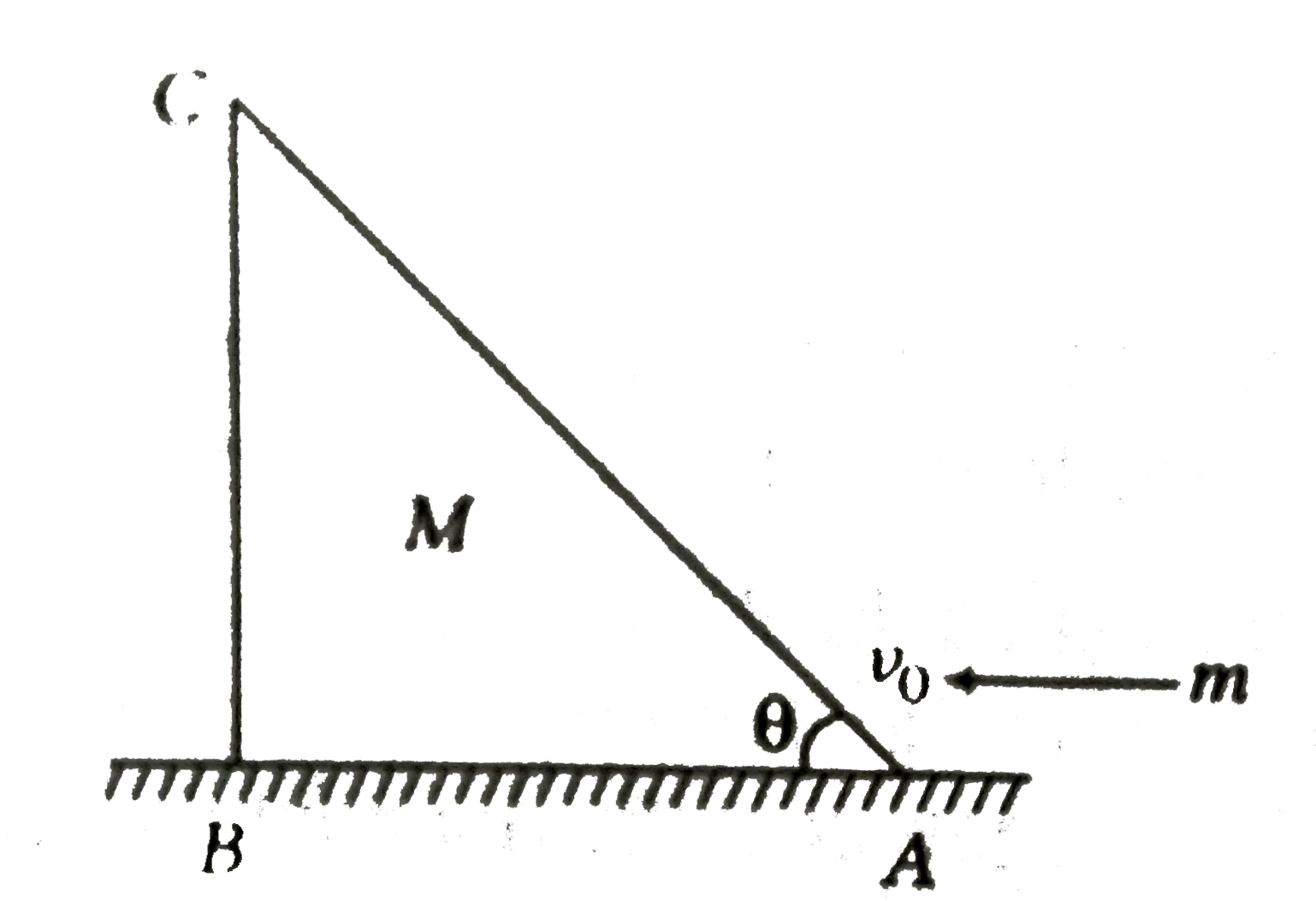
A shell of mass m is moving horizontally with velocity `v_(0)` and collides with the wedge of mass M just above points A, as shown in the figure. As a consequences, wedge starts to move towards left and the shell returns with a velocity in xy-plance. The principle of conservation of momentum can be applied for

Promotional Banner

Similar Questions

Explore conceptually related problems

A ball of mass m moving with velocity v , collide with the wall elastically as shown in the figure. After impact the change in angular momentum about P is : .

A ball of mass m moving with velocity v , collide with the wall elastically as shown in the figure. After impact the change in angular momentum about P is : .

A particle of mass m moving horizontal with v_(0) strikes a smooth wedge of mass M, as shown in figure. After collision, the ball starts moving up the inclined face of the wedge and rises to a height h. The final velocity of the wedge v_(2) is

A small ball of mass m is projected with a minimum horizontal velocity v_(0) on a smooth wedge of mass M so that it will reach the highest point of the wedge. Find the value of v_(0)

A particle of mass m moving horizontal with v_(0) strikes a smooth wedge of mass M, as shown in figure. After collision, the ball starts moving up the inclined face of the wedge and rises to a height h. The maximum height h attained by the particle is

A ball mass 2 kg moving horizontally with velocity 10 m/s hits a wedge of mass 5 kg placed on a horizontal surface as shown in the figure. Just after collision klvelocity of wedge is 3.2 m/s. There is no friction at any contact surface. Then (take sin 30^(@)=3//5 )

A ball mass 2 kg moving horizontally with velocity 10 m/s hits a wedge of mass 5 kg placed on a horizontal surface as shown in the figure. Just after collision klvelocity of wedge is 3.2 m/s. There is no friction at any contact surface. Then (take sin 30^(@)=3//5 )