

Home
Class 11
PHYSICS
Two radio frequency sources S(1) and S(2...

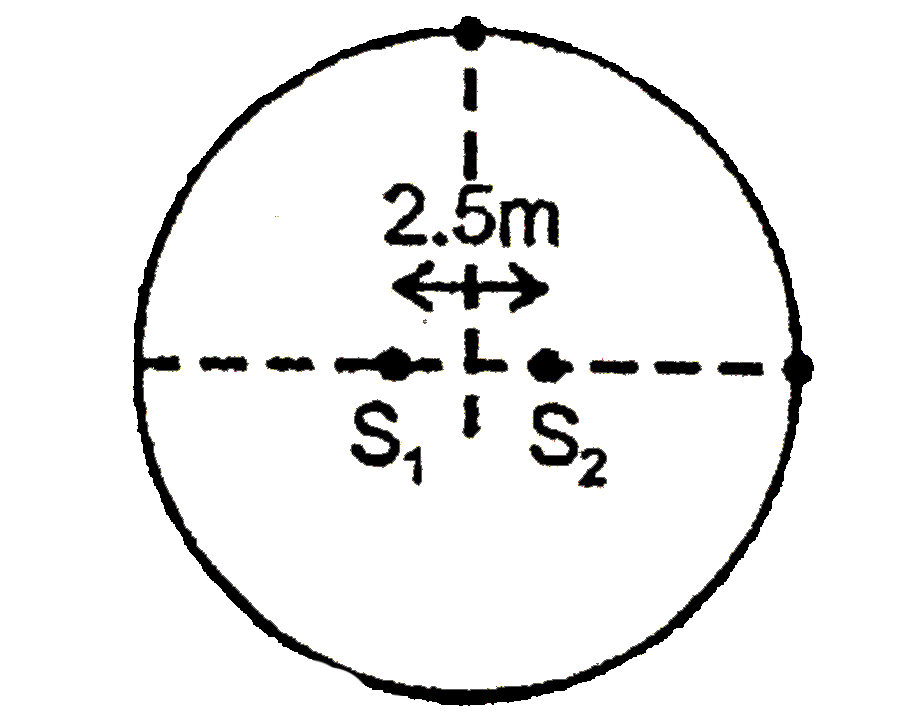
Two radio frequency sources `S_(1)` and `S_(2)`, separated by distance 2.5 m emitting in phase waves of wavelength 1m. A detector moves in a large circular path around the two sources in a plane containing them. The number of maxima that will be detected by it over the complete circular path. are

Promotional Banner

Similar Questions

Explore conceptually related problems

Two point sources separated by 2.0 m are radiating in phase with lambda = 0.50 m . A detector moves in a circular path around the two sources in a plane containing them. How many maxima are detected?

Two point sources separated by 2.0 m are radiating in phase with lambda = 0.50 m . A detector moves in a circular path around the two sources in a plane containing them. How many maxima are detected?

Two coherent sources separated by distance d are radiating in phase having wavelength lambda . A detector moves in a big circle around the two sources in the plane of the two sources. The angular position of n=4 interference maxima is given as

Two coherent sources separated by distance d are radiating in phase having wavelength lambda . A detector moves in a big circle around the two sources in the plane of the two sources. The angular position of n=4 interference maxima is given as

Two coherent radio point sources that are separated by 2.0 m are radiating in phase with a wavelength of 0.25m. If a detector moves in a large circle around their mid-point. At how many points will the detector show a maximum signal?

Two coherent radio point sources that are separated by 2.0 m are radiating in phase with a wavelength of 0.25m. If a detector moves in a large circle around their mid-point. At how many points will the detector show a maximum signal?

Two coherent radio-frequency point sources separated by 2.0 m are radiating in phase with lambda=0.50 m . A detector moves in a circuit of large radius around the two sources in a plane containing them as shown in figure. Find (a) the angular position of interference maxima for 0lethetale90^(@) and (b) number of maximum in the range (-pi/2)lethetalepi/2 and in one complete rotation.