

Home
Class 11
PHYSICS
Two identical particles are attached at ...

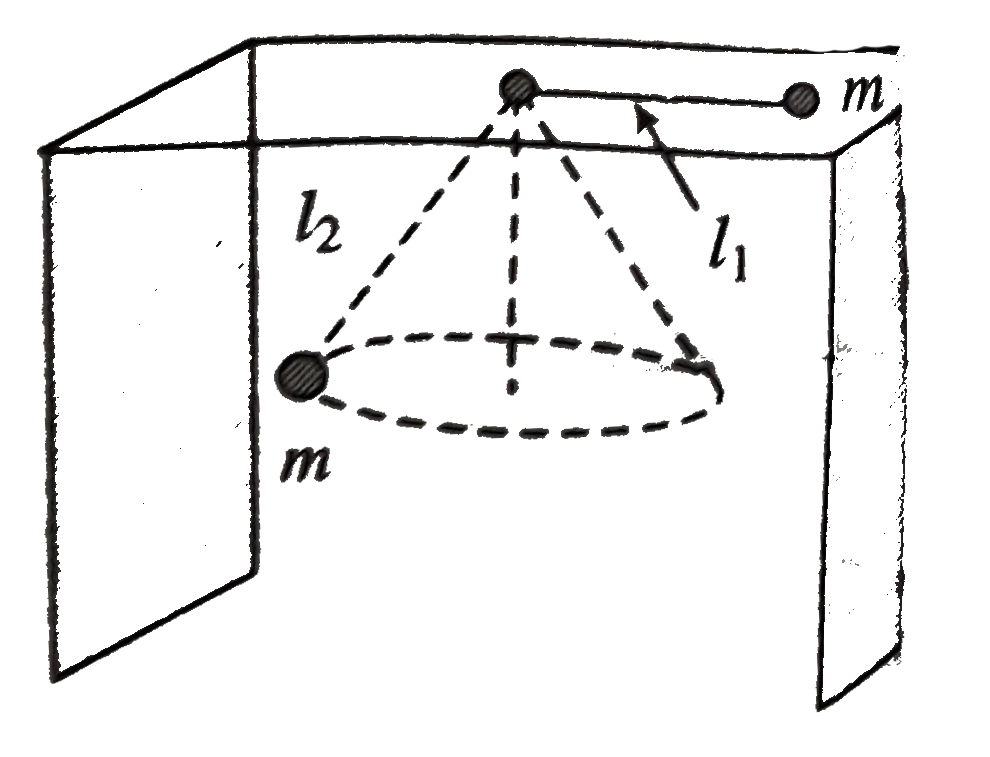
Two identical particles are attached at the end of a light string which passes through a hole at the center of a table One of the partical is made to move in a circle on a table with angular velocity `omega_(1)` and the ther is made a move is a horizontal `omega_(2)` if `l_(1)`and `l_(2)` are the length the table , than in order that particle under down the table neither moves down nor move up the ratio` l_(1)//l_(2)` is

Promotional Banner

Similar Questions

Explore conceptually related problems

Two particles, each of mass m are attached to the two ends of a light string of length l which passes through a hole at the centre of a table. One particle describes a circle on the table with angular velocity omega_(1) and the other describes a circle as a conical pendulum with angular velocity omega_(2) below the table as shown in figure -3.86. if l_(1) and l_(2) are the lengths of the portion of the string above and below the table then :

Two identical masses are attached by a light string that passes over a small pulley, as shown . The table and the pulley are frictionless. The hanging block is moving

Two identical masses are attached by a light string that passes over a small pulley, as shown . The table and the pulley are frictionless. The hanging block is moving

A particle of mass 'm' is attached to one end of a string of length 'l' while the other end is fixed to a point 'h' above the horizontal table, the particle is made to revolve in a circle on the table, so as to make P revolution per sec. The maximum value of P if the particle is to be contact with the table is

A particle of mass 'm' is attached to one end of a string of length 'l' while the other end is fixed to a point 'h' above the horizontal table, the particle is made to revolve in a circle on the table, so as to make P revolution per sec. The maximum value of P if the particle is to be contact with the table is

A particle of mass m is attached to one end of a string of length l while the other end is fixed to a point h above the horizontal table. The particle is made to revolve in a circle on the table so as to make p revolutions per second. The maximum value of p if the particle is to be in contact with the table will be :

A particle of mass m is attached to one end of a weightless and inextensible string of length L. The particle is on a smooth horizontal table. The string passes through a hole in the table and to its other and is attached a small particle of equal mass m. The system is set in motion with the first particle describing a circle on the table with constant angular velocity omega_(1) and the second particle moving in the horizontal circle as a conical pendulum with constant angular velocity omega_(2) Show that the length of the portions of the string on either side of the hole are in the ratio omega_(2)^(2): omega_(1)^(2)

A particle of mass m is attached to one end of string of length l while the other end is fixed to point h(h lt l) above a horizontal table. The particle is made to revolve in a circle on the table so as to make p revolutions per second. The maximum value of p, if the particle is to be in contact with the table, is : (l gt h)