

Home
Class 11
PHYSICS
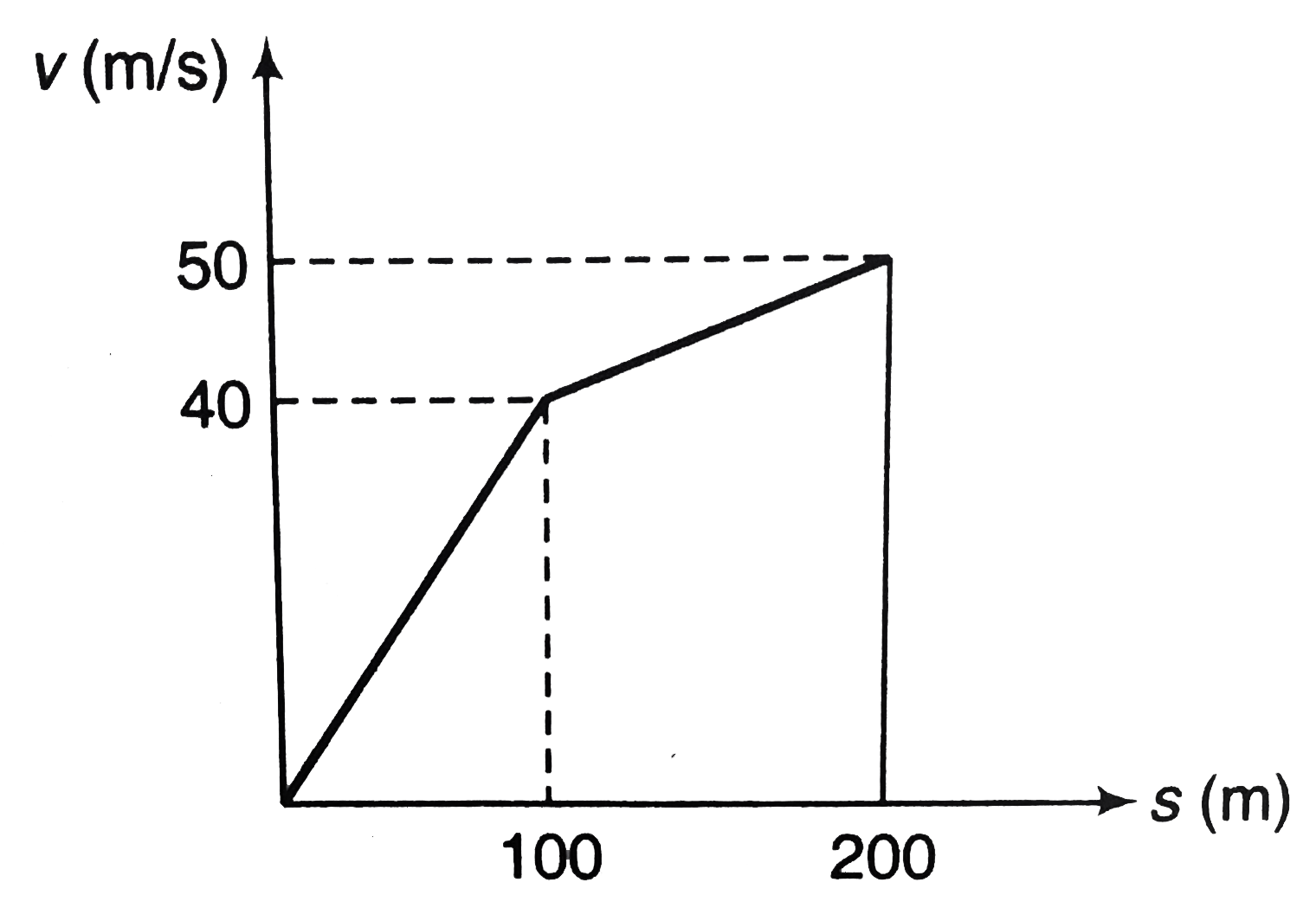
The v-s graph for an airplane travelling...

The v-s graph for an airplane travelling on a straight runway is shown. Determine the acceleration of the plane at `s = 50 m` and `s = 150 m`. Draw the a-s graph.

Promotional Banner

Similar Questions

Explore conceptually related problems

The velocity-displacement for a fer plane on a straight runway is shown in . Determine the speed and acceleration of the jet plane at s=150 m . .

The velocity –position graph of a particle moving along a straight line is shown. Then acceleration of the particle at s = 15 m is :

The velocity –position graph of a particle moving along a straight line is shown. Then acceleration of the particle at s = 15 m is :

The displacement-time graph for a particle moving in a straight line is as shown in the figure. Determine the velocity of the particle at t=1 s, 3 s and 6 s . Sketch the velocity-time graph.

The velocity-time graph of a particle moving along a straight line is shown is . The rate of acceleration and deceleration is constant and it is equal to 5 m s^(-2) . If the a average velocity during the motion is 20 m s^(-1) , Then . The value of t is.

The velocity-time graph of a particle moving along a straight line is shown is . The rate of acceleration and deceleration is constant and it is equal to 5 m s^(-2) . If the a average velocity during the motion is 20 m s^(-1) , Then . The value of t is.

The velocity-time graph of a particle moving along a straight line is shown is Fing. The rate of acceleration and deceleration is constant and it is equal to 5 m s^(-2) . If the a average velocity during the motion is 20 m s^(-1) , Then . The distace travelled with uniform velcoty is .

The velocity-time graph of a particle moving along a straight line is shown is Fing. The rate of acceleration and deceleration is constant and it is equal to 5 m s^(-2) . If the a average velocity during the motion is 20 m s^(-1) , Then . The distace travelled with uniform velcoty is .

The v-s and v^(2)-s graph are given for two particles. Find the accelerations of the particles at s=0 . .

The v-s and v^(2)-s graph are given for two particles. Find the accelerations of the particles at s=0 . .