

Home
Class 12
PHYSICS
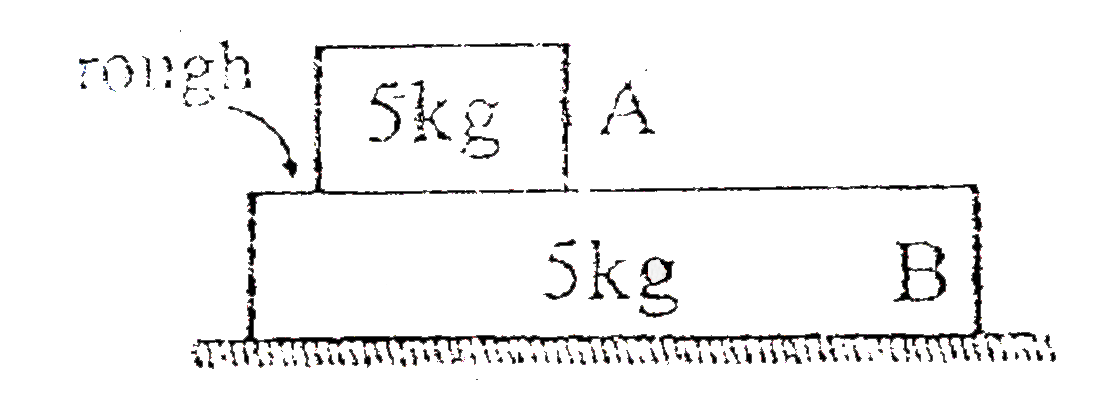
Block A of mass 5kg is placed on long bl...

Block `A` of mass `5kg` is placed on long block `B` having a mass of `5kg`. The coefficient of friction between two block is `0.4`. There is no friction between the ground and lower block. The upper block is given a sudden velocity of `10m//s`. The upper block slides toward right, so friction force acting on it will be toward left. Its reaction wall act on the lower block, which will act forward . The friction force absorbs `x` mechanical energy from upper block but supply only `y` mechanical energy to lower block. Due to friction the velocity of upper block reduces and velocity of lower block increases. This will continue till velocity of both the block get equal.

Which curve shows the correct variation of velocity of each block `v//s` time?

Promotional Banner

Similar Questions

Explore conceptually related problems

Block A of mass 5kg is placed on long block B having a mass of 5kg . The coefficient of friction between two block is 0.4 . There is no friction between the ground and lower block. The upper block is given a sudden velocity of 10m//s . The upper block slides toward right, so friction force acting on it will be toward left. Its reaction wall act on the lower block, which will act forward . The friction force absorbs x mechanical energy from upper block but supply only y mechanical energy to lower block. Due to friction the velocity of upper block reduces and velocity of lower block increases. This will continue till velocity of both the block get equal. The net energy loss due to friction in the entire process is

Block A of mass 5kg is placed on long block B having a mass of 5kg . The coefficient of friction between two block is 0.4 . There is no friction between the ground and lower block. The upper block is given a sudden velocity of 10m//s . The upper block slides toward right, so friction force acting on it will be toward left. Its reaction wall act on the lower block, which will act forward . The friction force absorbs x mechanical energy from upper block but supply only y mechanical energy to lower block. Due to friction the velocity of upper block reduces and velocity of lower block increases. This will continue till velocity of both the block get equal. The net energy loss due to friction in the entire process is

Block A of mass 5kg is placed on long block B having a mass of 5kg . The coefficient of friction between two block is 0.4 . There is no friction between the ground and lower block. The upper block is given a sudden velocity of 10m//s . The upper block slides toward right, so friction force acting on it will be toward left. Its reaction wall act on the lower block, which will act forward . The friction force absorbs x mechanical energy from upper block but supply only y mechanical energy to lower block. Due to friction the velocity of upper block reduces and velocity of lower block increases. This will continue till velocity of both the block get equal. The net energy loss due to friction in the entire process is

The friction acting on the upper block is

A force of 100 N is applied on a block of mass 3kg as shown below. The coefficient of friction between wall and the block is 1//4 . The friction force acting on the block is :

A force of 100 N is applied on a block of mass 3kg as shown below. The coefficient of friction between wall and the block is 1//4 . The friction force acting on the block is :

A force of 100 N is applied on a block of mass 3kg as shown below. The coefficient of friction between wall and the block is 1//4 . The friction force acting on the block is :

A block of mass 6 kg is being pulled by force 24 N as shown . If coefficient of friction between the block and the surface is 0.6 , frictional force acting on the block is :

A force of 100 N is applied on a block of mass 3 kg as shown in figure. The coefficient of friction between the surface and the block is 1/4 .Then the friction force acting on the block is

A block of mass 1 kg is placed on a truck which accelerates with acceleration 5ms^(-2) . The coefficient of static friction between the block and truck is 0.6. The frictional force acting on the block is