Home
Class 14
REASONING
In the following questions, two statemen...

In the following questions, two statements are given followed by twoconclusions I and II. You have to consider the two statements to be true even if they seem to be at variance from commonly known facts. You have to decide which of the given conclusions, if any, follow from the given statements.
Statements :
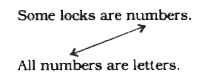
I. Some keys are locks, some locks are numbers.
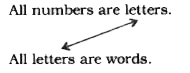
II. All numbers are letters, all letters are words.
Conclusions :
I. Some words are numbers.
II. Some locks are letters.

A

Conclusion I follows

B

Conclusion II follows

C

Conclusions I and II follow

D

None of the conclusion follows

Text Solution

Verified by Experts

The correct Answer is:
C

Statement I consists of two Particular Affirmative (I- type) Premises.
Statement II consists of two Universal Affirmative (A- type) Premises.

`I + A rArr ` I- type of Conclusion
"Some locks are letters".
This is Conclusion II.

`A + A rArr` A- type of Conclusion
"All numbers are words".
Conclusion I is Converse of it.
Promotional Banner

Similar Questions

Explore conceptually related problems

In each of the following questions, two statements are given followed by two/four conclusions I, II III and IV. You have to consider the two statements to be true even if they seem to be at variance from commonly known facts. You have to decide which of the given conclusions, if any, follow from the given statements. Statements : a) Some buses are four wheelers. (b) All four wheelers are vans. Conclusions : I. Some vans are buses. II. Some buses arc vans.

In the following questions one/two statements are given followed by two conclusions I and II. You have to consider the two statements to be true eve if they seem to be at variance from commonly known facts. You have to decide which of the given conclusions, if any, follow from the given statements. Statements : Some phones are watches. All watches are guns. Conclusions : I. All guns guns are watches. II. Some guns are Phones.

Two statements are given in each of the following questions. followed by two onclus1ons I and II. You have to take the two statements to be true even, if they seems to be at anance from commonly known facts. Read the conclusions and then decide which of the given conclusion logically follows the given two statement. disregarding the known facts. Statements I. Some keys are locks, some locks are numbers II. All numbers are letters, all the letters are words. Conclusions Some words are numbers. II. Some locks are letters.

In the question two statements are given, followed by two conclusions, I and II. You have to consider the statements to be true even if it seems to be at variance from commonly known facts. You have to decide which of the given conclusions, if any, follows from the given statements. Statement I: Some roses are flowers Statement II: Some red are roses Conclusion I: Some flowers are red Conclusion II: All red are flowers

In the question two statements are given followed by two conclusions, I and II You have to consider the statements to be true even if it seems to be at variance from commonly known facts. You have to decide which of the given conclusions, if any, follows from the given statements. Statement I: All tickets are coupons Statement II : All cards are tickets Conclusion I: Some coupons are cards Conclusion II: Some cards are coupons .

In each of the following questions one/two statements are given followed by two conclusions I and II. You have to consider the two statements to be true even if they seem to be at variance from commonly known facts. You have to decide which of the given conclusions, if any, follow from the given statements. Statements : All animals are birds. Some animals are human beings. Conclusions : I. Some human beings are birds. II. Some birds are human be ings.

In the question, two statements are given, followed by two conclusions, I and II. You have to consider the statements to be true even if it seems to be at variance from commonly known facts. You have to decide which of the given conclusions, if any, follow(s) from the given statements. Statement I: No ties are bows. Statement 2: All bows are silk. Conclusion I: some ties are silk. conclusion II: Some silk are bows.

Recommended Questions
  1. In the following questions, two statements are given followed by twoco...

    Text Solution

    |

  2. क्लोरोफॉर्म को प्रकाश एवं वायु के प्रभाव से बचाने के लिए क्या सावधानि...

    Text Solution

    |

  3. किन्ही दो संयोजक कड़ी वाले जन्तुओ के नाम तथा वे किस संघ से संबंधित कड़ी ...

    Text Solution

    |

  4. 60 W-220 V तथा 100 W-220 V के दो बल्ब श्रेणीक्रम में जोड़कर 220 व...

    Text Solution

    |

  5. दिए गये विघुत परिपथ की सहायता से ज्ञात कीजिए - (i) परिपथ में धारा , ...

    Text Solution

    |

  6. एक इलेक्ट्रॉन तथा एक प्रोटॉन जिनकी गतिज उर्जाएँ समान है, एकसमान चुम्बक...

    Text Solution

    |

  7. श्री मोहित ने एक निश्चित दूरी के लिए ट्रेडमिल पर चलने का फैसला किया है...

    Text Solution

    |

  8. एक रेखिक समीकरण दी गई है । दो चरो में एक ऐसी और रेखिक समीकरण लिख...

    Text Solution

    |

  9. एक मित्र दूसरे से कहता है कि 'यदि मुझे एक सौ दे दो, तो मैं आपसे दो गुन...

    Text Solution

    |