

Home
Class 12
PHYSICS
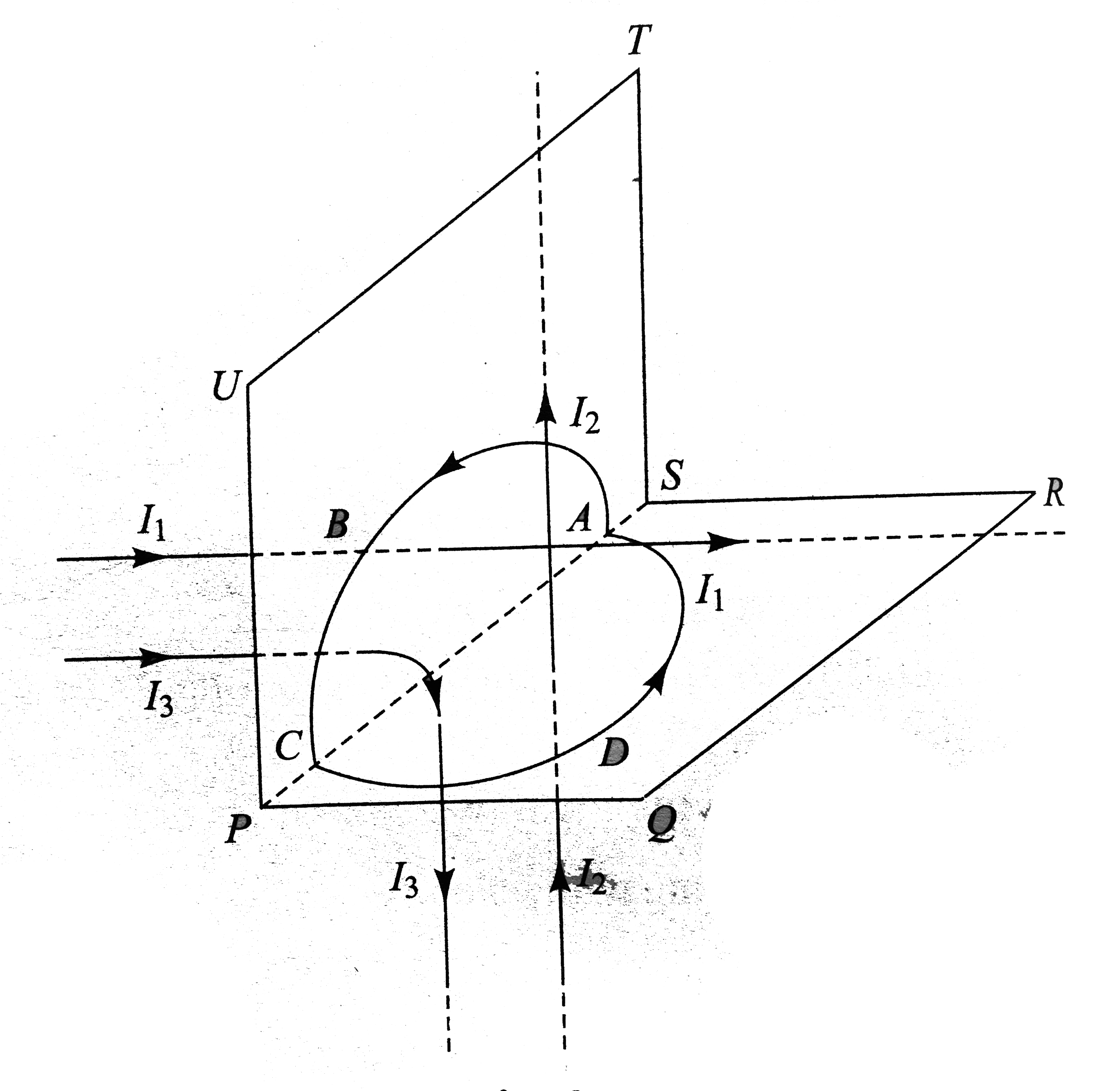
Figure shows an Amperian path ABCDA. Par...

Figure shows an Amperian path ABCDA. Part ABC is in vertical plane PSTU while part CDA is in horizontal plane PQRS. Direction of circulation along the path is shown by an arrow near point B and at D. `ointvecB.dvecl` for this path according to Ampere's law will be

Promotional Banner

Similar Questions

Explore conceptually related problems

Assertion A car moves along a road with uniform speed. The path of car lies in vertical plane and shown in fighre. The radius of curvature (R) of the path is same everywhere. If the car does not loose contact with road at the highest point, it can travel the shown path without loosing contact with road anywhere else. Reason For car to loose contact with road, the normal reaction between car and road should be zero.

Assertion A car moves along a road with uniform speed. The path of car lies in vertical plane and shown in fighre. The radius of curvature (R) of the path is same everywhere. If the car does not loose contact with road at the highest point, it can travel the shown path without loosing contact with road anywhere else. Reason For car to loose contact with road, the normal reaction between car and road should be zero.

Two particles A and V are projected in the vertical plane with same initial velocity u_(0) from part (0,0) and (l,-h) towards each other as shown in figure The path of particle A with respect to particle B will be –

A thin sphereical shell having uniform density is cut in two parts by as plane and kept separated as shown in figure. The point A is the center of the plane section of the first part and B is the center of the plane section of the second part. Show that the gravitational field at A due to the first part is equal in magnitude to the gravitational field at B due to the second part.

Figure shows three paths connecting points a and b, A single force F does the indicated work on a particle moving along each path in the indicated direction. On the basis of this information, is force F conservative?

Figure shows three paths connecting points a and b, A single force F does the indicated work on a particle moving along each path in the indicated direction. On the basis of this information, is force F conservative?

A man moves in x-y plane along the path shown. At what points is his average velocity vector in the sam direction as his instantaneous velocity vector. The man starts from point P .