

Home
Class 12
CHEMISTRY
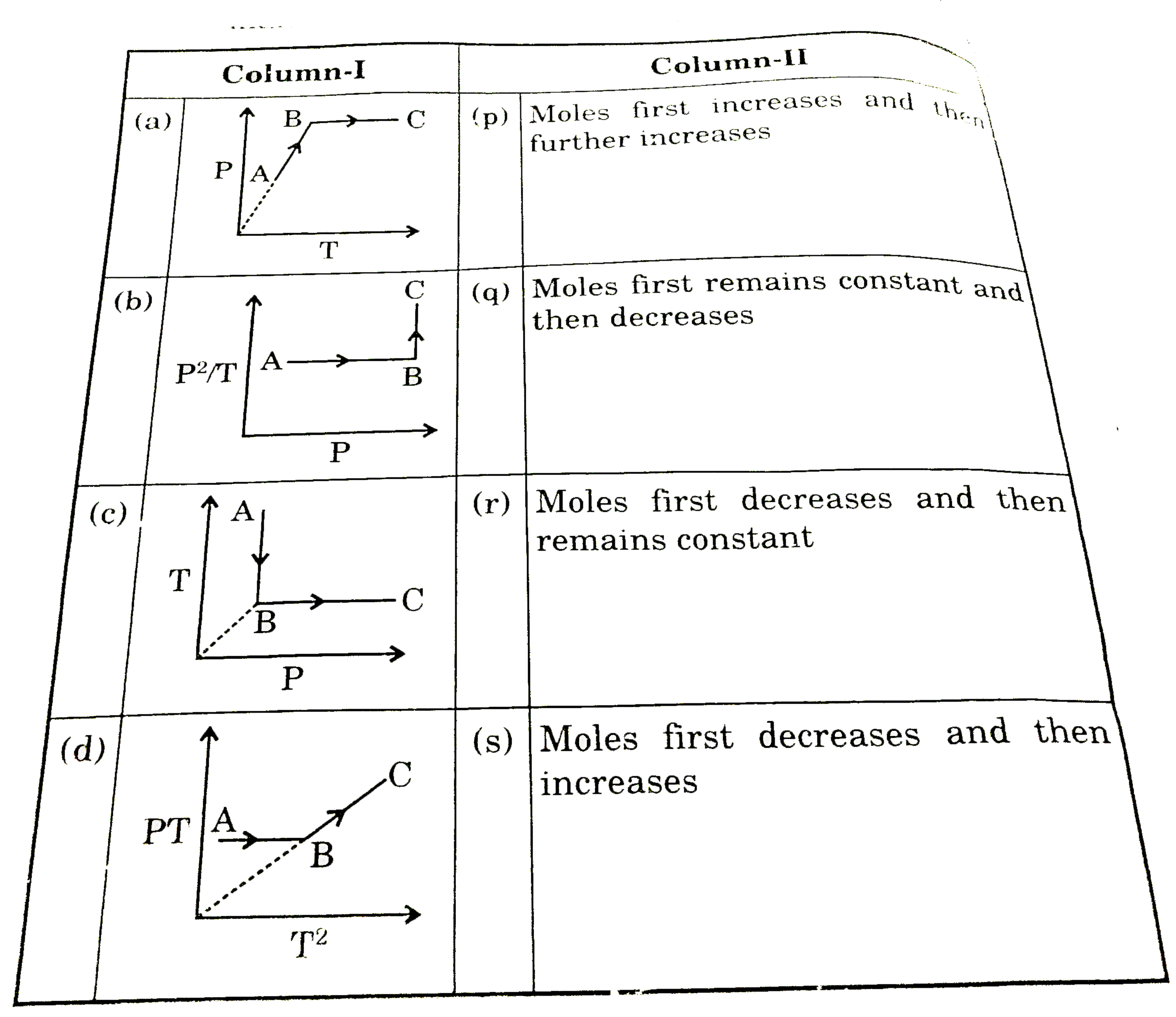
The following graphs are plotted for an ...

The following graphs are plotted for an ideal gas taken from state A to state B and then to state C, maintaining volume constant.

Promotional Banner

Similar Questions

Explore conceptually related problems

Equation of state of an ideal gas is

Four moles of an ideal gas is initially in state A having pressure 2 xx 10^(5) N//m^(2) and temperature 200 K . Keeping the pressure constant the gas is taken to state B at temperature of 400K . The gas is then taken to a state C in such a way that its temperature increases and volume decreases. Also from B to C , the magnitude of dT//dV increases. The volume of gas at state C is equal to its volume at state A . Now gas is taken to initial state A keeping volume constant. A total 1000 J of heat is withdrawn from the sample of the cyclic process . Take R=8.3 J// K// mol . The volume of gas at state C is

Four moles of an ideal gas is initially in state A having pressure 2 xx 10^(5) N//m^(2) and temperature 200 K . Keeping the pressure constant the gas is taken to state B at temperature of 400K . The gas is then taken to a state C in such a way that its temperature increases and volume decreases. Also from B to C , the magnitude of dT//dV increases. The volume of gas at state C is eqaul to its volume at statem A . Now gas is taken to initial state A keeping volume constant. A total 1000 J of heat is withdrawn from the sample of the cyclic process . Take R=8.3 J// K// mol . The volume of gas at state C is

Four moles of an ideal gas is initially in state A having pressure 2 xx 10^(5) N//m^(2) and temperature 200 K . Keeping the pressure constant the gas is taken to state B at temperature of 400K . The gas is then taken to a state C in such a way that its temperature increases and volume decreases. Also from B to C , the magnitude of dT//dV increases. The volume of gas at state C is eqaul to its volume at statem A . Now gas is taken to initial state A keeping volume constant. A total 1000 J of heat is withdrawn from the sample of the cyclic process . Take R=8.3 J// K// mol . The work done in path B to C is

Four moles of an ideal gas is initially in a state A having pressure 2xx10^(5)N//m^(2) and temperature 200 K . Keeping pressure constant the gas is taken to state B at temperature of 400K. The gas is then taken to a state C in such a way that its temperature increases and volume decreases. Also from B to C, the magnitude of (dT)/(dV) increases. The volume of gas at state C is eaual to its volume at state A. Now gas is taken is initial state A keeping volume constant. A total of 1000 J heat is rejected from the sample in the cyclic process. Take R=8.3J//K//mol . Which graph between temperture T and volume V for the cyclic process is correct.

Four moles of an ideal gas is initially in a state A having pressure 2xx10^(5)N//m^(2) and temperature 200 K . Keeping pressure constant the gas is taken to state B at temperature of 400K. The gas is then taken to a state C in such a way that its temperature increases and volume decreases. Also from B to C, the magnitude of (dT)/(dV) increases. The volume of gas at state C is eaual to its volume at state A. Now gas is taken is initial state A keeping volume constant. A total of 1000 J heat is rejected from the sample in the cyclic process. Take R=8.3J//K//mol . Which graph between temperture T and volume V for the cyclic process is correct.

Four moles of an ideal gas is initially in a state A having pressure 2xx10^(5)N//m^(2) and temperature 200 K . Keeping pressure constant the gas is taken to state B at temperature of 400K. The gas is then taken to a state C in such a way that its temperature increases and volume decreases. Also from B to C, the magnitude of (dT)/(dV) increases. The volume of gas at state C is eaual to its volume at state A. Now gas is taken is initial state A keeping volume constant. A total of 1000 J heat is rejected from the sample in the cyclic process. Take R=8.3J//K//mol . The work done by the gas along path B to C is

Four moles of an ideal gas is initially in a state A having pressure 2xx10^(5)N//m^(2) and temperature 200 K . Keeping pressure constant the gas is taken to state B at temperature of 400K. The gas is then taken to a state C in such a way that its temperature increases and volume decreases. Also from B to C, the magnitude of (dT)/(dV) increases. The volume of gas at state C is eaual to its volume at state A. Now gas is taken is initial state A keeping volume constant. A total of 1000 J heat is rejected from the sample in the cyclic process. Take R=8.3J//K//mol . The work done by the gas along path B to C is

Four moles of an ideal gas is initially in state A having pressure 2 xx 10^(5) N//m^(2) and temperature 200 K . Keeping the pressure constant the gas is taken to state B at temperature of 400K . The gas is then taken to a state C in such a way that its temperature increases and volume decreases. Also from B to C , the magnitude of dT//dV increases. The volume of gas at state C is eqaul to its volume at statem A . Now gas is taken to initial state A keeping volume constant. A total 1000 J of heat is withdrawn from the sample of the cyclic process . Take R=8.3 J// K// mol . Which graph between temperature T and volume V for the cyclic process is correct.