

Home
Class 12
PHYSICS
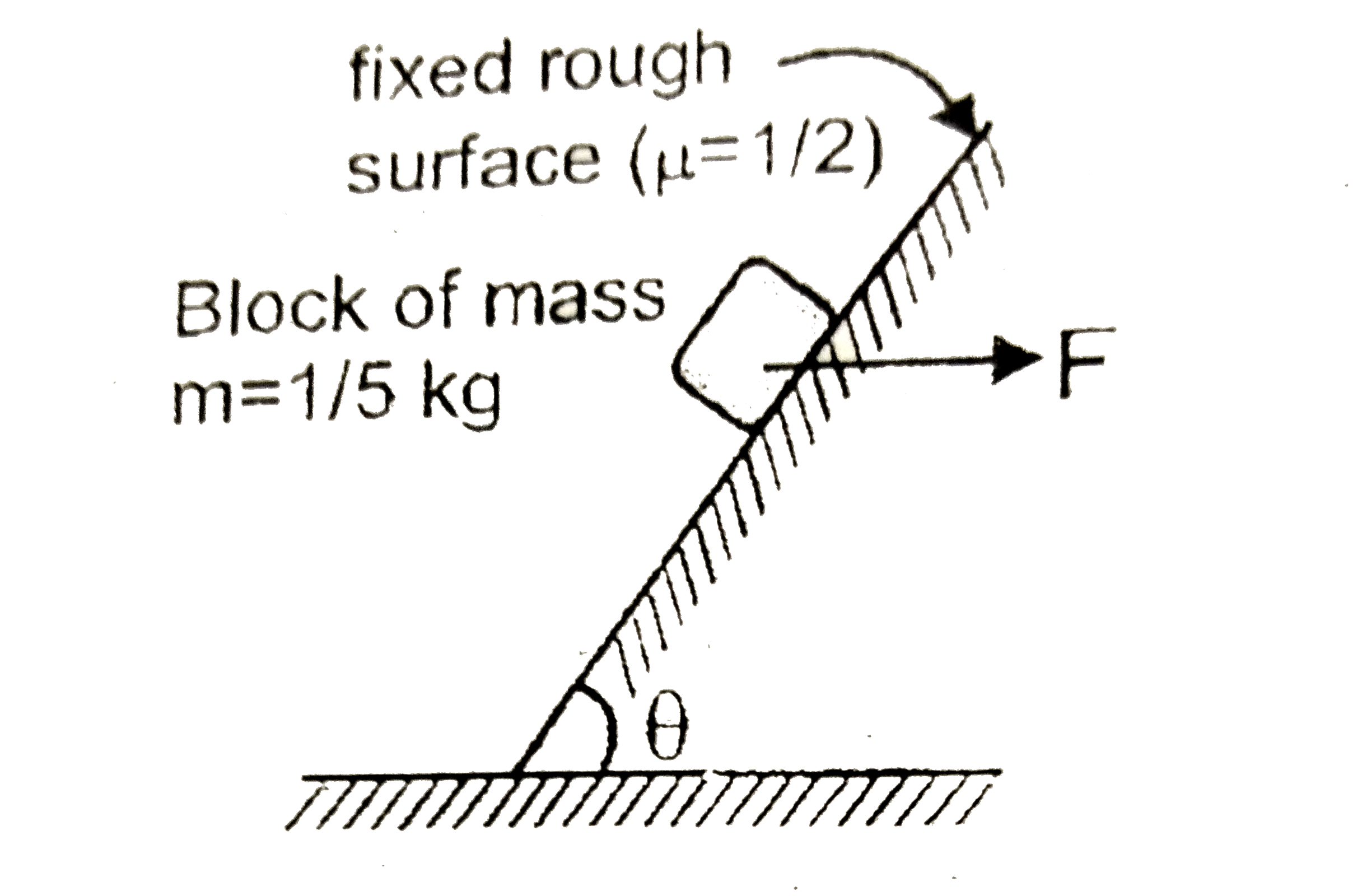
As shown in figure, if we apply a horizo...

As shown in figure, if we apply a horizontal force `F` on the block, find the maximum force `F` (in `N`) that can be applied so that block does not slide up. `( "Given" theta=45^(@),g=10m//sec^(2), m=1/5kg,mu=1/2)`

Promotional Banner

Similar Questions

Explore conceptually related problems

In the figure shown, the minimum force F to be applied perpendicular to the incline so that the block does not slide is

In the figure shown, the minimum force F to be applied perpendicular to the incline so that the block does not slide is

Two blocks a and B of mass m_(A)=1kg and m_(B)=3kg are kept on the table as shown in figure the coefficient of friction between A and B is 0.2 and between B and the surface of the table is also 0.2 the maximum force F that can be applied on B horizontally, so that the block A does not slide over the block B is [Take g=10m//s^(2) ]

In the arrangement shown in figure, m_A = m_B = 2kg. String is massless and pulley is frictionless. Block B is resting on a smooth horizontal surface, while friction coefficient beteen block A and B is mu=0.5 . the Maximum horizontal force F that can be applied so that block A does not slip over block B is.

Two block "A&B" of mass M_(A)=1kg&M_(B)=3kg are kept on a smooth table as shown in the figure.The coefficient of friction between "A&B" is "0.2" .The maximum force "F" that can be applied on "B" horizontally,so that the block "A" do not slide over the block "B" is Take g=10m/s^(2)andk=400N/m)

A block of mass m is placed on another block of mass M lying on a smooth horizontal surface as shown in the figure. The co-efficient of friction between the blocks is mu . Find the maximum horizontal force F (in Newton) that can be applied to the block M so that the blocks together with same acceleration? (M=3kg, m=2kg, mu=0.1, g=10m//s^(2))

A block of mass m is placed on another block of mass M lying on a smooth horizontal surface as shown in the figure. The co-efficient of friction between the blocks is mu . Find the maximum horizontal force F (in Newton) that can be applied to the block M so that the blocks together with same acceleration? (M=3kg, m=2kg, mu=0.1, g=10m//s^(2))

Two blocks A and B of masses m_(A) = 1kg and m_(B) = 3kg are kept on the table as shown in figure. The coefficient of friction between A and B is 0.2 and between B and the surface of the table is also 0.2. The maximum force F that can be applied on B horizontally, so that the block A does not slide over the block B is ________ (in N): [Take g = 10 m//s^(2) ]

Initially, both the blocks are at rest on horizontal surface as shown in the figure. Find the minimum value of force F in (N) so that sliding starts between the blocks (g=10ms^(-2))