

Home
Class 11
PHYSICS
A ball of mass m=1kg falling vertically ...

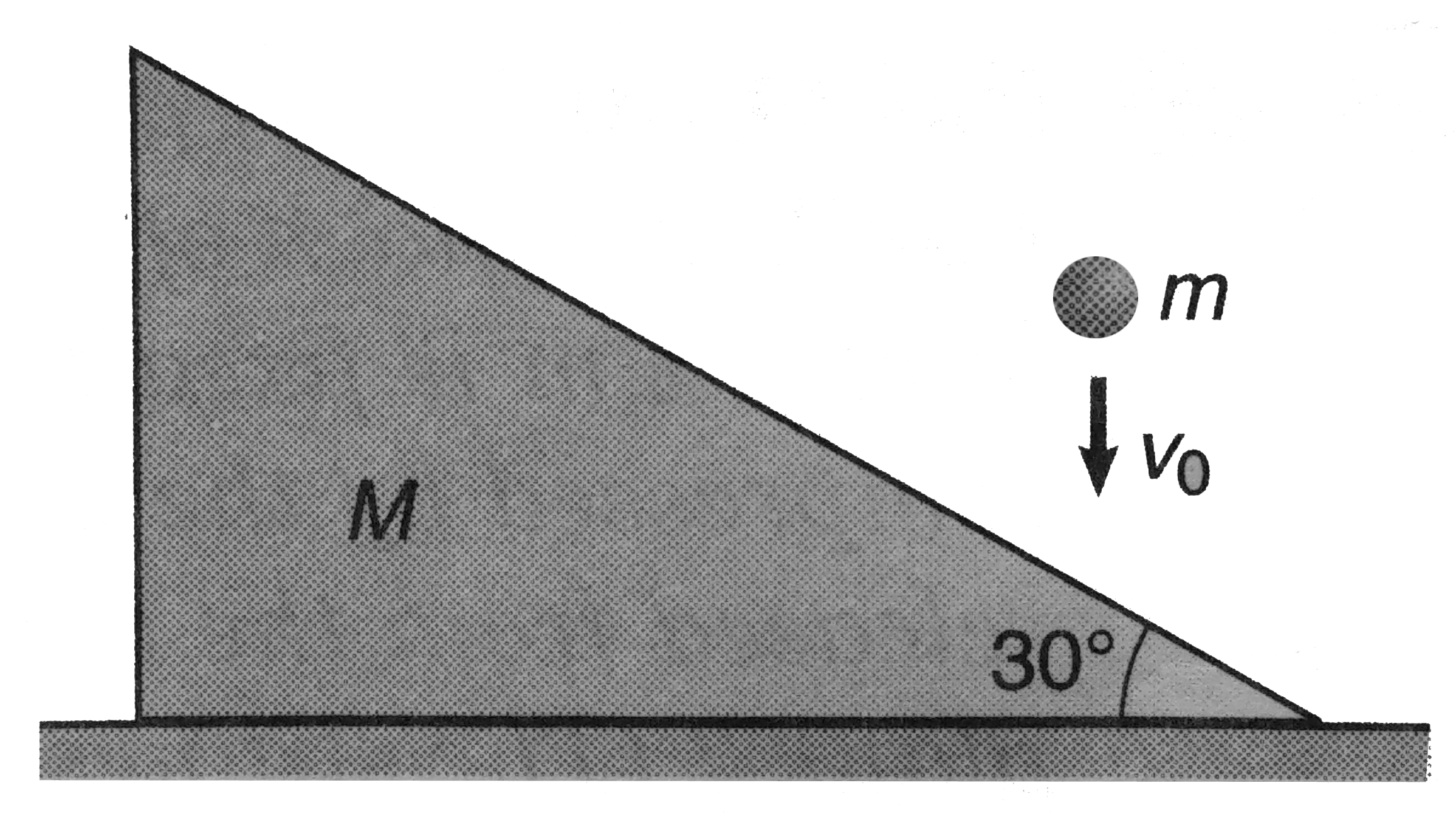
A ball of mass `m=1kg` falling vertically with a velocity `v_0=2m//s` strikes a wedge of mass `M=2kg` kept on a smooth, horizontal surface as shown in figure. If impulse between ball and wedge during collision is J. Then make two equations which relate J with velocity components of wedge and ball. Also find impulse on wedges from ground during impact.

Promotional Banner

Similar Questions

Explore conceptually related problems

A ball of mass m=1kg falling vertically with a velocity v_(0)=2m//s strikes a wedge of mass M=2kg kept o a smooth, horizontal surface as shown in figure. The coefficient of resitution between the ball and the wege is e=1//2 . Find the velocity of the wedge is e=1/2. find the velocity of the wedge and the ball immediately after collison.

A ball of mass m=1kg strikes a smooth horizontal floor as shown in figure. The impulse exerted on the floor is

A ball of mass m=1kg strikes a smooth horizontal floor as shown in figure. The impulse exerted on the floor is

A particle of mass m strikes normally to a stationary wedge of mass 5m kept on the smooth horizontal surface as shown.If the particle sticks to the wedge then loss in kinetic energy of the system during collision is?

A ball mass 2 kg moving horizontally with velocity 10 m/s hits a wedge of mass 5 kg placed on a horizontal surface as shown in the figure. Just after collision klvelocity of wedge is 3.2 m/s. There is no friction at any contact surface. Then (take sin 30^(@)=3//5 )

A ball mass 2 kg moving horizontally with velocity 10 m/s hits a wedge of mass 5 kg placed on a horizontal surface as shown in the figure. Just after collision klvelocity of wedge is 3.2 m/s. There is no friction at any contact surface. Then (take sin 30^(@)=3//5 )

A ball of mass m moving with constant horizontal velocity u strikes a stationary wedge of mass M on its inclined surface as shown in the figure. After collision, the ball starts moving up the inclined plane. The wedge is placed on frictionless horizontal surface. a. Calculate the velocity of wedge immediately after collision. b. Calculate the maximum height the ball can ascend on the wedge.

A ball of mass m moving horizotally which velocity u hits a wedge of mass M . The wedge is situated on a smooth horizontal source. If after striking with wedge the ball starts moving in vertical direction and the wedge starts moving in horizotal plane. calculate a. the velocity of wedge V . b. the velocity (v) at which the ball moves in vertical direction. c. the impulse imparted by the ball on the wedge. d. the coefficient of restitution e=?