

Home
Class 11
PHYSICS
A block of mass m(1) =2 kg slides along...

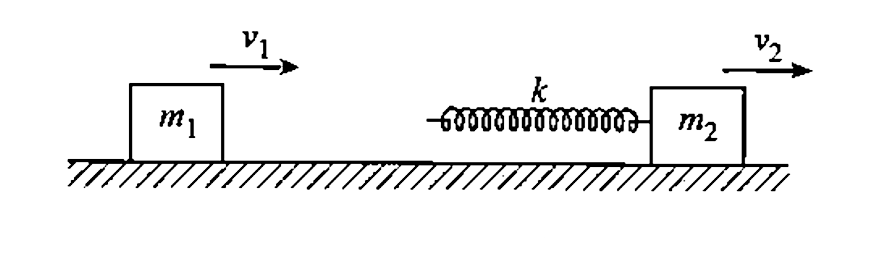
A block of mass `m_(1)` =2 kg slides along a firictionless table with a speed of 10m`//`s. Directly infront of it,and moving in the same direction is a block of mass `m_(2)` 5 kg moving at 3 m`//`s. A mass less spring with a spring constant 11.2 N`//`cm is attached to as shown in figure-5.146. When the block collide,what is the maximum compression of the spring ? Assume that the spring does not bend.

Promotional Banner

Similar Questions

Explore conceptually related problems

A block of mass 2kg slides on a frictionless table with with a speed of 10 ms^(-1) . Directly in front of it and moving in the same direction is a block of mass 5 kg moving at 3 ms^(-1) . A massless spring with force constant k = 1120 Nm^(-1) is attached to its back (the side facing 2 kg mass) When the blocks collide, what is the maximum compression of the spring ? [Hint : Apply 'work energy' theorem to the system of block and principle of conservation of momentum]

A block of mass m moving at a speed v_0 compresses a spring of spring constant k as shown in the figure. Find (a) the maximum compression of spring and (b) speed of the block when the spring is compressed to half of maximum compression.

A block of mass m slides with speed v on a frictionless table towards another stationary block of mass m. A massless spring with spring constant k is attached to the second block as shown in figure. The maximum distance the spring gets compressed through is

A block of mass 4 kg slides on a horizontal frictionless surface with a speed of 2m//s . It is brought to rest in compressing a spring in its path. If the force constant of the spring is 400 N//m , by how much the spring will be compressed

Two blocks of masses m_(1) = 2 kg and m_(2) = 5 kg are moving in the same direction along a frictionless surface with speeds 10 m//s and 3 m//s , respectively, m_(2) being ahead of m_(1) . An ideal spring with k = 1120 N//m is attached to the back side of m_(2) . Find the maximum compression of the spring when the blocks collide. What are the final velocities of the blocks when they separate?

Two blocks of masses m_(1)= 2 kg and m_(2) = 4 kg are moving in the same direction with speeds v_(1) = 6 m//s and v_(2) = 3 m//s , respectively on a frictionless surface as shown in the figure. An ideal spring with spring constant k = 30000 N//m is attached to the back side of m_(2) . Then the maximum compression of the spring after collision will be

Two blocks of masses m_(1)= 2 kg and m_(2) = 4 kg are moving in the same direction with speeds v_(1) = 6 m//s and v_(2) = 3 m//s , respectively on a frictionless surface as shown in the figure. An ideal spring with spring constant k = 30000 N//m is attached to the back side of m_(2) . Then the maximum compression of the spring after collision will be

Two blocks of masses 1 kg and 3 kg are moving with velocities 2 m//s and 1 m//s , respectively , as shown. If the spring constant is 75 N//m , the maximum compression of the spring is

A block of mass m is placed on a smooth block of mass M = m with the help of a spring as shown in the figure. A velocity v_(0) is given to upper block when spring is in natural length. Find maximum compression in the spring.