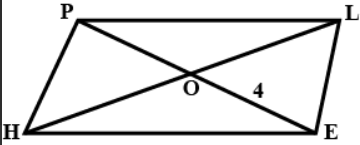
: In Fig 3.31 HELP is a parallelogram. (Lengths are in cms). Given that
OE = 4 and HL is 5 more than PE? Find OH
Text Solution
Verified by Experts
ABCD isaconvexquadrilateral made of two triangles ∆ABC and ∆ADC. We know thatthe sum of the angles of a triangle is 180 degree. So: `angle 6+angle 5+angle4=180^@`(sum of anglesof`triangleABC=180^@` `angle1+angle2+angle3=180^@`(sum oftheangles of `triangleADC=180^@`
addingweget `angle6+angle5+angle4+angle1+angle2+angle3` `=180^@+180^@` `=360` Using the angle sum propertyoftriangle, again ABCD is a concave quadrilateral,madeoftwo`triangleABD`and`triangleBCD` . Therefore, the sum of all theinterioranglesofthis
quadrilateral will also be
Topper's Solved these Questions
UNDERSTANDING QUADRILATERALS
NCERT|Exercise EXERCISE 3.2|6 Videos
UNDERSTANDING QUADRILATERALS
NCERT|Exercise EXERCISE 3.3|11 Videos
SQUARES AND SQUARE ROOTS
NCERT|Exercise EXERCISE 6.1|9 Videos
VISUALISING SOLID SHAPES
NCERT|Exercise EXERCISE 10.3|8 Videos
Similar Questions
Explore conceptually related problems
In Figure,HELP is a parallelogram.If OE=4cm and HL is 5cm more then PE Find OH.
Construct a parallelogram HOME with HO = 6 cm, HE = 4 cm and OE = 3 cm.
Find the area of a parallelogram whose base is 8 cm and altitude is 4.5 cm
In Fig.42, A B C D is a parallelogram in which A D=21\ c m , D H=18\ c m and D K=27\ c mdot The length of side A B is 63 cm (b) 63.5 cm 31.5 cm (d) 31 cm
Find the area of a parallelogram with base 5 cm and altitude 4.2 cm.
Find the area of a parallelogram with base 8cm and altitude 4.5cm.
In Fig. 9.10, ABCD is a parallelogram, in which AB = 8 cm, AD = 6 cm and altitude AE = 4 cm. Find the altitude corresponding to side AD.
In the given figure ABCD is a parallelogram, AEbotDCandCFbotAD . If AB = 16 cm, AE = 8 cm and CF = 10 cm then find the length of AD.