

Home
Class 11
PHYSICS
Two blocks of masses 1 kg and 2 kg are j...

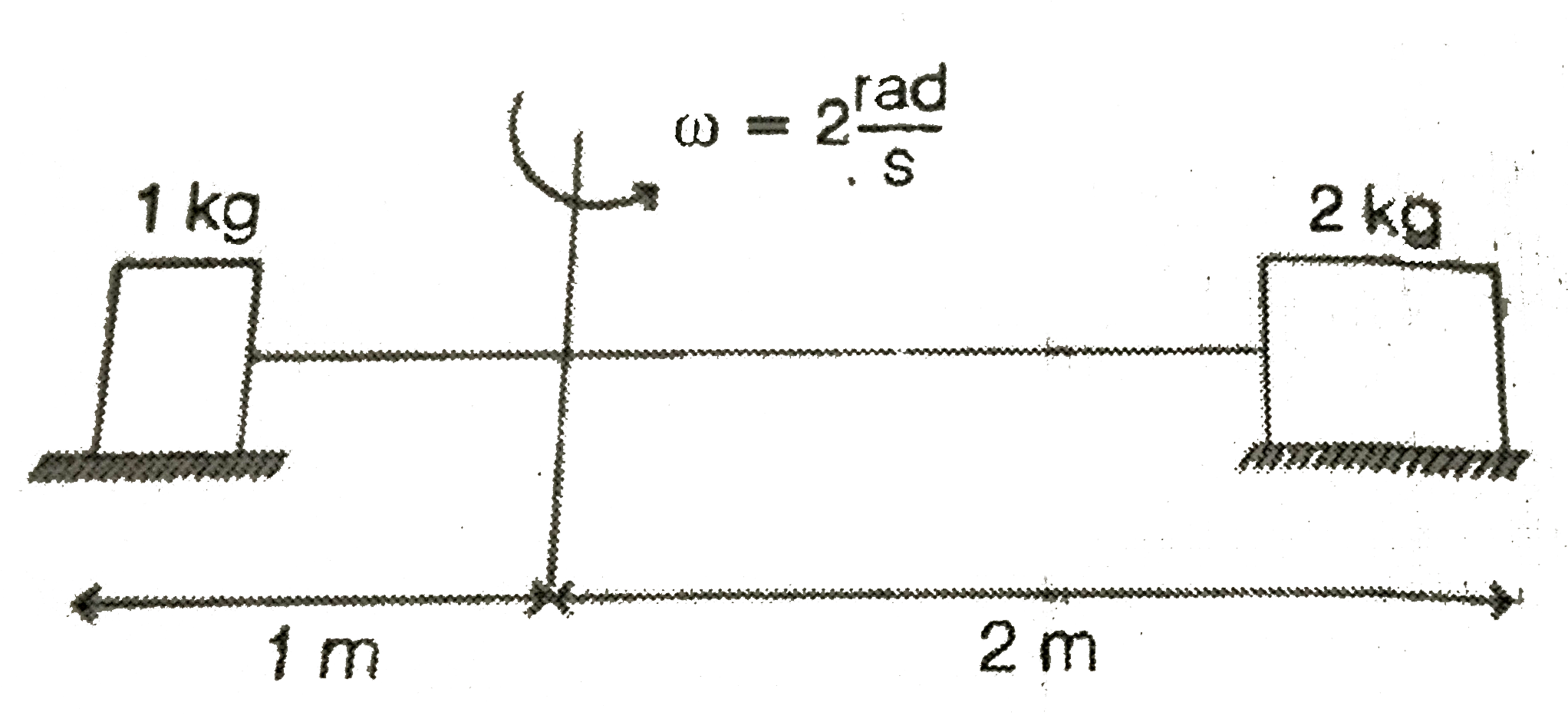
Two blocks of masses 1 kg and 2 kg are joined by a massless inextensible string of length 3m. Both blocks are kept on a horizontal table as shown. Friction coefficient between 2 kg block and table is zero. They are rotated about a vertical axis passing at a distance of 1m from 1 kg. Force of friction on 1kg block is (assume that there is enough friction between 1 kg block ground)

Promotional Banner

Similar Questions

Explore conceptually related problems

The frictional force acting on 1 kg block is

The frictional force acting on 1 kg block is

In the figure shown, block of mass 2 kg is very long. Force of friction on 1 kg block is

In the figure shown, block of mass 2 kg is very long. Force of friction on 1 kg block is

Two blocks of mass 10 kg and 2 kg are connected by an ideal spring of spring constant 1000 N/m and the system is placed on a horizontal surface as shown. The coefficient of friction between 10 kg block and surface is 0.5 but friction is assumed to be absent between 2 kg and surface. Initially blocks are at rest and spring is unstretched then 2 kg block is displaced by 1 cm to elongate the spring then released. Then the graph representing magnitude of frictional force on 10 kg block and time t is : (Time t is measured from that instant when 2 kg block is released to move)

Three blocks of masses 3 kg, 6 kg and 1 kg are connected by a string passing over two smooth pulleys attached at the two ends of the horizontal surface. If the co-efficient of friction between the block and the surface is 0.6, the frictional force acting on the block of mass 6 kg is

Three blocks of masses 3 kg, 6 kg and 1 kg are connected by a string passing over two smooth pulleys attached at the two ends of the horizontal surface. If the co-efficient of friction between the block and the surface is 0.6, the frictional force acting on the block of mass 6 kg is

A block of mass 1kg is at rest on a horizontal table. The coeficient of static friction between the block and the table is 0.5 . The magnitude of the force acting upward at an angle of 60^(@) from the horizontal that will just start the block moving is.