

Home
Class 12
PHYSICS
On a cold winter dry, the temperature of...

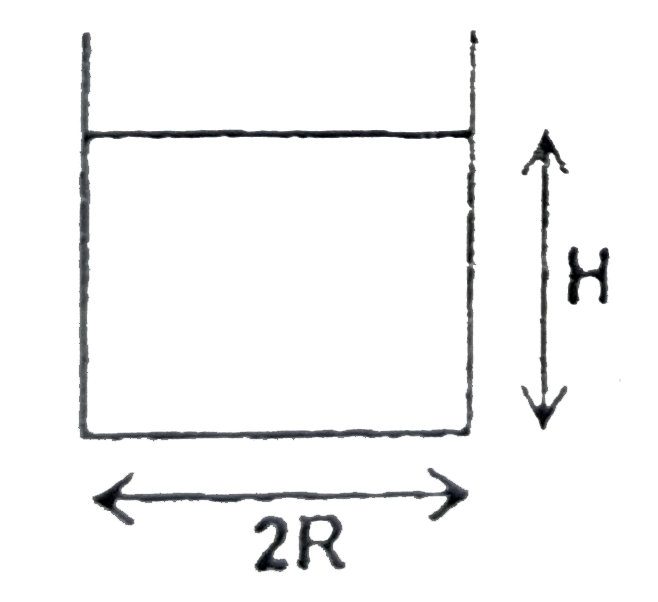
On a cold winter dry, the temperature of atmosphere is `-T^(@)C`. The cylindrical dram shown is made of insultating material and it contains water at `0^(@)C`. If `L` is latent heat of fusion of ice, `rho` is density of ice and `K_(R)` is thermal conductivity of ice, the time taken for total mass of water to freeze is

Promotional Banner

Similar Questions

Explore conceptually related problems

M g of ice at 0^@C is to be converted to water at 0^@C . If L is the latent heat of fusion of ice, the quantity of heat required for the above operation would be

On a cold winter day, the atmosheric temperature is -theta (on celsium scale) which is below 0^(@)C. A cylindrical drum oof height h made of a bad conductor is completely filled with water at 0^(@)C and is kept outside without any lid. Calculate the time taken for the whole mass of water to freeze. Thermal conductivity of ice is K and its laternt heat of fusion is L. Neglect expansion of water on freezing.

On a cold winter day, the atmospheric temperature is -theta (on celsius scale) which is below 0^(@)C . A cylindrical drum of height h made of a bad conductor is completely filled with water at 0^(@)C and is kept outside without any lid. Calculate the time taken for the whole mass of water to freeze. Thermal conductivity of ice is K and its latent heat of fusion is L . Neglect expansion of water on freezing.

On a cold winter day, the atmospheric temperature is -theta (on celsius scale) which is below 0^(@)C . A cylindrical drum of height h made of a bad conductor is completely filled with water at 0^(@)C and is kept outside without any lid. Calculate the time taken for the whole mass of water to freeze. Thermal conductivity of ice is K and its latent heat of fusion is L . Neglect expansion of water on freezing.

An ice layer of thickness d_1 is floating on a pond of water. The atmospheric temperature is - T^@C . What is the time taken for the thickness of the layer to increase from d_1 to d_2 if L, rho and K are the latent heat of fusion of water, density of ice and thermal conductivity of ice, respectively?

Find the heat required to convert 20 g of ice at 0⁰C into water at the same temperature . (Specific latent heat of fusion of ice = 80 cal/g)

Calculate the amount of heat absorbed by 100 g of ice to change into water of 30^@ C.(Latent heat of fusion of ice is 80 cal//g )