

Home
Class 12
PHYSICS
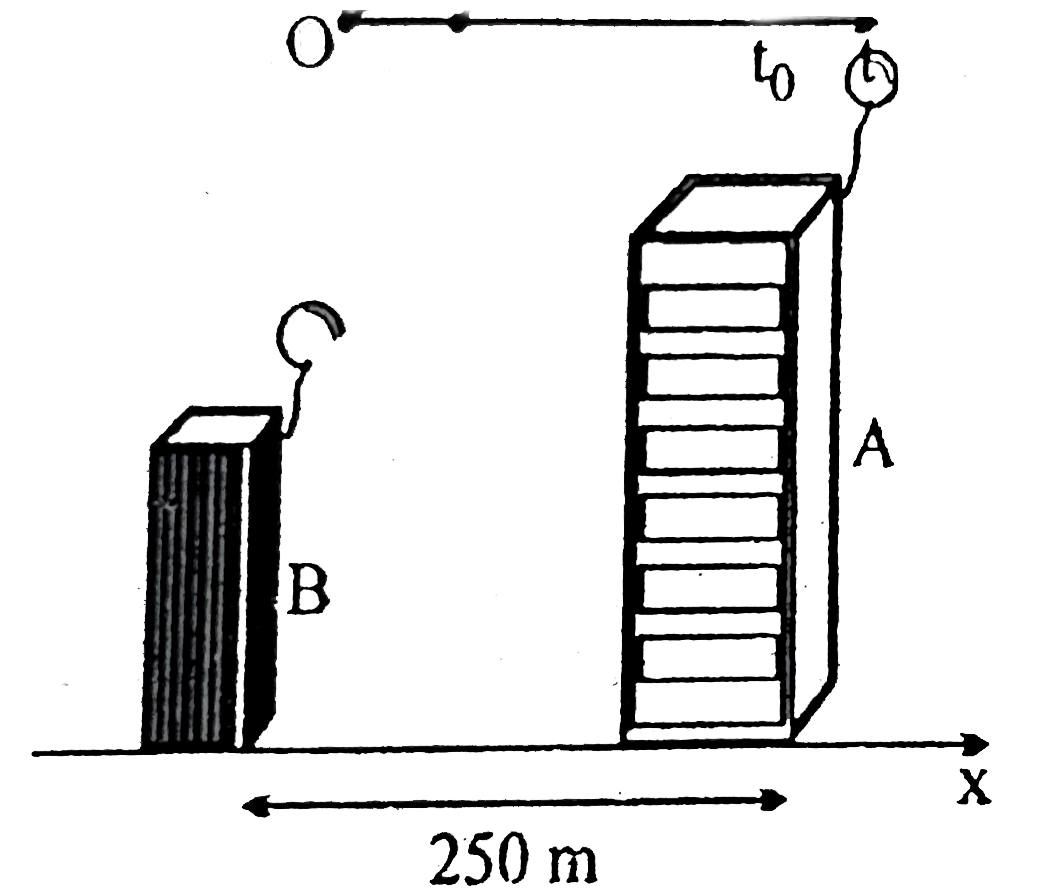
Two ballons are simultaneously released ...

Two ballons are simultaneously released from two buildings A and B. Balloon from A rises with constant velocity `10ms^(-1)` While the other one rises with constant velocity of `20ms^(-1)` Due to wind the balloons gather horizontal velocity `V_(x)=0.5` y, where 'y' is the height from the point of release. The buildings are at a distance of `250` m & after some time 't' the balloons collide.

Promotional Banner

Similar Questions

Explore conceptually related problems

Two balls of equal mass are projected upwards simultaneously, one from the ground with initial velocity 50ms^-1 and the other from a 40m tower with initial velocity of 30ms^-1 . The maximum height attained by their COM will be

Two particles , one with constant velocity 50 m//s and the other with uniform acceleration 10 m//s^(-2) . Start moving simultaneously from the same place in the same direction. They will be at a distance of 125m other after.

A stone is dropped from a balloon rising upwards with a velocity of 16 ms^(-1) . The stone reaches the ground in 4 s. Calculate the height of the balloon when the stone was dropped.

A balloon starts rising from the surface of the earth with vertical component of velocity v_(0) . The balloon gathers a horizontal velocity v_(x) = ay , where a is a constant and y is the height from the surface of the earth, due to a horizontal wind. Determine (a) the equation of trajectory of the balloon. (b) the tangential, normal and total acceleration of the balloon as function of y.

A ball is thrown with a velocity of 30 ms^(-1) from the top of a building 200m high . The ball makes an angle of 30^(@) with the horizontal . Calculate the distance from the foot of the building where the ball strikes the ground (g=10ms^(-2)) .

Two particles are thrown simultaneously from points A and B with velocities u_1 = 2ms^(-1) and u_2 - 14 ms^(-1) , respectively, as shown in figure. The relative velocity of B as seen from A in

A ball is dropped from the top of a building 100 m high. At the same instant another ball is thrown upwards with a velocity of 40ms^(-1) form the bottom of the building. The two balls will meet after.

A balloon starts rising from the earth's surface. The ascension rate is constant and equal to v_(0) . Due to the wind. The balloon gathers the horizontal velocity component v_(x)=ky , where k is a constnat and y is the height of ascent. Find how the following quantities depednd on the height of ascent. (a) the horizontal drift of the balloon x (y) (b) the total tangential and normal accelrations of the balloon.

A balloon starts rising from the surface of the earth with a verticle component of velocity v_(0) . The baloon gathes a horizontal velocity v_(x)=lambda_(y) , where lambda is a constant and y is the height from the surface of earth, due to a horizontaln wind. determine (a) the equation of trajectory and (b) the tangential, normal and total acceleration of the balloon as a function of y .

A body is simultaneously given two velocities, one 10 ms^(-1) due east and other 20 ms^(-1) due north-west. Calculate the resultant velocity.