

Home
Class 12
PHYSICS
A rod lies across frictionless rails in ...

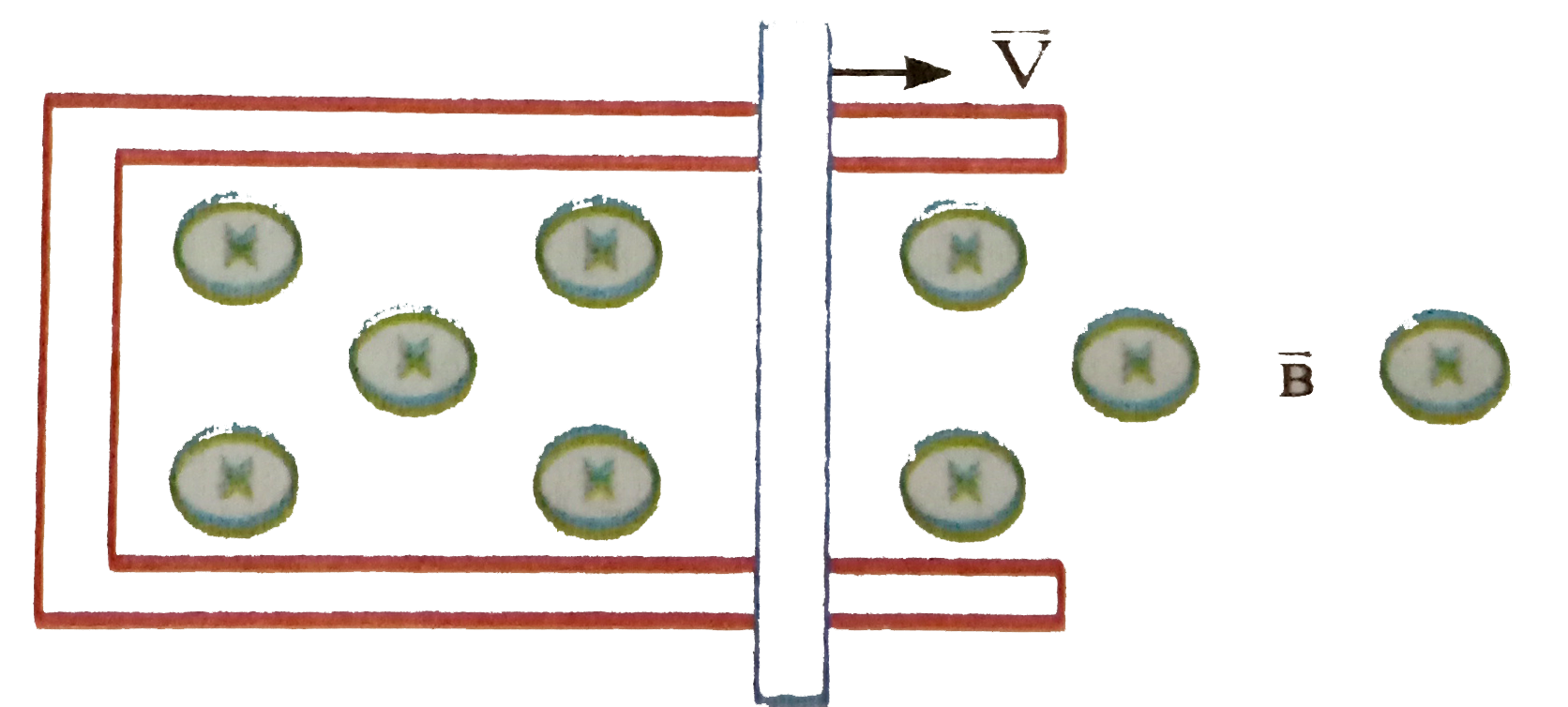
A rod lies across frictionless rails in a uniform magnetic field `vec(B)` as shown in figure. The rod moves to the right with speed `V`. In order to make the induced emf in the circuit to be zero, the magnitude of the magnetic field should

Promotional Banner

Similar Questions

Explore conceptually related problems

A rod AB moves with a uniform velocity v in a uniform magnetic field as shown in figure

A rod AB moves with a uniform velocity v in a uniform magnetic field as shown in figure.

A rod AB moves with a uniform velocity v in a uniform magnetic field as shown in figure

A rod with resistance R lies across frictionless conducting rails in a constant uniform magnetic field vecB , as shown in the following figure. Assume the rails have negligible resistance. The magnitude of the force that must be applied by a person to pull the rod to the right at constant speed v is

A conducting movable rod AB lies across the frictionless parallel conducting rails in a uniform magnetic field vecB whose magnitude at t=0 is B_(0) . The rod AB is given velocity v right ward and it continues to move with same velocity through out the motion [The acceleration due to gravity is along negative z- axis, i.e. vecg=10m//s^(2)(-hatk) , mass of rod =m .] Which of the following graphs will be the best representation of magnitude of magnetic field versus time.

A uniform conducting rod of length I is moving with speed v_0 in a uniform transverse magnetic field B_0 as shown in figure. The emf developed across the two ends of the rod will be

A glass rod of length l moves with velocity in a uniform magnetic field B. What is the e.m.f. induced in the rod ?

A small conducting rod of length l, moves with a uniform velocity v in a uniform magnetic field B as shown in fig __