

Home
Class 11
PHYSICS
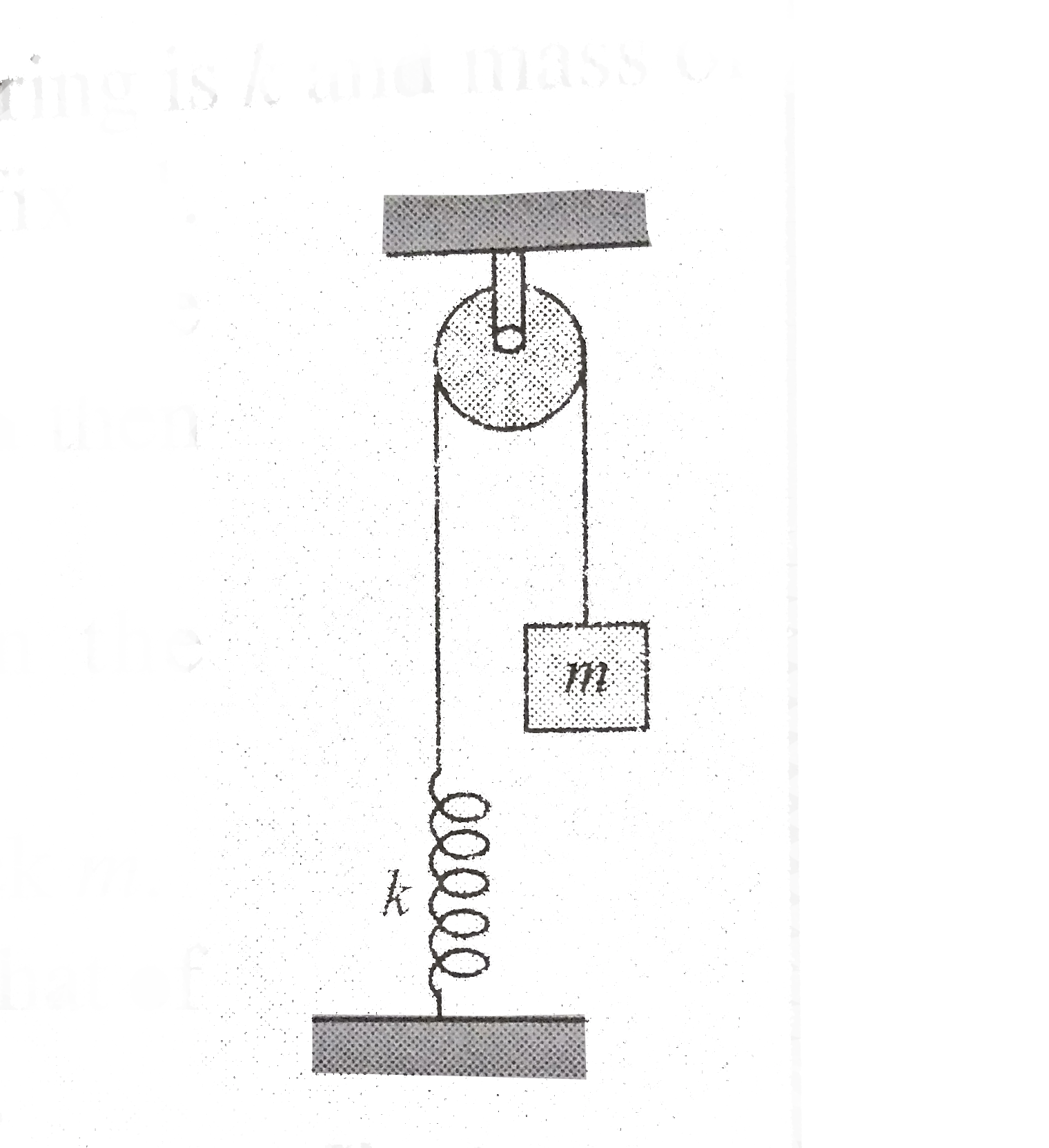
In figure, the stiffness of the spring i...

In figure, the stiffness of the spring is `k` and mass of the block is `m`. The pulley is fixed. Initially, the block `m` is held such that the elongation in the spring is zero and then released from rest. Find:
a. the maximum elongation in the spring.
b. the maximum speed of the block `m`. Neglect the mass of the spring and that of the string. Also neglect the friction.

Promotional Banner

Similar Questions

Explore conceptually related problems

The block of mass m is released when the spring was in its natrual length. Spring constant is k. Find the maximum elongation of the spring.

The block of mass m is released when the spring was in its natrual length. Spring constant is k. Find the maximum elongation of the spring.

Block of mass 2 m is given v_(0) towards the right. If L is the natural length of spring constant k , find the maximum elongation of the spring.

A block of mass m held touching the upper end of a light spring of force constant K as shown in figure. Find the maximum potential energy stored in the spring if the block is released suddenly on the spring.

A block of mass m held touching the upper end of a light spring of force constant K as shown in figure. Find the maximum potential energy stored in the spring if the block is released suddenly on the spring.

Consider the situation shown in figure. Initially the spring is unstretched when the system is released from rest. Assuming no friction in the pulley, find the maximum elongation of the spring?

For shown situation find the maximum elongation in the spring. Neglect friction everywhere. Initiallthe blocks are at rest and spring is unstreched.

For shown situation find the maximum elongation in the spring. Neglect friction everywhere. Initiallthe blocks are at rest and spring is unstreched.

A system of wedge and block as shown in figure, is released with the spring in its natural length. All surfaces are frictionless. Maximum elongation in the spring will be .